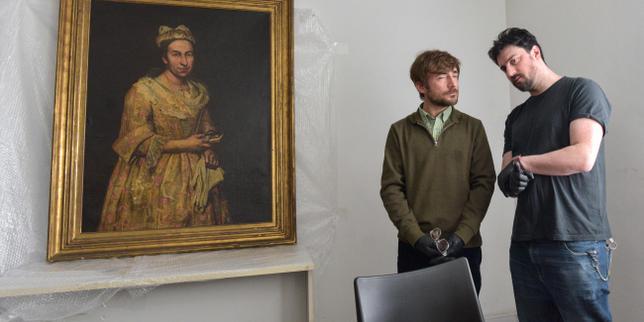
Sometimes, history's greatest secrets don't surface in dark archives or high-security vaults. They show up in plain sight on a routine online listing. An 18th-century masterpiece, stolen by the Nazi regime over eight decades ago, recently made headlines when a court in Argentina officially ordered its return to the heirs of a Jewish art dealer.
If you think stolen art is only a plot point for Hollywood movies, think again. The global hunt for Nazi-looted cultural property is an ongoing, messy reality. This specific case highlights how digital open-source intelligence and sheer luck are rewriting the rules of provenance research.
The Bizarre Discovery in Mar del Plata
It started with a real estate listing. In late August 2025, a Dutch media outlet spotted something unusual while browsing photos for a house sale in Mar del Plata, Argentina. Hanging casually on a living room wall was a baroque painting that art historians had hunted for decades.
The artwork in question, often known as Portrait of a Lady and painted around 1710 (attributed by recent studies to Giacomo Ceruti), belonged originally to Jacques Goudstikker. Goudstikker was a prominent Jewish art dealer in Amsterdam whose vast collection was violently plundered after the Nazi invasion of the Netherlands. Under severe persecution, Goudstikker fled, tragically dying on a cargo ship during his escape in 1940. His gallery and personal inventory were systematically looted, scattering thousands of cultural artifacts across the globe.
The house in Argentina where the painting reappeared belonged to the descendants of Friedrich Kadgien, a high-ranking Nazi official. When local authorities moved in to search the property following the viral spread of the real estate photos, the drama escalated. The painting had briefly vanished from the wall, hidden away in a frantic attempt to obstruct justice. Patricia Kadgien, the daughter of the former Nazi officer, and her husband ultimately handed the artwork over to law enforcement as legal pressure mounted.
Why Restitution Lawsuits Take Decades
Recovering spoliated art is rarely straightforward. Families like the Goudstikkers—represented today by heirs such as Marei von Saher—spend lifetimes navigating international borders, uncooperative holders, and varying local statutes of limitations.
When artworks vanish into private collections in South America, where many Nazi officials fled after World War II, tracking them down becomes a needle-in-a-haystack challenge. Local families often inherit these items without knowing their dark history—or, conversely, protect them fiercely despite knowing their origin. In this case, the Argentine court's ruling in September 2026 marks a massive victory for provenance sleuths, proving that digital transparency tools make it increasingly difficult for illicit owners to hide stolen heritage.
The Broader Battle for Looted Culture
This discovery isn't an isolated incident. Thousands of paintings, sculptures, and rare prints remain missing or contested worldwide. Major museums across Europe and North America face ongoing pressure to audit their walls, while private holders are finding out that online visibility exposes hidden inheritances.
When you browse online property listings or estate sales today, you're looking at more than just interior design choices. You might just be staring at a missing chapter of World War II history waiting to be reclaimed.