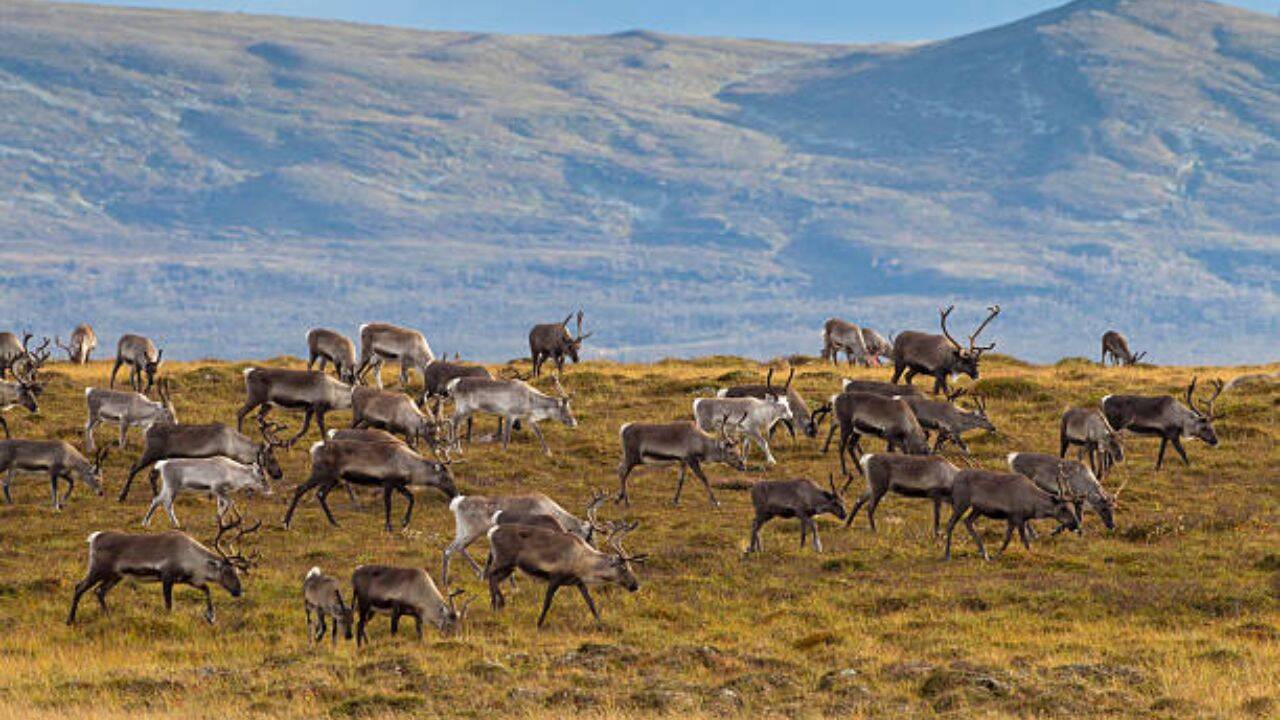
Biology offers few cautionary tales as stark as the St. Matthew Island reindeer experiment. Back in 1944, the United States Coast Guard dropped twenty-nine reindeer onto a remote, uninhabited sliver of tundra in the Bering Sea. They intended to create a moving emergency food pantry for a radio navigation station.
Instead, they launched a biological disaster.
The men stationed there never ended up eating a single deer. World War II wound down, the station closed, and the animals were left entirely alone. Without predators, without hunting pressure, and with an island carpeted in thick blankets of lichen, those twenty-nine reindeer hit the biological jackpot.
What followed wasn't a sustainable wildlife population. It was a mathematical explosion that ended in total annihilation.
The Exponential Boom
If you give any herbivore unlimited food and zero predators, numbers spike. That is basic ecology. St. Matthew Island spans roughly thirty-two miles long and four miles wide, sitting more than two hundred miles off the coast of the Alaskan mainland. It's harsh, isolated, and rich in slow-growing ground lichens—the absolute favorite food of reindeer.
When biologist Dave Klein first visited the island in 1957, thirteen years after the drop, he counted 1,300 reindeer. The herd looked healthy, fat, and energetic. They were multiplying rapidly, doubling their numbers every few years.
Klein returned in 1963. What he found blew past normal ecological expectations.
The population had skyrocketed to roughly 6,000 animals. That translated to forty-seven reindeer for every single square mile of the island. The landscape looked entirely different. The lush green and white carpets of lichen were gone, trampled to dust and overgrazed down to the soil. The reindeer had stripped the pantry bare. They had eaten their future.
The Breaking Point
Populations don't just hover peacefully at carrying capacity when they overshoot it. They crash.
When Klein stepped ashore again in the summer of 1966, the vibrant herd of 6,000 was gone. In its place were skeletal remains scattered across the tundra. Exactly forty-two reindeer remained alive out of thousands. Worse still, out of those survivors, only one male was found, and he carried deformed antlers that likely left him sterile. Not a single fawn was spotted.
The herd had effectively engineered its own extinction over the span of a single generation.
Researchers later pieced together what delivered the final blow. The winter of 1963-1964 across the northern Bering Sea was brutal. Climate data reconstructed by scientists years later revealed hurricane-force winds, sub-zero air temperatures, and wind chills plunging past minus seventy degrees Fahrenheit.
More importantly, massive amounts of heavy snow blanketed the island, turning into an impenetrable ice crust. The starving reindeer, already weakened by chronic malnutrition from overgrazing, could no longer dig through the frozen armor to find the microscopic remnants of vegetation left in the soil.
Most of the pregnant females died right around the storms, their bodies found with fetal remains still inside them. By the early 1980s, the US Geological Survey recorded the death of the very last reindeer on St. Matthew Island.
Lessons We Keep Ignoring
We love to view nature as a harmonious, self-correcting machine. Sometimes, it's just a math problem with a tragic outcome.
The St. Matthew Island disaster teaches us hard truths about carrying capacity and resource management. When you remove natural checks and balances—whether through predator eradication, habitat fragmentation, or human intervention—populations do not gently stabilize. They consume everything in sight until the environment turns hostile.
It is a pattern repeated on a global scale whenever consumption outpaces regeneration. The reindeer didn't understand long-term planning. They just ate until there was nothing left, trusting that tomorrow would look like yesterday.
Nature didn't punish them out of malice. It simply enforced the limits of the physical world.
If you're looking at natural systems, corporate growth strategies, or localized resource planning, the math remains identical. Unchecked expansion without regard for baseline replenishment always ends in a cliff.
Pay attention to your margins before you hit the ice.