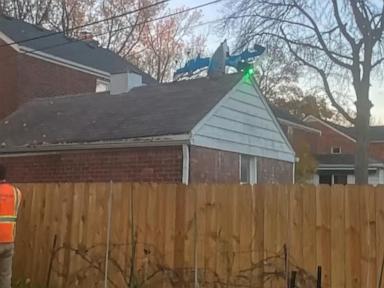
An 83-pound drone dropping a bottle of shampoo in your backyard sounds like sci-fi convenience until it clips an overhead wire and lands on your neighbor's garage. That's basically what happened on November 20, 2026, in Huntington Woods, Michigan, when an Amazon Prime Air MK30 drone finished a backyard delivery, hit a fiber-optic line, tangled near a power line, and came down on a nearby garage roof. Nobody got hurt, though the roof took minor shingle damage and utility crews had to temporarily de-energize service to get the aircraft clear.
Short video clips of the aftermath sparked fresh safety questions across local news and aviation circles. If you're wondering whether a single mishap means skies are falling on suburbs, the short answer is no—serious injuries haven't happened in these headline crashes, and Amazon delivers nearly 6,000 packages a day. Still, pretending a stray 80-plus-pound flying machine clipping wires in a residential neighborhood is "just a minor hiccup" misses the bigger problem. Low-altitude neighborhood flying is messy, and the tech hasn't solved every ground-level trap yet. Discover more on a similar topic: this related article.
What Actually Happened in Huntington Woods
Let's look at the sequence of events rather than relying on dramatic clips alone. According to local reports and statements from residents and utility workers, a Prime Air drone completed a delivery of shampoo to a backyard in Huntington Woods, a densely built Detroit suburb. As the drone departed or maneuvered near the property, it struck an overhead fiber-optic service drop line, lost a propeller, and ended up near an electric line before coming to rest on a neighboring garage or shed roof.
DTE Energy had to step in to safely remove the drone and briefly de-energize power to the affected service line while restoring normal service. Local public safety notified federal aviation authorities, with the Federal Aviation Administration looking into the incident and the National Transportation Safety Board gathering information to decide whether a formal probe is warranted. One local resident whose property was involved told reporters his address had been placed on a no-drone-delivery list afterward as a precaution. More analysis by ZDNet delves into comparable perspectives on the subject.
Amazon spokesperson Jack Stelzner emphasized that no one was injured, the drone was recovered, the company was working directly with the resident, and Prime Air relies on redundant hardware—including six motors, a three-cell battery, and two independent navigation software systems. From Amazon's perspective, incidents where a flight goes off script are rare compared with hundreds of thousands of packages delivered in 2026.
Why Overhead Wires Are the Achilles Heel of Low-Altitude Delivery
Anyone who has flown small drones around trees, fences, or house eaves knows the hardest obstacles to spot from the air aren't massive buildings. They're thin cables. Fiber-optic drops, coax lines, and residential service wires are narrow, often dark or weathered, and sometimes hang at awkward angles between utility poles and structures.
Optical sensors and cameras struggle with thin linear objects under changing light, glare, or wind gusts—especially right around takeoff, descent, or low-altitude transitions when a drone is close to human structures. Even when an aircraft has six motors for propulsion redundancy, hitting a taut wire can shear or jam a blade, throw off flight stability, and pull the craft into power lines or roofs.
That's the practical reality that gets lost in glossy promotional videos. Smooth skies at cruise altitude don't guarantee clean clearances in tight backyards filled with mature trees, swing sets, clotheslines, and utility drops. Honestly, the "last 30 feet" problem has always been harder than getting from a fulfillment hub to the neighborhood.
How This Fits Into a Bigger Pattern of Mishaps
The Huntington Woods garage incident isn't happening in a vacuum. Trade reporting and aviation trackers have documented multiple Prime Air incidents over the past couple of years—including a November 2025 incident in Waco, Texas, where a delivery drone struck an overhead internet cable and drew FAA scrutiny, and an October 2025 episode in Tolleson, Arizona, where two MK30 drones collided with a construction crane boom minutes apart, prompting NTSB attention.
At the same time, scale changes statistics. When a program flies thousands of sorties a day across expanding markets, edge-case encounters with cranes, wires, or weather are bound to show up eventually. Critics point to repeated accidents as proof that residential drone expansion is moving faster than obstacle-avoidance maturity, while proponents argue that a handful of non-injury property scrapes out of hundreds of thousands of deliveries shows strong underlying reliability.
Both points can be true at once. The system can work most of the time and still have blind spots in cluttered suburban airspace. Pretending otherwise is bad engineering and bad public policy.
The Regulatory Fight Over Part 108 and Detect-and-Avoid
Behind the scenes, these neighborhood crashes collide with a major regulatory shift in the United States: the FAA's proposed Part 108 framework for routine beyond-visual-line-of-sight (BVLOS) drone operations. Instead of forcing operators to chase individual waivers for every new route or scenario, Part 108 is designed to create a structured, risk-tiered pathway—using operating permits for lower-risk flights and operating certificates (complete with safety management systems) for larger or higher-risk operations.
Where things get tense is over technical safety rules, particularly detect-and-avoid (DAA) capabilities. Earlier in 2026, Amazon parted ways with the Commercial Drone Alliance over disagreements regarding safety standards and DAA expectations around crewed aircraft. Meanwhile, general aviation groups like the Aircraft Owners and Pilots Association have pointed to past drone collisions—such as the 2025 Arizona crane crashes—to argue that rules shouldn't be overly permissive.
If you're watching how drone delivery evolves, keep an eye on two things:
- How Part 108 defines risk tiers in populated suburban neighborhoods versus rural corridors.
- What proof regulators require for obstacle detection near non-cooperative hazards like thin cables and cranes, not just other transponder-equipped aircraft.
What Homeowners and Neighbors Should Actually Watch For
You don't need to panic every time you hear a whir overhead, nor do you have to take a corporate press release on faith. Look at concrete behavior instead. If drone delivery operates in your area, pay attention to whether the company maps low-hanging utility drops accurately, respects property exclusions when residents opt out or report hazards, and responds quickly when property is damaged.
If you're a homeowner in an active delivery zone and want to stay practical:
- Check your overhead lines and yard clearances before signing up for drone drops—heavy tree cover, low service wires, and tight spaces between houses create more friction than wide-open yards.
- Document anything unusual right away with clear photos or video (without approaching downed wires or damaged aircraft) and report hazards to your local utility and police or aviation authorities if lines or structures are affected.
- Ask about opt-out or geofencing options if you don't want low-flying drones over your roof or yard, since individual delivery preferences and address restrictions vary by operator and location.
Drone delivery can be genuinely handy for small, urgent items. Until low-altitude navigation handles every thin wire and tight suburban corner without flinching, though, healthy skepticism is the smartest stance you can take.