History loves a good coincidence. Sometimes, geology writes punchlines that no author could ever invent.
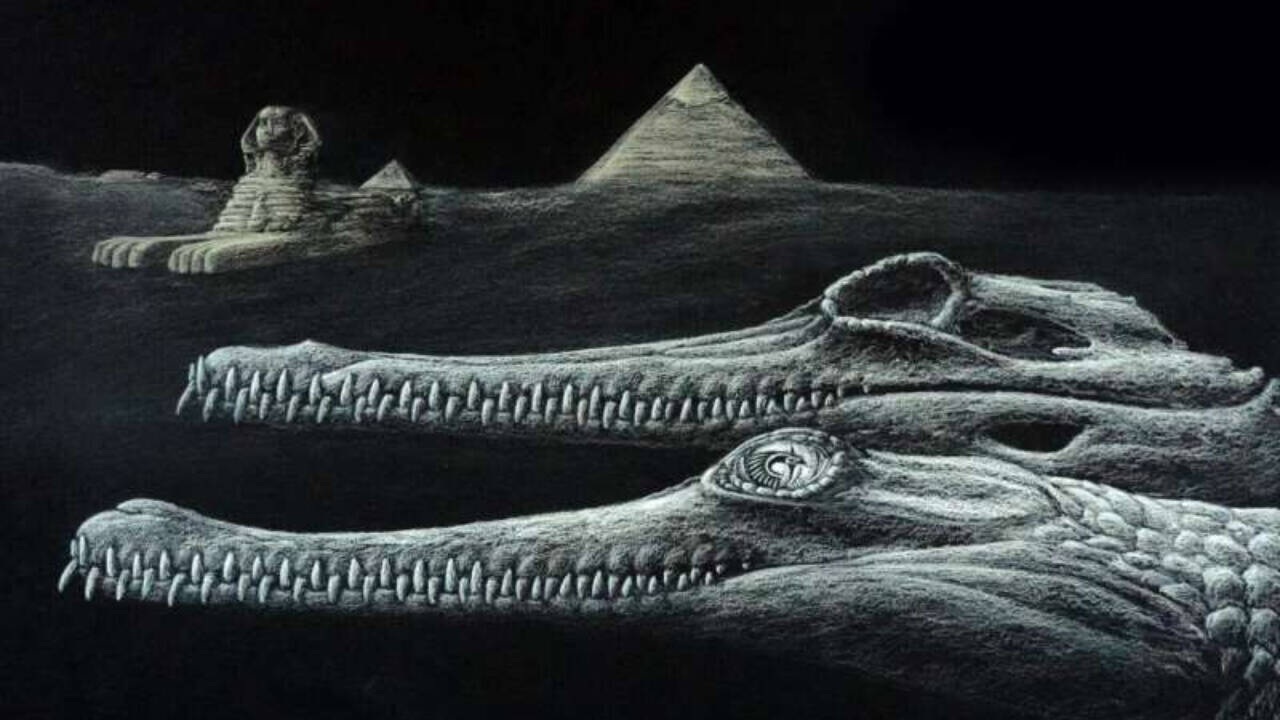
Take a 45-million-year-old fossil dug up from Egypt's Mokattam Formation, tucked away in museum storage for nearly a hundred years. Researchers recently took a fresh look at this skull using modern CT scanning technology. They discovered it belongs to an entirely new extinct species of long-snouted crocodilian named Herugavialis cairensis. But the real kicker? Just like the iconic Great Sphinx carved from those exact same Egyptian rocks, this ancient fossil is missing the tip of its snout.
Nature basically sculpted a prehistoric parallel thousands of years before builders put chisel to stone in Giza.
Inside the Mokattam Formation Discovery
The fossils weren't unearthed yesterday. Workers and early paleontologists recovered them during the 1920s from the middle Eocene rocks surrounding Cairo. Back then, scientists slapped a generalized label on the skull, assuming it belonged to Tomistoma, the group of false gharials native to Southeast Asia today. It looked long-snouted, so they called it a day.
Science moves forward when people stop trusting old labels. A team of researchers recently re-examined the specimen and published their findings in Royal Society Open Science. Instead of slicing the fossil open or risking structural damage, they used computed tomography (CT) scanning.
This non-destructive imaging exposed internal cranial features that old-school researchers missed entirely. The internal bone architecture proved the specimen wasn't just another run-of-the-mill false gharial ancestor. It belonged to a distinct genus and species.
Why the Snout Matters
Gavials and their extinct relatives are famous for one defining feature: an absurdly long, slender snout. Modern gavials use these thin jaws to snap up fish in fast-moving rivers. Today, only two living species hang on by a thread—the critically endangered Indian gharial (Gavialis gangeticus) and the false gharial (Tomistoma schlegelii).
The fossil record tells a much wilder story. Long-snouted crocodilians ruled shallow marine environments across the globe for over 100 million years.
Herugavialis cairensis adds a heavy anchor to that evolutionary timeline. Forty-five million years ago, the landscape around modern Cairo wasn't a dry desert. It sat beneath warm, shallow seas teeming with diverse marine life. Herugavialis didn't hunt alone in those ancient coastal waters either. Paleontological data shows at least two other gavial species swam the same region during that epoch. Egypt's prehistoric coastlines supported a dense neighborhood of long-snouted predators that put modern ecosystems to shame.
Then climate shifts and dropping sea levels altered the Mediterranean basin permanently, driving these marine-adapted crocodilians out of the picture.
The Sphinx Connection That Named the Species
The geographical poetry here is hard to ignore. The Mokattam Formation provided the heavy limestone blocks used to construct the Great Sphinx. When researchers realized their newly classified fossil came from the exact same geological strata—and featured a broken, missing snout tip mirroring the Sphinx's famous missing nose—they leaned right into the folklore.
They named the genus Herugavialis. The prefix draws from Heru, the ancient Egyptian falcon-headed deity Horus, whose imagery heavily influenced Egyptian monumental sculpture.
You can't script irony like that. A fossil sits in a drawer for a century, waiting for tech to catch up, only to emerge with a missing nose that matches Egypt's most famous landmark.
Geology leaves its marks in strange ways. The next time you look at pictures of the Giza plateau, remember the ancient predators swimming through the shallow seas below those very stones, missing their snouts just like the stone lion watching over the sand.