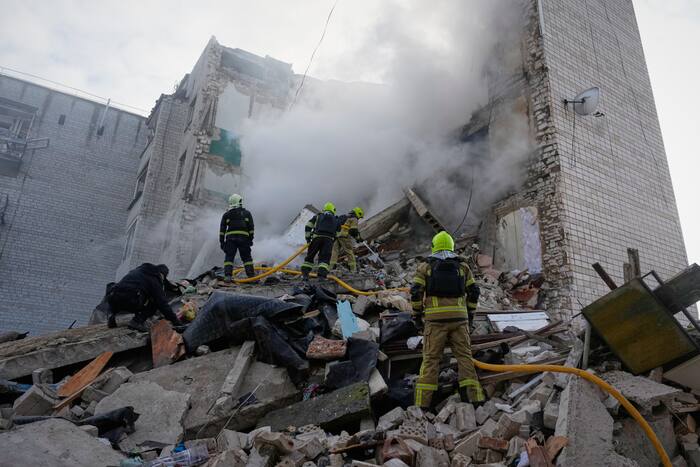
An apartment building in Dymer just collapsed onto people's beds north of Kyiv, killing at least three and leaving families screaming in the cold while air raid sirens wailed hundreds of miles away in Kaliningrad.
If you only read wire summaries, those events look like separate blips on a noisy Sunday morning. Honestly, they aren't. Watching conflict coverage over the past few years has taught me that residential strikes in Kyiv Oblast and maritime flare-ups near Finland happen inside the same grinding escalation loop. One side hits apartment blocks and energy infrastructure ahead of winter. The other pushes long-range strikes further toward Russian logistics and naval hubs.
How the Attack Near Ukraine's Capital Unfolded in Dymer
The strike near Ukraine's capital hit a five-story residential building in the village of Dymer, north of Kyiv. Authorities reported at least three deaths and four injuries, with roughly eleven people feared trapped under collapsed concrete and debris. Emergency crews pulled nine people out, including a child, while another injured child went to the hospital.
Two of the dead identified by Ukraine's State Emergency Service were a 48-year-old woman and an 18-year-old. Retiree Arkadii Kozenko told The Kyiv Independent his 18-year-old son, Roman Komarenko, had been inside before a daytime internship and was among those missing under the rubble. Neighbors described waking up to violent blasts and fires before search teams could even steady the site.
What makes rescue work brutal in places like Dymer isn't just heavy concrete. It's the stop-and-start rhythm of incoming threats. Rescuers have to pause digging whenever fresh air alerts or drone warnings sound, leaving families standing by collapsed walls wondering if another strike is coming.
Why Wire Reports Split the Kyiv Strike From the Baltic
The syndicated report I reviewed bundled the Dymer apartment strike with sirens in Kaliningrad and a burning Russian cargo ship off Finland. That layout is typical of breaking-news feeds—fast, factual, and thin on context. It tells you what happened, yet leaves the reader guessing why a residential block in Kyiv Oblast shares space with a ship fire in the Gulf of Finland.
Look at the mechanics instead. Russia has stepped up drone and missile strikes against Kyiv and surrounding areas as winter closes in. Meanwhile, Ukrainian long-range operations and maritime pressure have reached further into Russian territory and Baltic supply lines. You don't need conspiracy theories to see the connection. Both sides are testing air defenses, straining emergency services, and raising the political stakes for neighboring states.
A common mistake people make when reading these combined dispatches is treating unverified social media clips as settled proof. On November 21 and 22, reports circulated online about drone activity and explosions near Baltiysk in Kaliningrad Oblast, where Russia bases much of its Baltic Fleet. Kaliningrad Governor Alexei Bezprozvannykh pointed to a suspicious object coming from the direction of Lithuania in the Nemansky district, while authorities called a dramatic smoke photo fake. Lithuania's foreign minister, Kęstutis Budrys, flatly rejected claims of Lithuanian involvement or airspace use. When fog of war meets Telegram footage, patience beats jumping to conclusions every single time.
The Sparta II Fire and NATO's Northern Waters
While search crews worked in Dymer, Finnish emergency teams were still battling a fire aboard the Russian cargo ship Sparta II in the Gulf of Finland. Reports indicate the vessel was bound for Kaliningrad when drone strikes hit it and left it without steering, drifting into Finnish territorial waters off Loviisa.
Here's where maritime realities get messy fast:
- Cargo uncertainty: Finnish Border Guard officials noted they didn't have confirmed details on what was inside the hold, though military materiel couldn't be ruled out.
- Crew evacuation and salvage: The crew was moved off the ship, while responders worked to cool and fight the fire without adding so much water that the vessel destabilizes or sinks in shallow coastal waters.
- Border tension: Finland also reported a suspected airspace violation by a Russian helicopter near Loviisa shortly after the ship drifted in, prompting ongoing investigation and temporary air and sea restrictions in the eastern gulf.
Both Russian and Finnish officials pointed toward Ukrainian drones hitting the ship, while Ukrainian authorities hadn't commented publicly as of Sunday morning. For Finland and other Baltic states, a burning Russian ship drifting into territorial waters isn't abstract geopolitics. It's an immediate hazard to navigation, environment, and border security.
What People Usually Misread About These Headlines
People often assume a big headline means a single decisive turning point. Usually it doesn't. In this war, high-volume drone waves—like the overnight counts reported by both Ukrainian and Russian military sources—are mostly about attrition and pressure rather than one magic weapon.
Another trap is assuming official statements from any single side tell the whole story on day one. Early casualty counts shift as rubble is cleared—that's why death tolls and injury numbers in strikes like Dymer sometimes change between morning and afternoon updates. Similarly, claims about whether an alert was a drill, an intercept, or a real strike often collide with conflicting accounts over the next 24 hours.
What actually works when following this kind of coverage? Slow down, cross-check multiple outlets like The Kyiv Independent and Finnish public broadcaster Yle alongside wire dispatches, and separate confirmed rescue facts from unverified online video.
Practical Next Steps If You're Following or Supporting Relief
If you're tracking the situation closely—or looking to help rather than just doomscroll—take a few practical steps:
- Track verified rescue and humanitarian updates: Watch official emergency service updates and reputable reporting for confirmed survivor counts, evacuation zones, and winter infrastructure damage around Kyiv Oblast.
- Verify visuals before sharing: Don't repost dramatic photos or videos of explosions, smoke, or sirens without checking location markers, timestamps, and independent verification.
- Veterinary-style due diligence on aid: If you donate to winter relief or emergency medical support for displaced families in Ukraine, check charity transparency and direct operational track records first rather than sending money to unvetted social media fundraisers.
- Watch Baltic maritime advisories: If you follow shipping, energy markets, or regional security in Northern Europe, pay attention to Finnish Border Guard and defense notices around the Gulf of Finland and Kaliningrad.