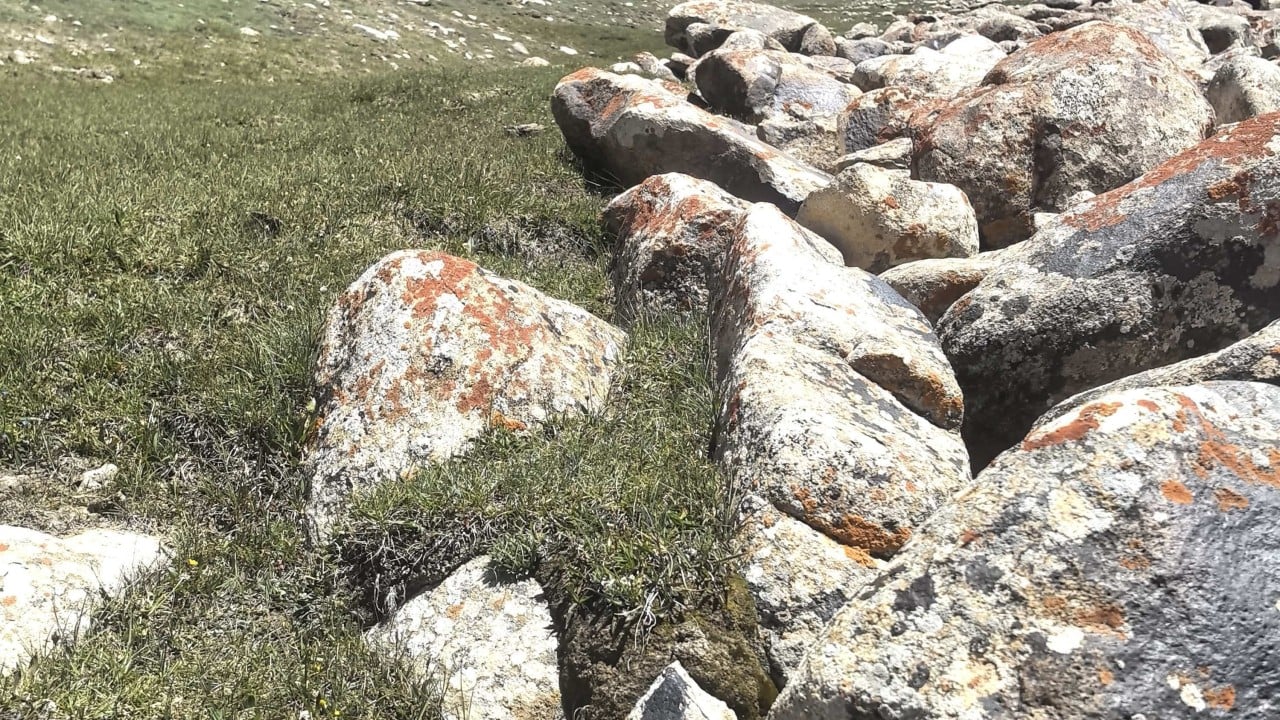
You walk past mossy boulders every day without a second thought. But if you spot a patch of brilliant, fiery orange crust clinging to specific stones, you might be looking at a natural prospecting map.
Geologists have long relied on heavy machinery, extensive core drilling, and expensive ground surveys to hunt down critical minerals. Now, a strange biological clue is changing how researchers think about mineral exploration. A specific type of organism growing right out in the open air is catching the eye of economic geologists.
The Science Behind the Orange Stain
The organism in question is Xanthoria elegans, a striking orange-yellow lichen that thrives on exposed rock surfaces. It is a hardy survivor, weathering freezing winds and scorching sun without breaking a sweat. Recent research published in the peer-reviewed journal Economic Geology points out something remarkable about this organism. It doesn't just grow anywhere.
When scientists mapped out the massive Bayan Obo mining area in northern China—known globally as a premier deposit for rare earth elements—they noticed a sharp pattern. This orange lichen popped up on 57 out of 67 mapped carbonatite rock formations. Meanwhile, on surrounding non-mineralized rocks like granite or sandstone, its presence plummeted to under one percent.
It basically acts like a living indicator flag for the ground beneath it.
Why Rare Earth Elements Draw This Organism
Lichens are biological sponges. They trap airborne dust, absorb moisture, and break down the microscopic outer layers of the rocks they inhabit through organic acids. Because of this intimate contact, they soak up the chemistry of their hosts.
Laboratory tests on these lichen samples revealed staggering numbers. Total rare earth element concentrations inside the tissue ranged from 3,500 to a massive 17,000 parts per million. Even wilder, the concentration inside the lichen shifted up or down depending on how mineralized the rock was underneath. If the underlying stone was rich in targeted metals, the lichen mirrored that richness.
You aren't going to get rich stripping moss off your backyard landscaping tomorrow. Most residential backyards don't sit on carbonatite intrusions packed with critical metals. But the principle translates directly to how modern field geology is evolving.
Moving Beyond Traditional Prospecting
Finding deposits of neodymium, lanthanum, and other technology-critical elements costs millions of dollars. Traditional prospecting involves blind drilling or sweeping geochemical grid sampling that tears up local ecosystems.
Using bio-indicators turns nature into an ally. Professor Li Yang and a team of researchers from Peking University and the Chinese Academy of Sciences point out that spotting these distinct biological markers allows exploration teams to drastically narrow down their search grids. Instead of drilling at random across a massive mountain range, field geologists can target specific zones where the biological environment signals a unique geochemical signature.
The next phase of this technique involves technology upgrades. Researchers are pairing high-resolution drone mapping with specialized aerial sensors to scan remote terrain. Because Xanthoria elegans has a distinct visual color and unique spectral reflectance, automated drones can spot these orange patches from the air.
Biogeochemistry is proving that the answers to heavy industrial challenges are sometimes written right on the surface of the earth. Keep an eye on the rocks next time you hike out in the rugged backcountry. That splash of neon orange might just be pointing toward the future of tech manufacturing.