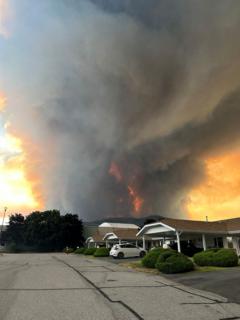
You have minutes, not hours, when an out-of-control fire charges down the mountain. That is the harsh reality thousands of residents faced in British Columbia as the Bald Range wildfire exploded overnight, forcing over 20,000 people to flee their homes along Okanagan Lake.
If you are wondering how a single fire can double in size and overrun entire communities almost overnight, you are looking at a terrifying shift in modern wildfire dynamics. Let's break down what actually happened, why this specific blaze caught emergency crews off guard, and what it means for residents living in high-risk zones.
The Speed of the Bald Range Fire
First reported on a Friday evening, the Bald Range wildfire did something historic. It covered roughly 15 kilometers (9 miles) in a matter of hours, tearing through the smaller community of Faulder before slamming into Summerland and threatening Peachland.
Emergency officials didn't just coordinate the response from a safe distance—they had to run. Erick Thompson, an emergency official with the Regional District of Okanagan-Similkameen, was forced to abandon his post at the emergency operations center to evacuate his own family as traffic backed up behind them.
- Over 20,000 people ordered to evacuate instantly.
- The entire community of Summerland (about 12,000 residents) told to leave.
- Roughly 8,000 more displaced in and around Peachland.
- The fire size expanding rapidly past 9,500 hectares (23,500 acres).
Why These Fires Move So Dangerously Fast
Most people assume wildfires grow at a steady, predictable pace. They don't. When dry timber, high winds, and extreme heat combine, a fire creates its own weather system.
The Okanagan region is Canada's primary wine country, known for dry microclimates and rolling hills. When a blaze ignites in steep terrain, uphill winds act like a bellows. The flames pre-heat the brush ahead of them, making the trees explode into fire almost before the main front arrives.
Homeowner Kerry Gold and her husband fled around 12:30 a.m. after watching flames crest the mountains behind them. They packed bags, grabbed a cat carrier, and ran. That split-second decision is becoming the standard playbook for anyone living near timber lines.
What You Need to Know If You Face an Evacuation Order
Waiting to see which way the wind blows is a fatal mistake. If you live in an area prone to seasonal blazes, preparation is your only real defense.
- Keep your vehicle fueled: Gas stations lose power or get overrun during mass evacuations. Never let your tank drop below half.
- Pack a grab-and-go kit: Include essential documents, medications, chargers, and pet supplies within arm's reach.
- Designate a meeting spot: Cell towers drop or burn down instantly. Agree on an out-of-town destination with your family ahead of time.
British Columbia declared a state of emergency as local resources stretched to their absolute limits. Stay alert to local emergency alerts, pack early, and never wait for a knock on the door when the smoke starts rolling in.