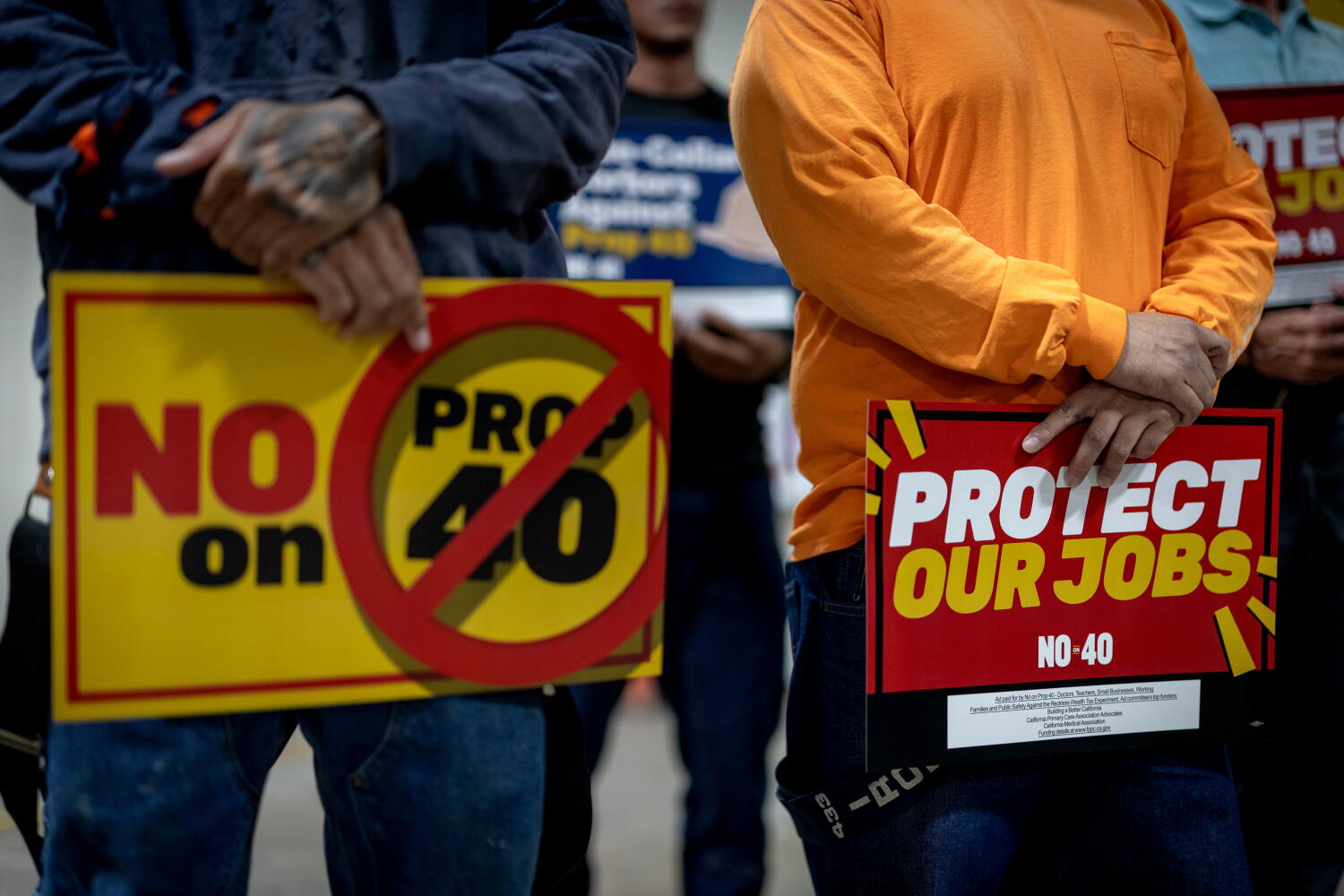
You can't tax your way out of a structural budget crisis if the taxpayers simply pack up and leave before the ballots are even counted. That is the hard lesson coming out of California following the defeat of Proposition 40, the much-debated ballot measure that sought to impose a one-time five percent tax on the net worth of the state's roughly two hundred billionaires.
The measure went down in flames after a campaign cycle that shattered spending records. Silicon Valley elites and corporate opponents poured hundreds of millions of dollars into defeating it, arguing that squeezing the ultra-rich would trigger an economic exodus. Voters ultimately agreed, choosing protection of the broader economy over a massive infusion of state revenue.
The Anatomy of a High-Stakes Ballot Fight
Proposition 40 was pushed aggressively by the health-care union SEIU United Healthcare Workers West. The pitch seemed simple on paper: extract a one-time five percent levy on stocks, bonds, and private business holdings from individuals worth over one billion dollars to backfill billions in impending federal health-care and social service cuts.
Proponents argued it was a matter of basic fairness. Research pushed by supporting economists noted that between 2019 and 2025, the state income tax paid by billionaires amounted to a fraction of their overall wealth gains, landing significantly lower proportionally than what average working-class families shelled out from their paychecks.
But the opposition didn't just run ads; they executed a masterclass in political mobilization. Tech titans like Google co-founder Sergey Brin personally dropped immense sums into political action committees dedicated to killing the measure. Critics pointed to a Stanford University study estimating that several high-profile billionaires—including PayPal co-founder Peter Thiel, former Uber CEO Travis Kalanick, and Google founders Larry Page and Sergey Brin—had already shifted their primary residences or assets out of California prior to the vote, stripping roughly thirty percent of the state's potential billionaire wealth base right off the table.
The Deep Divide Within the Democratic Party
One of the most fascinating layers of this political slugfest was the severe fracture it caused among traditional Democratic allies. Usually, progressive tax measures enjoy unified support from party leadership. Proposition 40 broke that mold entirely.
California Governor Gavin Newsom openly opposed the measure. Far from backing the union's crusade, Newsom engaged in high-stakes maneuvering to keep the initiative off the ballot entirely, arguing that a state-level wealth tax would hand a competitive disadvantage to California's economy. Instead, Newsom threw his weight behind counter-measures like Proposition 42, which aimed to permanently block future wealth taxes on financial assets and private businesses.
When top Democrats split—with labor unions and progressive lawmakers on one side, and moderate executive leaders on the other—voters grew deeply skeptical. Opponents capitalized on that uncertainty, turning what should have been a straightforward debate about income inequality into an existential warning about jobs, investment flight, and the long-term health of the state treasury.
What Happens Next for State Financing
With Proposition 40 defeated, California is left staring down a massive fiscal shortfall without its high-profile emergency fund. Proponents warned that healthcare programs and public schools will bear the brunt of federal funding rollbacks. Opponents counter that preserving the state's status as a magnet for venture capital and tech innovation is the only way to sustain organic tax revenues over the long haul.
Tax policy is rarely just about numbers on a spreadsheet; it's about human behavior. When the targets of a tax possess private jets, multi-state properties, and portable wealth, forcing compliance becomes remarkably difficult once the rate crosses a psychological threshold. California just drew a hard line in the sand, proving that even in a heavily progressive state, voters remain deeply nervous about what happens when you squeeze the golden goose too hard.