You don't usually expect to find commercial aircraft resting next to schools of rockfish and giant Pacific octopuses. Yet, off the coast of Vancouver Island near Chemainus, a retired Boeing 737 sits nearly ninety feet underwater.
This isn't a crash site or a disposal shortcut. It’s a carefully engineered artificial reef known as Xihwu, transforming an old machine into a thriving marine ecosystem.
The Journey From Runway to Seabed
The story started back in November 2002. Fraser MacLean of Air Canada looked at a retiring Boeing 737-200 and remembered the media coverage surrounding the sinking of the naval ship HMCS Cape Breton. He wondered if the Artificial Reef Society of British Columbia (ARSBC) might want an airplane for their next project.
They did. But getting a fifteen-tonne, thirty-meter metal tube onto the ocean floor legally and safely is no small task.
Volunteers spent hundreds of hours scrubbing the fuselage. They stripped away every trace of grease, plastic, insulation, and potential pollutant. If a single drop of toxic material remained, Environment Canada would never grant a permit.
The planning took nearly four years. Crews had to secure approvals from environmental regulators and six local First Nations groups. Finding the right home sparked intense local debates across coastal towns from Victoria to Vancouver. Eventually, southern Vancouver Island won out, chosen specifically because decades of logging debris had left the local seafloor barren and devoid of diverse marine life.
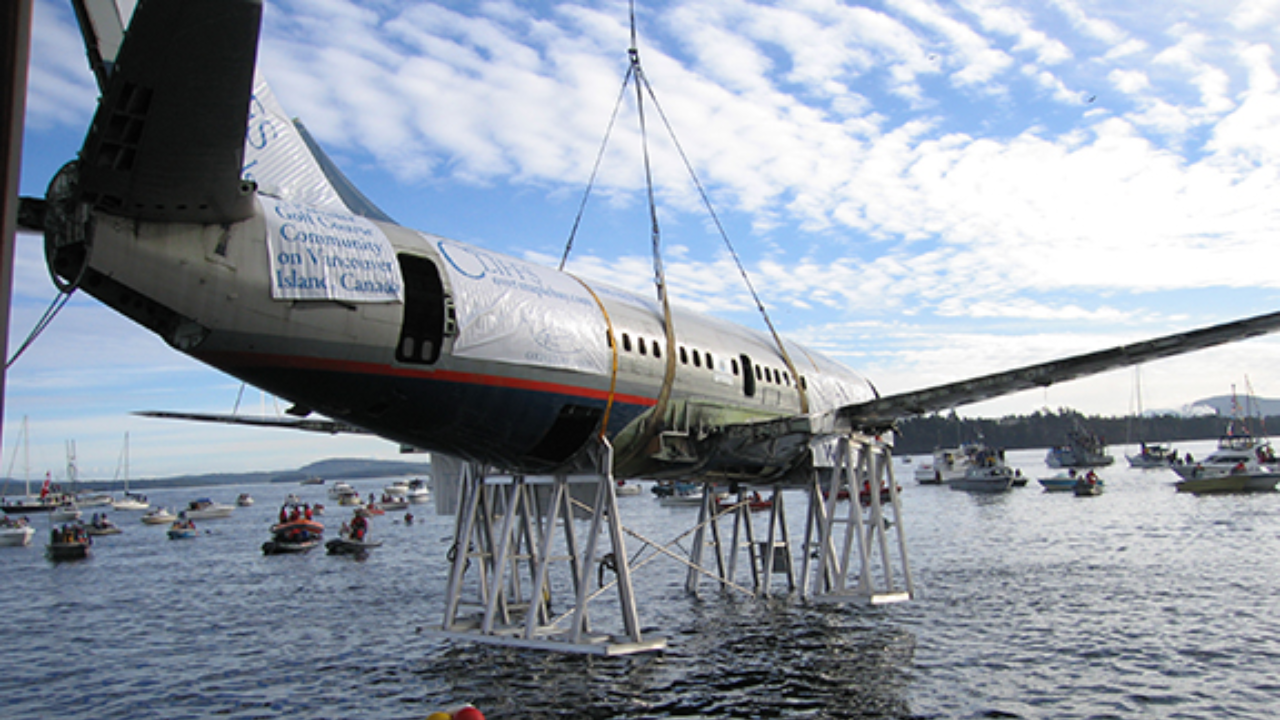
On January 14, 2006, cranes finally lowered the stripped-down airframe into the Strait of Georgia. They mounted the jet on custom stands roughly eleven feet high. This elevation wasn't just for stability. It kept the fuselage clear of the bottom sediment and allowed divers and fish to swim underneath the plane as well as through it.
What Lives on the Xihwu Reef Today
The name Xihwu comes from the Hul'qumi'num language. It translates to the red sea urchin, a creature whose populations had suffered heavily in the area due to overfishing and pollution.
The gamble worked. Today, the wreck hosts more than a hundred distinct marine species.
The metal wings and fuselage provide solid shelter against strong ocean currents. Copper rockfish hover near the cockpit windows. Lingcod lounge on the sand below, and brilliant white plumose anemones coat the exterior surfaces like thick snow. Giant cloud sponges and feather stars have turned the aluminum skin into a living tapestry of cold-water color.
Diving the Sunken Jet
If you plan to visit the site yourself, you need to prepare for cold-water conditions. Vancouver Island diving demands a thick drysuit or a heavy wetsuit, regardless of the calendar month.
The maximum depth hits roughly ninety feet, putting the main structure well within recreational limits. Local dive charters run regular boats out of Chemainus. Because the interior has been completely gutted and cleared of hazards, trained recreational divers can swim through the old cabin layout, peer down into the cargo holds, and check out the empty cockpit.
It is a surreal feeling to glide past empty window frames where passengers once sat reading magazines, now surrounded by swimming marine life.
Stop looking at old airplanes as scrap metal. Sometimes, they make the best homes the ocean has ever seen.