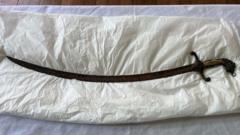
Droughts are terrible for lawns, but they are surprisingly great for unearthing lost history. When water levels in the historic lake at Chiddingstone Castle in Kent plummeted during a scorching summer heatwave, volunteers clearing out overgrown branches spotted something glinting in the mud. It wasn't just a piece of scrap metal. It was a centuries-old sword, sticking straight out of the receding waterline like a cinematic prop.
Naturally, the internet immediately lost its mind and dubbed it Kent's Excalibur.
Reality is usually stranger and far more interesting than Arthurian legend. If you look past the viral headlines, this 200-year-old sword offers a fascinating glimpse into local heritage, military history, and the unexpected things hiding right beneath our feet. Let's break down what we actually know about the find, the theories floating around, and why shrinking water levels are rewriting local history across the UK.
The Discovery That Triggered the Excalibur Hype
It happened on a Thursday afternoon. Volunteers Paul Fletcher and Gordon Proctor were using a grappling hook to clear debris near the bridge of the castle's lake. That is when they hit metal. Hauling it to the surface, they realized they had snagged a heavily corroded, mud-caked blade featuring a distinct gilded brass hilt adorned with a lion head.
They handed the object over to Naomi Collick, the castle's curator. She wrapped it carefully in acid-free tissue to prevent further decay.
The physical condition of the weapon tells its own story. While the blade is heavily pitted with rust and bears a few distinct chips along the cutting edge, the brass hilt remains remarkably well-preserved. A small loop sits on the lion's nose, suggesting a chain once attached there. It is roughly two centuries old, matching the timeline of the lake itself, which was constructed in the late 1700s and early 1800s when the original Tudor manor was transformed into a Gothic-style castle by the Streatfeild family.
Who Actually Dropped a Sword in a Castle Lake?
As soon as the find went public, armchair historians started spinning theories. Some are plausible. Others belong in fiction books.
The leading theory points to a Victorian bandsman's sword. Early 1800s military bands often used ceremonial curved swords with ornate brass hilts similar to the one recovered from the Kent mud. Given that the estate hosted various residents and events over the centuries, a ceremonial weapon could easily have been discarded, lost, or misplaced during a parade or party.
Then there is the World War II connection. Troops were stationed at Chiddingstone Castle during the mid-20th century. Military encampments are notorious for leaving behind stray equipment, though a nineteenth-century style sword would have already been an antique by the 1940s.
You also have the eccentric former owner angle. Denys Eyre Bower, an art dealer and collector who lived at the castle from the 1950s through the 1970s, amassed a massive collection of curiosities and weapons. While Bower mostly collected Japanese and Jacobite items, the idea that an eccentric collector might have tossed an unwanted artifact into the water isn't outside the realm of possibility.
Finally, local folklore claims a soldier once fell into the lake and drowned. Toss in a bit of ghostly legend, and you have all the ingredients for a local myth.
Why Climate Shifts Are Uncovering Our Past
This isn't an isolated incident. When severe droughts hit historic properties, lakes and reservoirs recede to reveal decades or centuries of accumulated debris. From sunken vehicles to ancient weapons, drying waterways act as a reset button for local archaeology.
For property managers and curators, managing these discoveries requires a delicate balance. Historic artifacts submerged in oxygen-poor mud are often stable until exposed to air. Once pulled from the water, rapid oxidation can destroy them if curators do not intervene immediately. Collick and her team did everything right by keeping the artifact moist, wrapping it safely, and reporting it directly to the local Finds Liaison Officer for proper documentation.
What Happens Next to the Kent Sword
Right now, the sword sits away from public view. Experts are waiting for official guidance from archaeological authorities while comparing the hilt design to online databases and museum archives to pinpoint its exact manufacturing date and regiment.
If you are hoping to visit Chiddingstone Castle to catch a glimpse of the blade, hold off for now. Conservation comes first. Until historians can stabilize the corroded steel and verify its pedigree, the weapon remains locked away in preservation storage.
Keep an eye on local heritage updates. If history repeats itself, receding waters across Europe will likely expose even more bizarre artifacts before the summer is through.
200-year-old 'Excalibur' sword emerges from lake after water levels plummet
This video provides a firsthand look at the historic Chiddingstone Castle lake and a close-up view of the recovered sword's intricate brass hilt.
http://googleusercontent.com/youtube_content/1