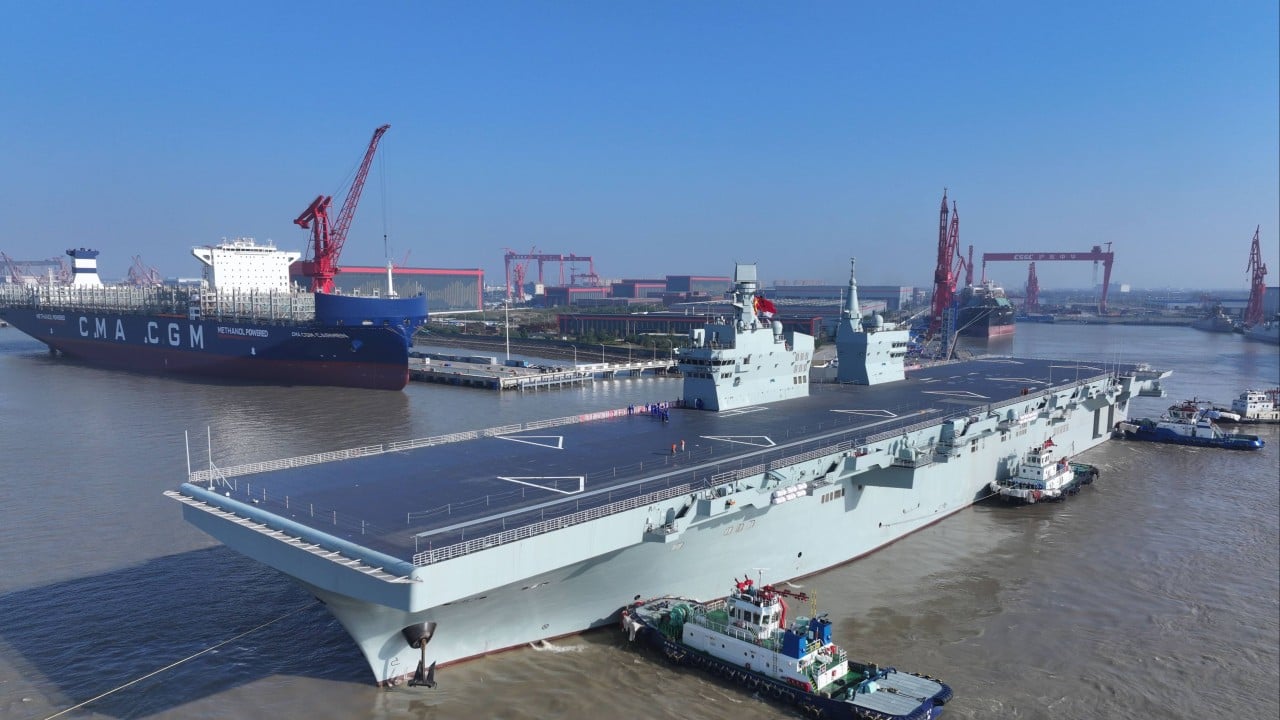
Military technology rarely shifts overnight, but when it does, it usually happens at sea. Recent announcements from state media confirm that China successfully launched and landed the GJ-21 stealth drone from its brand-new Type 076 amphibious assault ship, the Sichuan. If you think this is just another routine naval test, you're missing the entire point. We are looking at a fundamental rewrite of how large flat-top warships operate.
For decades, naval aviation meant one thing: expensive, heavy, manned fighters requiring massive nuclear-powered or conventional supercarriers. By successfully catapulting and recovering a heavy fixed-wing stealth drone from a 50,000-tonne amphibious assault ship, the People's Liberation Army Navy is cutting past traditional constraints. They aren't just building bigger ships. They are changing the math of attrition at sea.
Inside the Type 076 and GJ-21 Pairing
The Sichuan isn't your grandfather's landing helicopter dock. Launched in late 2024, this massive warship features a built-in electromagnetic catapult system—the same high-tech launch mechanism found on China's most advanced flat-top carrier, the Fujian. Electromagnetic catapults give operators unprecedented control over launch weights and stress tolerances, making it possible to shoot heavy, fuel-loaded aircraft off a shorter deck without tearing the airframe apart.
Pairing this system with the GJ-21 changes everything about strike reach. The GJ-21 is a dedicated carrier-borne stealth drone designed for both reconnaissance and heavy strike missions. Because it lacks a cockpit, life-support systems, and pilot ejection seats, every kilogram of internal volume goes straight toward fuel and ordnance. You get the radar-evading profile of a modern fifth-generation fighter combined with the endurance and risk-tolerance of an unmanned platform.
Why Traditional Carriers Should Be Nervous
Building a traditional aircraft carrier takes billions of dollars and years of specialized metallurgical work, training elite pilots to handle extreme G-forces. Losing a pilot and a multi-million-dollar fighter jet during a contested mission is a catastrophic strategic blow.
Unmanned platforms remove the pilot from the cockpit equation entirely. If a GJ-21 takes a missile to the wing during an integrated strike package, the operational loss remains purely financial rather than tragic.
Moreover, operating these platforms from a Type 076 offers incredible tactical flexibility. Military analysts note that these drone-heavy amphibious ships can act as force multipliers alongside standard carrier strike groups. While manned fighters handle high-intensity aerial dogfights, stealth drones can push ahead into heavily defended airspace, baiting enemy surface-to-air missile batteries and neutralizing radar sites before manned assets even enter the danger zone.
Operational Realities and What Comes Next
Skeptics often point out that sea trials are heavily scripted environments. Pulling off a clean catapult launch and a smooth arrested recovery in calm seas during October sea trials is a far cry from executing the same maneuver in a raging typhoon with high sea states and active electronic jamming.
Yet, the speed at which this capability has moved from a blueprint to reality is staggering. Back in early 2026, defense watchers only had blurry mock-ups spotted on older decks to guess what Beijing was planning. Now, actual flight tests are underway, signaling that the supporting software, automated landing guidance systems, and deck crews are maturing rapidly.
Naval planners across the globe are currently scrambling to update their modeling. When middle-tier regional conflicts or major power standoffs happen in the coming decade, the dominant power won't necessarily be the one with the biggest battleships. It will be the one that can launch, recover, and scale smart, low-risk stealth aviation faster than anyone else can shoot it down.