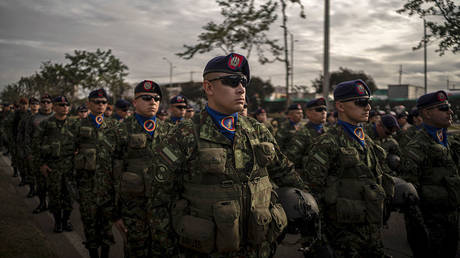
Three dead soldiers. Four wounded. More than twenty explosive-laden drones raining terror from the sky.
When a swarm of unmanned aerial vehicles struck the El Trapiche military post in Ocaña, Norte de Santander, it wasn't just a localized skirmish. It marked a terrifying escalation in modern asymmetric warfare inside South America. The attack, which Colombian authorities immediately blamed on the National Liberation Army (ELN), highlights an alarming shift in how rebel groups operate. They are trading traditional jungle ambushes for cheap, commercial drone technology packed with explosives.
President Abelardo de la Espriella didn't mince words after the strike. Stepping into office on a hardline security platform, he promised an absolute state response. When militants use air power against barracks, conventional counter-insurgency playbooks go out the window.
The Anatomy of the Ocaña Strike
The assault on Friday night caught the base off guard, even as the country faces its most violent spell in a decade. Over twenty UAVs descended on the military compound, dropping ordnance directly onto barracks before ground combat broke out. Two troops died instantly, a third succumbed to wounds later, and shrapnel ripped through a Colombian Air Force helicopter parked on site.
This wasn't an isolated incident. Look at the timeline of the past few weeks and a grim picture emerges.
An explosion outside a Cúcuta police station injured eleven officers and killed a police dog. A car bomb in the northeast killed a civilian and injured eleven others just days before the Ocaña raid. Colombia is bleeding, and security forces are scrambling to adapt to urban and rural terror campaigns fueled by drug money.
Cracking Down on the ELN in Catatumbo
Catatumbo is the prize and the curse in this equation. It is a massive coca-producing hub and drug-trafficking highway running right along the Venezuelan border. For decades, the ELN has fought rivals like FARC dissidents for absolute control of these lucrative smuggling routes.
De la Espriella has made it clear that his administration plans to uproot the organization from top to bottom. His new strategy targets the group's leadership networks, hidden finances, and illegal revenue pipelines. He called the insurgency a cancer bleeding the region dry, vowing to bring down the full weight of the state for every fallen soldier or police officer.
You cannot negotiate with networks that adapt commercial tech into flying bombs. The government knows this, which explains why the response is shifting from defensive postures to aggressive hunting.
The International Dimension and Washington's Role
Bogotá is not fighting this war in a vacuum. De la Espriella shares a close alignment with Washington and has embraced heavy international cooperation. The nation has tied itself to the US-led "Shield of the Americas" anti-cartel alliance alongside regional partners like Argentina, Ecuador, and El Salvador.
With US Secretary of State Marco Rubio heading to Barranquilla soon, security assistance and intelligence sharing are about to take center stage. When foreign policy and domestic survival intersect like this, expect rapid deployment of specialized counter-drone technology and joint tactical training.
The messaging from the top is direct. The rules of engagement have changed, and the state intends to match every technological escalation with overwhelming force.
Secure the borders, hunt the financial backers, and neutralize the drone operators before the next wave takes off. That is the only roadmap left.