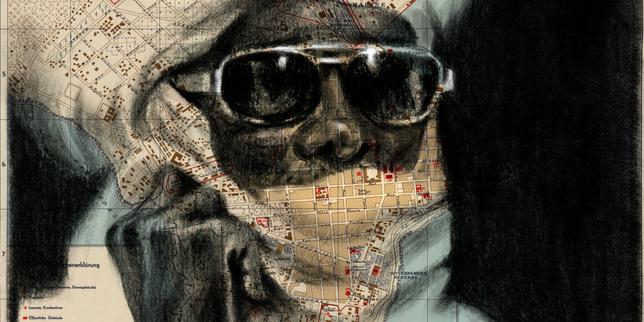
When Hissène Habré’s plane touched down at Dakar’s Yoff airport in December 1990, he wasn't just another deposed dictator looking for a place to hide. He was a man with a plan, a massive amount of stolen cash, and an entire country’s treasury packed into his luggage. For over three decades, the Dakar exile of Hissène Habré became a masterclass in survival, political maneuvering, and eventually, a groundbreaking legal reckoning that Africa had never seen before.
Most people think of deposed tyrants as reclusive ghosts hiding behind high walls. Habré didn't play by those rules. He carved out three distinct lives in Senegal, transforming from a high-society billionaire benefactor into a trapped legal fugitive, and finally, into a convicted criminal who died behind bars. His story isn't just a biography. It’s a messy, decades-long political drama that still holds a mirror to West African politics and the incomplete promise of international justice.
The Billionaire Benefactor of the Almadies
When Habré fled Chad after being overthrown by his former military chief, Idriss Déby, he didn't run empty-handed. He reportedly looted billions of CFA francs from the national treasury. In Dakar, cash buys peace. He quickly established himself in the ultra-wealthy neighborhood of Les Almadies, a coastal enclave of mansions, embassies, and sea breezes.
He didn't hide. He integrated.
Habré knew that to survive in Senegal, he needed to become part of its social fabric. He married a Senegalese woman, Fatou Diagne, as his second wife. He funded local mosques, gave generously to community projects, and built deep ties with Senegal's powerful Islamic brotherhoods, particularly the Mourides and Layenes. To his neighbors, he wasn't the "African Pinochet" who oversaw the slaughter of an estimated 40,000 people and the systematic torture of tens of thousands more. He was just a devout, quiet elder who wore immaculate white boubous and paid for local kids to go to school.
For ten years, this strategy worked perfectly. Senegal’s political elite, led by President Abdou Diouf, had no interest in stirring the pot. Habré had bought his safety, and his exile was golden.
The Golden Cage Begins to Rust
The peace didn't last. In 2000, human rights organizations and a relentless group of Chadian survivors, spearheaded by activist Souleymane Guengueng and lawyer Jacqueline Moudeina, decided to break the silence. They teamed up with Reed Brody of Human Rights Watch. Together, they filed a criminal complaint in Dakar.
The Legal Tug-of-War (2000–2012)
- 2000: First indictment by a Senegalese judge.
- 2001: Senegal's highest court rules it has no jurisdiction.
- 2005: Belgium issues an international arrest warrant.
- 2006: The African Union mandates Senegal to try Habré.
- 2012: The International Court of Justice orders Senegal to prosecute or extradite.
This kicked off Habré’s second life in Senegal. He was no longer a free benefactor. He was a political hot potato. Senegal’s new president, Abdoulaye Wade, spent over a decade playing a cynical game of cat and mouse with the international community. Wade would promise to hold a trial, then demand millions of dollars from international donors to fund it, then threaten to expel Habré to another country where he would be safe from prosecution.
During this period, Habré’s house in Dakar became a gilded prison. He was under house arrest, watched by police, his assets slowly freezing, and his political capital draining away. His supporters cried foul, claiming Senegal was violating his asylum and acting as a puppet of Western neo-colonialism. But the victims refused to back down. They kept showing up in Dakar, holding press conferences, and keeping the pressure on.
Why the Trial Changed Everything
The game ended in 2012 when Macky Sall became president of Senegal. Sall had no personal or political loyalty to Habré. He wanted to signal that Senegal was a modern state governed by the rule of law.
In 2013, the Extraordinary African Chambers (CAE) were inaugurated in Dakar. This was a unique, hybrid tribunal created by Senegal and the African Union. It marked the first time in history that the domestic courts of one African nation tried the former leader of another for human rights crimes.
Key Statistics of the CAE Trial
- Witnesses who testified: 93
- Pages of evidence analyzed: Thousands of DDS secret police files
- Total compensation awarded: 150 billion CFA francs ($250 million)
- Sentence: Life imprisonment
The trial, which began in 2015, was a dramatic spectacle. Habré refused to recognize the court’s legitimacy. On the opening day, he had to be carried into the courtroom by masked security guards, kicking and screaming insults. He spent the rest of the trial sitting in complete silence, wearing a white turban and dark sunglasses, refusing to speak a single word to the judges.
It didn't save him. The prosecution had a devastating weapon: the secret archives of Habré’s own political police, the DDS. Discovered by Human Rights Watch in a abandoned building in N'Djamena, these documents contained meticulous records of executions, torture, and direct orders signed by Habré himself.
In May 2016, the court found him guilty of crimes against humanity, war crimes, and torture. They sentenced him to life in prison.
The Ghost of Cap Manuel and the Unfinished Justice
Habré’s third life was spent in a special cell in Dakar’s Cap Manuel prison. His comfortable mansion was replaced by a concrete room. Even in prison, his shadow loomed large. His supporters continued to lobby for his release, citing his deteriorating health. When the COVID-19 pandemic swept through Dakar in 2020, his lawyers successfully secured a temporary release to his home, sparking outrage among his victims.
He returned to prison shortly after. On August 24, 2021, at the age of 79, Habré died of COVID-19 complications in a Dakar hospital. He was quietly buried in the Muslim cemetery of Yoff.
But don't mistake his death for closure. The battle is far from over.
The court ordered Habré to pay 150 billion CFA francs (roughly $250 million) in reparations to more than 7,300 victims. Today, those victims have still not received a single franc. Habré’s assets were never fully recovered, and neither Senegal, Chad, nor the African Union has shown the political will to fund the trust fund established for the victims.
For the survivors, justice remains a half-written story. They won the battle in the courtroom, but they are losing the battle for survival as many elderly victims pass away in poverty.
Actionable Next Steps for Justice Advocates
If you want to support international accountability and ensure this landmark precedent doesn't fade into history, here is what you can do.
- Support the Victim Associations: Groups like the Association of Victims of the Crimes of Hissène Habré's Regime (AVCRHH) are still actively campaigning for their court-ordered reparations. Keep their struggle visible by sharing their updates and donating to their legal advocacy funds.
- Read the Primary Source Materials: Educate yourself on how this historic case was built. Read The Prosecutor and the President or explore the digital archives of the DDS police files published by human rights organizations.
- Lobby for Regional Human Rights Courts: The Extraordinary African Chambers proved that African nations can successfully prosecute their own dictators without relying on the International Criminal Court in The Hague. Advocate for regional bodies like the ECOWAS Court of Justice to receive greater political and financial backing.
The legacy of Habré’s Dakar exile proves that even the most powerful leaders can be brought to account, but it also warns us that a court verdict is meaningless if the victims are left with nothing but paper promises.