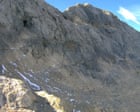
The ice is gone. On the jagged limestone slopes of Mount Triglav, Slovenia's highest peak, the final frozen remnant of an ancient glacier has officially melted away.
For a country where scaling this 2,864-meter giant is practically a rite of passage, losing the Triglav glacier isn't just an ecological statistic. It's a cultural gut punch. New photographic evidence captured by the Anton Melik Geographical Institute confirms that after an exceptionally punishing, scorching summer across Europe, the last isolated patch of ice has completely vanished, leaving behind bare, sun-baked rock. Recently making waves in this space: Why Simple Rope Bridges Are Quietly Saving Amazon Wildlife From Asphalt.
If you've followed European environmental news lately, you know the Alps are transforming into moonlike wastelands at an alarming pace. Switzerland lost a staggering chunk of its glacial volume over the past five years. But Slovenia's loss hits a very specific nerve because the mountain sits right on the national flag. It's woven into the country's identity.
How the Triglav Glacier Collapsed
Glaciers don't disappear overnight, even when the end feels sudden. Back in the mid-1800s, the Triglav glacier spanned a respectable 40 hectares. By 1946, when formal scientific monitoring finally began, that footprint had already shrunk down to 14 hectares. More insights on this are explored by Associated Press.
Then came the modern acceleration. Between 1983 and 2003, the ice mass hemorrhaged 93% of its surface area, plunging below a single hectare. Researchers watched in disbelief as it hung on for two decades past its predicted expiration date, surviving on sheer grit and shaded pockets.
That borrowed time ran out. The past five years brought unprecedented European heatwaves driven by carbon pollution. Matija Zorn, director of the Anton Melik Geographical Institute, noted that while researchers expected shrinkage year after year, the sheer velocity of the recent thaw shocked even veteran field scientists. Where researchers drilled five-meter ice cores for geochemical analysis in 2002, they found nothing but solid, exposed rock the very next year.
Beyond the Ice Loss
When a glacier dies, we lose more than frozen water. We lose an irreplaceable climatic archive. Scientists rely on ice cores to read centuries of atmospheric history, tracking shifts in temperature, precipitation, and industrial pollution. Once that ice turns to water and runs down the mountain, that historical data disappears forever.
Miha Pavšek, a glaciologist and mountain guide who keeps a photograph of his parents standing near the glacier in 1957, put it bluntly when speaking to researchers. Nature is shifting right in front of our eyes, yet society largely treats these milestones as distant abstractions rather than immediate emergencies. When things we assumed were permanent vanish within a single human lifetime, the psychological baseline shifts.
What Comes Next for the Alps
Triglav might be the most high-profile casualty in Slovenia right now, but it's far from alone. A secondary glacier on the nearby Skuta mountain has also thinned drastically, though better topography and shade might buy it a few more years of fragile existence. Meanwhile, subterranean ice shafts have been discovered in caves beneath Triglav as the retreating surface exposes new rock fissures, offering a strange, hidden glimpse into the mountain's changing internal dynamics.
Western Europe's brutal summer didn't just strip mountains bare. It triggered an estimated 50,000 heat-related deaths, crippled agricultural harvests, and forced industrial power plants to throttle operations due to soaring river temperatures.
Glaciers are the canary in the coal mine for global hydrological systems. When they melt out completely, downstream water supplies, summer river flows, and local mountain ecosystems all face severe disruption.
Support local climate monitoring initiatives, reduce personal and institutional carbon footprints, and pay attention to how rapidly alpine regions are transforming before your eyes.