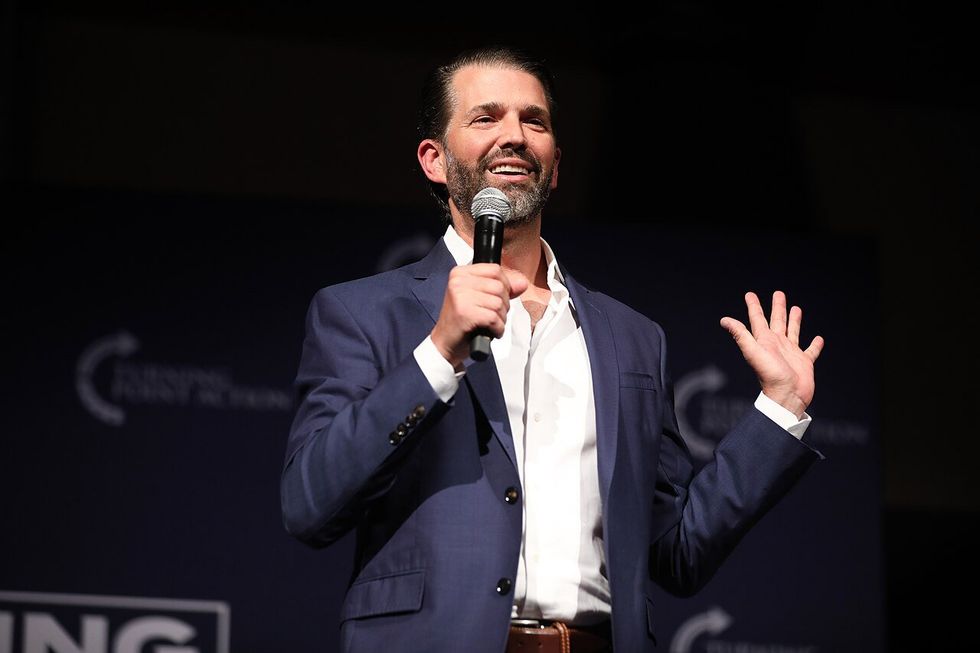
Political scandals often start with something absurd, but few match the bizarre optics of a Kremlin-linked billionaire footing the bill for American political royalty. When investigative reports revealed that Russian oligarch Umar Kremlev bankrolled a massive multi-day post-wedding celebration for Donald Trump Jr. and Bettina Anderson in the Bahamas, Washington didn't just blink—it erupted.
You’ve probably seen the headlines. Critics screamed about foreign influence, watchdogs demanded federal probes, and defenders shrugged it off as an innocent present between pals. But behind the partisan shouting, the entire situation highlights a much deeper, messier reality about how modern political dynasties interact with international wealth. Let’s break down what really happened, why the blowback was so fierce, and what it tells us about the current state of political ethics.
The Bahamas Celebration and the Russian Oligarch Connection
The core of the story revolves around a luxury weekend getaway in the Bahamas following a private family wedding. Investigative findings showed that Umar Kremlev—the head of the International Boxing Association with well-documented ties to Vladimir Putin—poured hundreds of thousands of dollars into funding two nights of festivities.
Donald Trump Jr. and his wife initially defended the arrangement, framing the funding as a generous wedding gift from a friend who happens to be wealthy. They argued that personal friendships shouldn't be scrutinized through a geopolitical lens and that generosity doesn't automatically carry a hidden agenda.
Yet, expecting Washington to ignore a Kremlin-aligned billionaire bankrolling a celebration for a president's son is wildly naive. Kremlev has received honors straight from Putin's inner circle, and his sporting organization has historic backing from Russian state-run energy giant Gazprom. When that kind of money mixes with the family of a sitting US president, red flags naturally fly across Capitol Hill.
Why Lawmakers and Ethics Experts Lost Their Minds
The pushback wasn't just coming from the usual partisan corners. While top Democrats on congressional oversight committees immediately opened inquiries into potential conflicts of interest, even some Republicans expressed sharp discomfort. Lawmakers called out the optics as blatant corruption, arguing that accepting luxury hospitality from a foreign power player crosses a dangerous ethical line.
Let's be honest about why this matters. Political families operate under a microscope for a reason. Proximity to power has a market value. When an oligarch spends heavily on a presidential relative, watchdogs aren't worried about the cost of catering; they're worried about access, influence, and unspoken quid pro quo agreements.
President Donald Trump eventually addressed the fallout, noting that while the arrangement was technically permissible, the money would ultimately be paid back to squash the growing controversy. Umar Kremlev himself chimed in to downplay the noise, claiming people blew the whole thing out of proportion and that they were simply sports fans enjoying camaraderie.
The Broader Pattern of Scrutiny Around Trump Jr
This isn't the first time Donald Trump Jr. has found his international associations under a public microscope. Back during the 2016 campaign, a meeting at Trump Tower involving a Russian lawyer became a central fixture of extensive federal investigations. Because of that history, any financial or social overlap between the Trump orbit and Russian figures instantly triggers an aggressive media and legislative reaction.
Critics point to these recurring episodes as evidence of a relaxed attitude toward foreign boundaries. Supporters, on the other hand, argue that Trump Jr. is a private citizen running businesses and living his life, and that political opponents weaponize every ordinary social connection for maximum PR damage.
Both views contain elements of truth, which is exactly why the story refuses to die quickly. Being part of a famous political family means the line between private friendship and public policy vanishes completely. Every vacation, every gift, and every handshake is scrutinized as a potential geopolitical signal.
Navigating the Noise of Modern Political Scandals
If you are trying to make sense of headlines like these without getting sucked into hyperventilating partisan feeds, you have to separate the legal definitions from the political reality.
- Look at the source of funding: Foreign money attached to political families always carries inherent optics risks, regardless of whether a law was technically broken.
- Watch the damage control: Notice how quickly high-profile figures pivot from defending an action as totally normal to arranging repayments once public pressure hits a boiling point. That tells you where the actual threshold of political pain lies.
- Understand the historical baggage: Past controversies ensure that any new association with foreign actors will automatically be viewed through a magnifying glass.
Ultimately, the wedding gift controversy highlights the perpetual friction between private personal lives and public accountability. When billionaires with deep ties to foreign adversaries start funding luxury celebrations for political heirs, nobody wins the optics battle.
Stop expecting transparency to emerge naturally from these circles. The friction is a permanent feature of modern governance, and the rules of engagement are only getting stricter.
Russian oligarch's lavish gift to Donald Trump Jr. raises questions
This video provides additional context regarding the investigation into the funding behind Donald Trump Jr.'s wedding celebrations.
http://googleusercontent.com/youtube_content/1