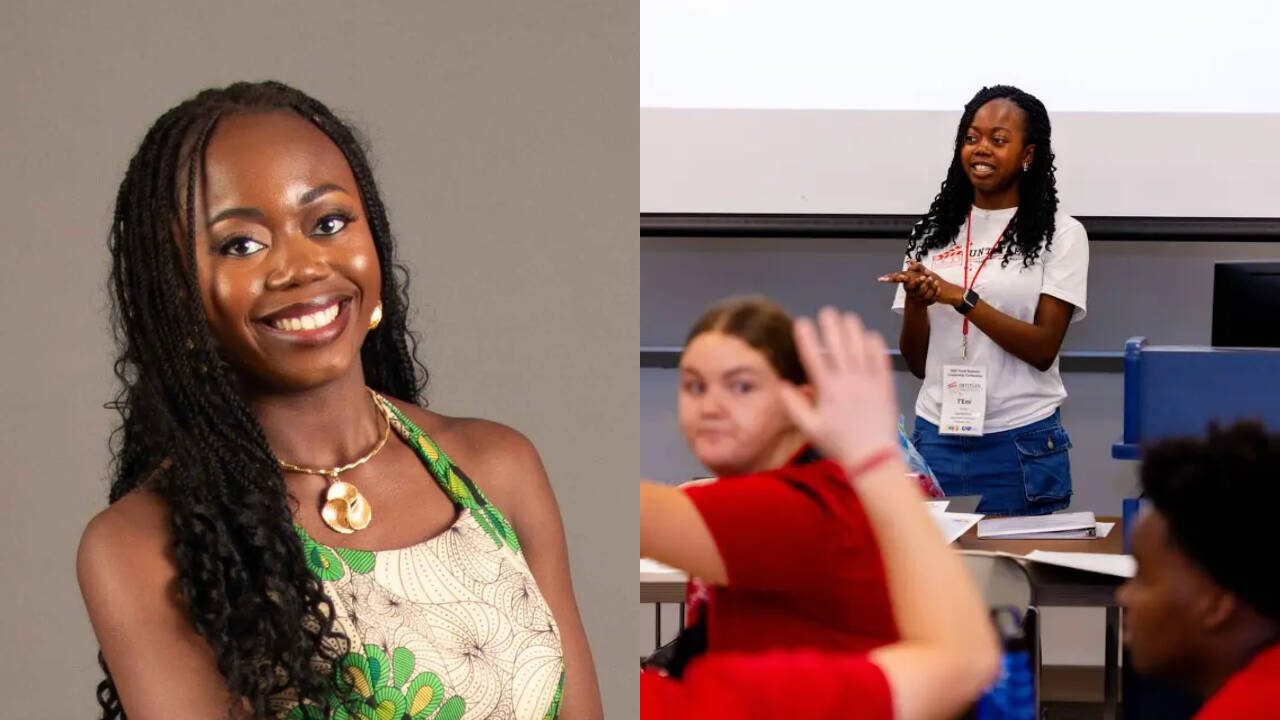
Most twenty-year-olds are still trying to figure out their class schedules, let alone reshaping public health systems and winning national honors. But T’Emi Oshin isn't your average college student. At just twenty years old, this Wayne State University junior has already scored a blistering 1590 on the SAT, secured a spot in a competitive BS/MD Med-Direct program, and broken institutional ground by becoming her university's first-ever Obama-Chesky Voyager Scholar.
If you look past the impressive test scores and trophy cabinets, her trajectory offers a masterclass in how student advocacy actually works when driven by local action rather than resume padding. Let's break down how a student from Midland, Michigan, built a blueprint for modern youth leadership that goes far beyond traditional academic success.
From Midland Classrooms to National Recognition
Oshin’s journey didn't start in a high-powered university lab or a fancy think tank. It began in the hallways of H.H. Dow High School in Midland, Michigan, where she graduated in 2024. As a junior, she noticed a glaring gap in her school community. After conversations with fellow Black students, she realized they lacked a safe, structured space to connect and discuss their shared experiences.
Instead of waiting for an administrator to fix the issue, she founded the Black Student Alliance. She didn't stop at creating a support group either. The organization started giving presentations to younger students about Black history, turning a localized peer group into an active educational platform.
This grassroots approach snowballed. She later helped establish the Black Youth of Midland, bringing together young people from different schools for monthly meetings at the Midland Area Community Foundation. Her early involvement with the Midland Area Youth Action Council also gave her a front-row seat to local philanthropy.
When you examine her record, the common thread is clear: she solves problems where she stands. That foundation is exactly why she was named a semifinalist in the U.S. Presidential Scholars Program, standing out among more than 6,000 candidates nationwide.
Breaking Ground as a Voyager Scholar
In September, Oshin clinched a major milestone by being selected for the 2026-28 class of Obama-Chesky Voyager Scholars. Created by the Obama Foundation and Airbnb co-founder Brian Chesky, the public service scholarship is designed for college juniors committed to public leadership.
For Wayne State University, this selection marks a first. No student from the institution had ever received the honor before Oshin.
The program isn't just about financial aid or prestige. It includes travel funds and a dedicated summer work experience designed by the scholar. Oshin plans to use her Voyager summer in 2027 to study youth-led organizations in other communities, analyzing how young leaders tackle local systemic challenges and what hurdles stand in their way.
This fits squarely into her long-term vision. She isn't studying public health and neuroscience just to memorize textbook anatomy. She is actively mapping out how policy, community organizing, and clinical medicine intersect.
Merging Public Health with Clinical Ambition
Many pre-med students live in a bubble of chemistry exams and organic lab reports, losing sight of the human beings behind the stethoscopes. Oshin took a completely different route. Her fascination with public health started bubbling up in high school as she recognized that a patient's wellbeing is dictated just as much by zip codes and social structures as it is by genetics.
She zeros in heavily on Black youth mental health and the structural conditions that shape adolescent wellbeing. It’s a pragmatic approach to medicine. She understands that treating a symptom inside a sterile clinic room means very little if the patient returns to an environment plagued by systemic barriers and community neglect.
By joining Wayne State's BS/MD Med-Direct program, she secured a direct pathway to medical school while still an undergraduate. Whether she ultimately lands in primary care, pediatrics, public health administration, or a hybrid of all three, her focus remains fixed on preventative impact.
The Reality of Modern Youth Advocacy
If you want to replicate even a fraction of what Oshin has achieved, you have to throw out the playbook of passive volunteering. Too many students collect resume bullet points by logging hours in environments where they don't actually contribute anything meaningful.
Oshin’s track record proves that authentic leadership requires three specific things:
- Spotting Local Gaps: She didn't try to solve global issues on day one. She looked at her high school, noticed a lack of connection for minority students, and built the Black Student Alliance.
- Scaling with Purpose: She expanded her local efforts into structured community programs like the Black Youth of Midland, proving her ideas could scale beyond a single classroom.
- Connecting Micro to Macro: She bridged the gap between community-level youth advocacy and high-level academic rigor, using her neuroscience and public health studies to inform her social work.
On November 18, she is set to receive the Outstanding Young Philanthropist award at the National Philanthropy Day Awards Luncheon at Saginaw Valley State University, nominated by the Midland Area Community Foundation. It’s another trophy for the shelf, but for Oshin, the recognition simply highlights the momentum of the work itself.
Look closely at how she operates. She doesn't wait for permission, she doesn't treat community service as a checkbox, and she refuses to separate clinical science from human empathy. That is why she is Wayne State's first Voyager Scholar, and that is why her name is going to matter long after she graduates.