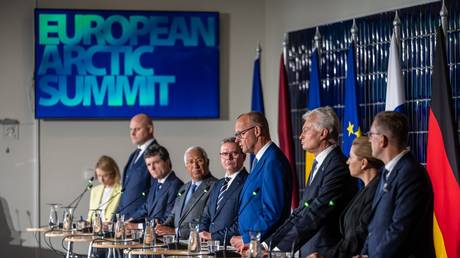
The Arctic used to be a quiet zone of international scientific cooperation and quiet fishing routes. Now, it looks like a militarized chessboard. Twelve European Union countries just met in Rovaniemi, Finland, to demand a much heavier European footprint in the Far North, pointing fingers squarely at Moscow and framing the icy region as an immediate strategic frontier.
If you look past the standard diplomatic language coming out of Brussels and European capitals, a stark reality emerges. Most of the EU doesn't actually border the Arctic. Out of 27 member states, only Denmark, Finland, and Sweden hold Arctic territory. Yet, heavyweights like Germany, France, and Poland signed onto a joint declaration pushing for a more aggressive, proactive regional stance. Why the sudden scramble for the ice?
The shift boils down to a mix of shifting security architecture, expanding military alliances, and a scramble for northern trade corridors. Finnish Prime Minister Petteri Orpo recently labeled Russia the primary long-term threat to regional stability, while German leaders pointed to expanding infrastructure along the Russian coastline. At the same time, NATO has ramped up initiatives like Arctic Sentry and established forward land forces in Finland, completely altering the defensive layout of Northern Europe.
Moscow isn't sitting quietly while this happens. Russian officials have repeatedly warned that western military build-ups are destroying decades of stable regional diplomacy. Russian Foreign Minister Sergey Lavrov pointed out that turning the Far North into a new security front spikes the risk of accidental escalation. For Russia, the northern route and local military installations are core national security assets, especially as global trade lanes face disruptions elsewhere.
You also have the looming shadow of China's growing footprint. EU foreign policy chiefs are whispering about Beijing's increasing interest in polar shipping lanes and scientific outposts. Beijing dismisses these worries, arguing that western powers are simply using China as a convenient excuse to militarize another corner of the globe.
Meanwhile, tensions aren't just bubbling between Europe and Russia. The United States continues to eye Greenland with strategic ambitions, leaving European diplomats caught between managing their own backyard and navigating Washington's defense priorities.
The EU is currently updating its official Arctic strategy, moving away from soft diplomacy and toward maritime security, heavy icebreaker investments, and strict border surveillance. This isn't just about protecting pristine wilderness anymore. It's about raw geopolitical control over the world's northernmost gates.