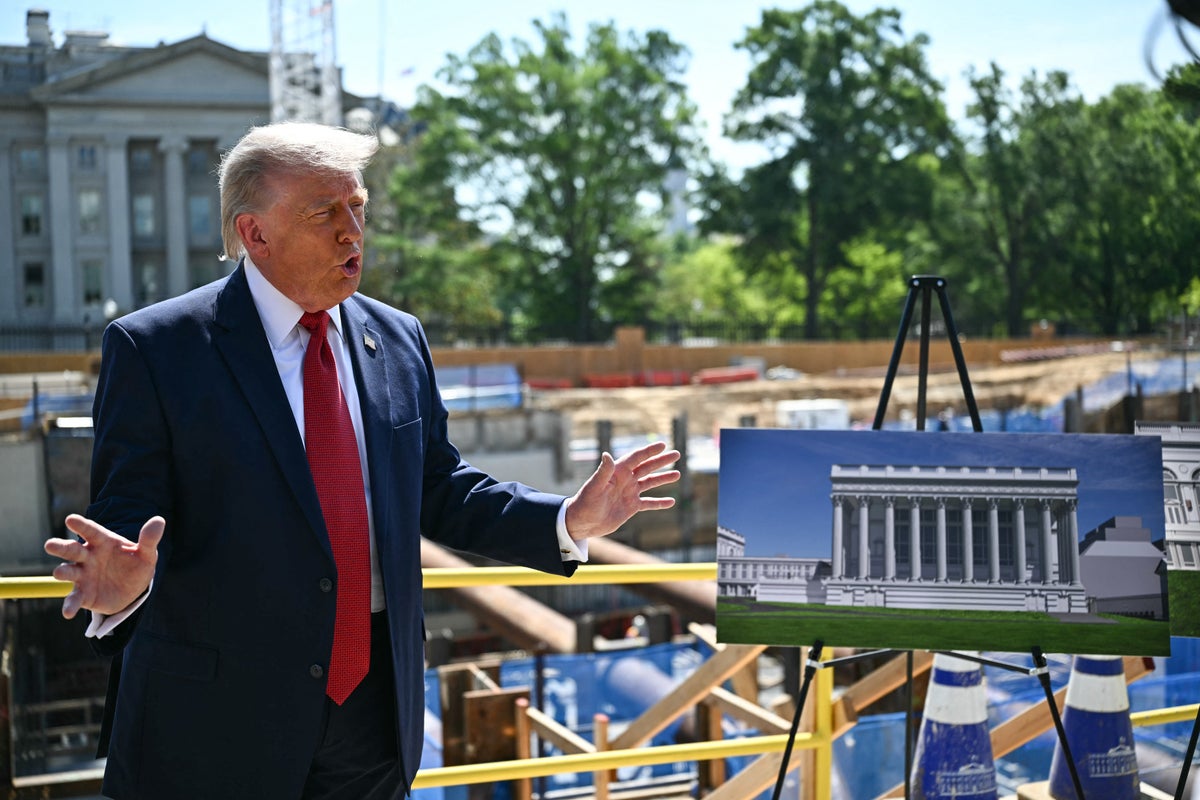
Donald Trump looked out the window of his campaign ride and saw a fixer-upper. It was late on the trail before he reclaimed the White House, and according to insiders, that exact moment sparked his current fixation. He didn't see an august, imperial capital steeped in history. He saw a second-tier swamp town that had slouched into decay. He saw an old building begging for a real estate mogul's signature touch.
Seventeen months into his second term, that vision is pounding jackhammers into the concrete of the nation's capital. This isn't just about policy or shifting executive power. Trump is physically rewriting the geography of Washington DC, treating the entire city like a massive piece of premium real estate.
Most people look at the construction zones and think it's just standard political vanity. They're wrong. This is an aggressive, literal rebranding of the American state, executed by a man who still views the presidency through the lens of a New York developer. From a massive new ballroom to armed troops at transit hubs, the capital city is changing fast. If you haven't been to DC lately, you won't even recognize it.
The Secret Five Hundred Million Dollar Ballroom and the Demolition of the East Wing
The most shocking manifestation of this architectural campaign is hidden right behind the gates of the White House. Trump didn't just redecorate the Oval Office. He brought in the wrecking balls. The historic East Wing and the East Colonnade were completely demolished to clear space for a massive, 90,000-square-foot ballroom facility.
To get this done fast, the administration completely bypassed the traditional, sluggish federal bidding process. Internal records recently revealed a confidential, no-bid contract awarded to Clark Construction that could be worth up to $500 million. Normally, federal agencies like the General Services Administration or the National Park Service handle these massive structural overhauls to ensure cost controls and oversight. The White House simply stepped around them.
The administration used a specific loophole in federal law that gives the president unilateral authority to spend freely on the care, maintenance, and improvement of the Executive Residence. While architectural historians and critics are screaming foul in court, the project is moving ahead at breakneck speed. Trump has publicly defended the massive project by framing it as a matter of national security. He talks about a sprawling underground military bunker and a protective drone facility built into the roof. But to anyone watching the construction crews, it looks exactly like the kind of high-end event space you would find at a Mar-a-Lago expansion.
Painting the Lincoln Memorial Reflecting Pool and Shifting National Park Funds
If you walk down to the National Mall, the changes become even more bizarre. The Lincoln Memorial Reflecting Pool, traditionally a calm, gray expanse of water, has been fitted with a new $14.7 million filtration system. The goal was to paint the bottom and treat the water to turn it a deep, bright blue.
Naturally, this project immediately ran into trouble. A massive algae bloom recently struck the pool, turning Trump's pristine blue water into a murky green mess. The political fallout was immediate. Joe Biden seized on the failure during a fiery speech in Hanover, Maryland, calling Trump a loser and blasting the reflecting pool project as a clear example of blatant corruption. It turns out the $1.7 million filtration contract was awarded without competitive bidding to a Trump donor who happens to live right next to Mar-a-Lago.
Funding these cosmetic changes has forced some creative accounting within the federal government. The administration has been redirecting hundreds of thousands of dollars directly out of National Parks budgets and other public infrastructure funds to finance these capital projects. While the Interior Department claims they are simply addressing deferred maintenance using flexible funding streams, critics argue that vital environmental and preservation programs are being starved to pay for aesthetic overhauls.
Banners on Federal Buildings and the Claw on the South Lawn
The visual branding extends far beyond the construction sites on the Mall. Walk down Constitution Avenue and you'll find massive banners bearing Trump's face hanging directly on the facades of historic government buildings. It is an unprecedented sight for a sitting American president.
At the Department of the Interior, a giant banner places Trump's image side-by-side with George Washington, complete with slogans contrasting America's First with America First. A mile down the road, Trump's face stares down from the Department of Justice building. It is a highly literal, physical marker of his administration's fight to exert direct control over a law enforcement apparatus that previously maintained a strict tradition of independence from the White House.
Then there are the temporary structures that feel more like Las Vegas than the District of Columbia. In June, a massive 92-foot steel structure known as The Claw was erected right on the South Lawn of the White House to host a UFC fight. Combine that with a massive, 16-day Great American State Fair taking over the National Mall to mark the country's 250th anniversary, and the entire city feels less like a bureaucratic hub and more like a permanent Trump production.
Armed Guards and the Ghost Towns of DOGE
It isn't just the architecture that feels different. The day-to-day security reality on the ground has fundamentally shifted. Walk into Union Station or Metro Center and you're immediately confronted by armed National Guard troops.
These troops aren't there for a temporary crisis. They have been deployed indefinitely since August 2025 under an emergency order Trump issued to combat local crime. By this summer, the number of guardsmen stationed at street corners and transit hubs is expected to hit 5,000. While the administration points to data showing a substantial drop in homicides, carjackings, and property crimes as proof of success, the presence of military uniforms on everyday commuter routes has become an eerie, permanent fixture of the city's scenery.
Meanwhile, a few blocks away, the physical scars of the administration's budget cuts are on full display. The U.S. Agency for International Development building on Pennsylvania Avenue sits largely empty. It was the very first target hit by the Department of Government Efficiency, the aggressive cost-cutting unit previously led by Elon Musk. The administration eliminated 90 percent of foreign aid contracts, wiping out roughly $60 billion in funding and triggering tens of thousands of sudden layoffs. The workers cleared their desks months ago, leaving behind massive, vacant real estate footprints in the heart of downtown.
How the Supreme Court Cleared the Runway
Many critics wondered how Trump could pull off such an aggressive, unilateral transformation of a federal city without Congress stopping him. The answer lies directly across the street from the Capitol at the U.S. Supreme Court.
The court's conservative majority has systematically expanded the scope of presidential power. Through an embrace of the unitary executive theory, recent rulings have affirmed that the president holds absolute, total control over the executive branch of government. The court ruled that the president has the right to remove the head of any federal agency at will, completely overturning decades of legal precedent that limited that power.
This legal shield has made the administration incredibly bold. When local historical societies or environmental groups file lawsuits to stop the demolition of historic structures or challenge no-bid construction contracts, the White House legal teams simply wave the Supreme Court's latest opinions. The traditional system of checks and balances has been drastically altered, leaving the presidency with powers that resemble a powerful monarch rather than a co-equal branch of government.
What to Do Next If You Are Tracking the Capital Overhaul
The transformation of Washington DC is moving incredibly fast, and staying ahead of the changes requires looking at the right sources. If you want to follow the real story behind the scaffolding, skip the standard political commentary and track the actual money and legal filings.
- Monitor the Executive Residence Budget: Keep a close eye on the congressional appropriations and internal White House spending reports regarding the Executive Residence. This is where the administration hides the true costs of the East Wing ballroom expansion.
- Track the Shadow Docket Rulings: Watch the Supreme Court's emergency stays and shadow docket decisions. This is where the legal battles over the Triumphal Arch and the Arlington Cemetery renovations are actually won or lost before they ever hit a public trial.
- Follow Local DC Real Estate Records: The true impact of the Department of Government Efficiency is found in commercial real estate data. Watch for federal building lease cancellations and downsizings in the DMV area to see which agencies are getting hollowed out next.
Trump's makeover of Washington isn't a temporary political stunt. It's a permanent structural rewrite. By the time this term ends, the physical identity of the capital city will be fundamentally altered, locked in stone, concrete, and deep blue paint.