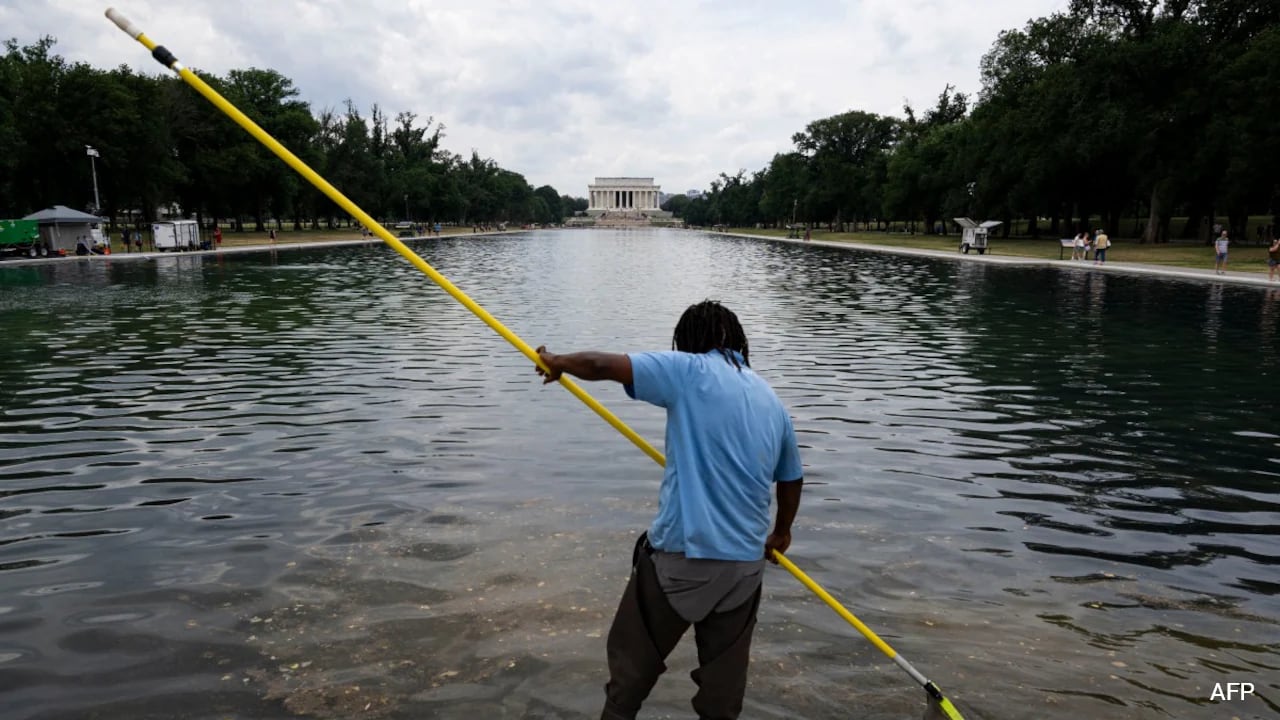
The Lincoln Memorial Reflecting Pool is green again. Not just normal, murky pond green, but a bright, fluorescent shade of algae soup that looks like something out of a bad sci-fi film. This comes exactly two weeks after a massive, rushed 14.7 million dollar renovation aimed at polishing up the capital before the big July 250th American anniversary celebrations.
Donald Trump says it is sabotage. He claims deranged vandals snuck onto the National Mall with knives and industrial chemicals to ruin his handiwork. He wants people thrown in federal prison for a decade. The U.S. Park Police are locking up senior citizens who merely dipped a finger in the water out of pure curiosity.
Look past the loud social media posts. The real story here is not a coordinated partisan attack on a national monument. It is a classic tale of government rushing, suspicious no-bid contracts, and a paint job that simply refused to stick. Washington is treating a maintenance failure like an act of terror.
The American Flag Blue Experiment
The trouble started when the administration decided the historic pool needed a makeover. The old concrete looked dull. Algae had always been an issue. The solution was a major overhaul that concluded on June 6. Trump personally insisted on coating the bottom of the 2,000-foot-long pool with a specific shade he called American flag blue.
The theory was simple. A bright blue bottom would make the water look pristine and reflect the Washington Monument beautifully. In practice, it turned out to be a disaster.
Within days of refilling the pool, the bright blue floor began to peel. Giant, rubbery sheets of blue coating detached themselves from the concrete and floated to the surface. It looked terrible. To make matters worse, a heatwave triggered a massive algae bloom. The combination of bright yellow-green algae over a vivid blue coating created a glowing neon mess.
Instead of admitting the epoxy failed to bond properly to the damp concrete, the narrative shifted immediately to a criminal plot. Trump took to social media to announce that a vandal used a blade to slash a massive 300-foot gash right through the new facade. He offered zero evidence for this. Experts who understand industrial coatings know that when a seal fails on a body of water that large, hydrostatic pressure will split the paint in long, straight lines. It does not take a box cutter. It just takes bad engineering.
Reaching for the Deep State in the Mud
The conspiracy theories did not stop with the paint. The administration claimed that saboteurs poured fertilizer and specialized chemicals into the water to trigger the green slime. National Park Service workers spent days dumping hydrogen peroxide into the pool to kill the bloom, which only made the peeling paint chunks float faster.
Then came the bizarre political tie-ins. Trump linked the pool issues to an incident on the grass nearby. Someone had etched the numbers 8647 into a section of the National Mall lawn. In restaurant slang, to 86 something means to get rid of it. Since Trump is the 47th president, the message was pretty clear.
The administration bizarrely suggested this grass-carving was inspired by former FBI Director James Comey. Why? Because Comey had recently posted an Instagram picture of seashells that allegedly spelled out the same numbers. Connecting a bad paint job at the Lincoln Memorial to James Comey and an Instagram post about seashells shows how quickly infrastructure problems turn into full-blown political theater in Washington.
U.S. Attorney Jeanine Pirro joined the fray. She promised the full weight of the federal government would crush anyone messing with the monuments. Trump reminded the public that damaging federal property carries a mandatory maximum of 10 years in prison under statutes he has championed.
The Arrest of a Curious Olympian
The hunt for the phantom vandals has already claimed some incredibly unlikely victims. Take David Hearn. He is a 67-year-old resident of Bethesda, Maryland. He is also a former Olympic canoe racer who used to manufacture composite materials for watercraft. He knows a thing or two about fiberglass, epoxy, and how things interact with water.
On Friday, Hearn was out on a 64-mile bicycle ride when he stopped by the National Mall to look at the pool. He noticed the big blue sheets of paint peeling off the sides. Being a guy who spent his whole life building boats, he was scientifically curious. He reached down into the water to touch a piece of the loose coating to see what kind of material they used.
A park employee yelled at him to stop. Hearn let go immediately. That did not save him. National Guard troops and U.S. Park Police swarmed the elderly cyclist. They arrested him, threw him in custody, and held him for five hours.
Hearn is now facing federal charges for destroying government property. He maintains he did nothing but touch a piece of paint that was already broken. The idea that a senior citizen on a bike ride is part of a covert team of anti-monument saboteurs is absurd, but it fits the narrative the White House wants to sell. So far, authorities have arrested at least five people and handed out over a dozen citations around the pool area. Most are just tourists and locals caught in a dragnet.
A Rushed Timeline and No Bid Contracts
The real culprit behind the green water and peeling paint is far less exciting than an underground network of vandals. It comes down to bad planning and a rushed deadline.
The nation is celebrating its 250th birthday next month. The administration desperately wanted the National Mall looking flawless for the cameras. According to local records, the contract to recoat the pool was pushed through quickly without the usual competitive bidding process.
Applying industrial coatings to a massive public pool requires perfect conditions. The concrete must be completely dry. The curing process cannot be rushed. If you slap thick blue rubberized paint onto old, damp concrete just to meet a political photo-op deadline, the moisture underneath will trap gas. The paint will bubble. It will peel.
The DC Water authority has already issued an emergency permit to drain the entire 2,000-foot structure again. The repair company claims they will fix the peeling floor under their warranty, but the clock is ticking. Draining, scraping, drying, repainting, and refilling a monument that holds millions of gallons of water takes weeks. They are almost out of time before the July fireworks.
What Happens Next on the National Mall
The drama over the Reflecting Pool is a perfect example of modern political distraction. A failure of basic construction management is being packaged as an attack on American history to deflect from a botched 14 million dollar project.
If you are planning to visit Washington to see the monuments over the next few weeks, prepare yourself for a mess. Here is what you need to keep in mind.
Expect heavy security. Park Police and National Guard units are highly sensitive right now. Do not get close to the water. Do not reach in to check the quality of the paint, and do not try to clean out the floating debris yourself. You will end up in handcuffs like David Hearn.
Watch where you walk. The grass areas around the Mall are heavily monitored, and minor infractions are resulting in federal citations.
The pool will likely be empty or mid-drain during your visit. The city has no choice but to empty the water to vacuum out the dead algae and scrape away the failed American flag blue experiment.
Washington loves a conspiracy. It is much easier to blame a shadow group of box-cutter-wielding political enemies than to admit that you rushed a paint job on a damp piece of concrete. The truth is floating on top of the water for everyone to see. It is just bad paint.