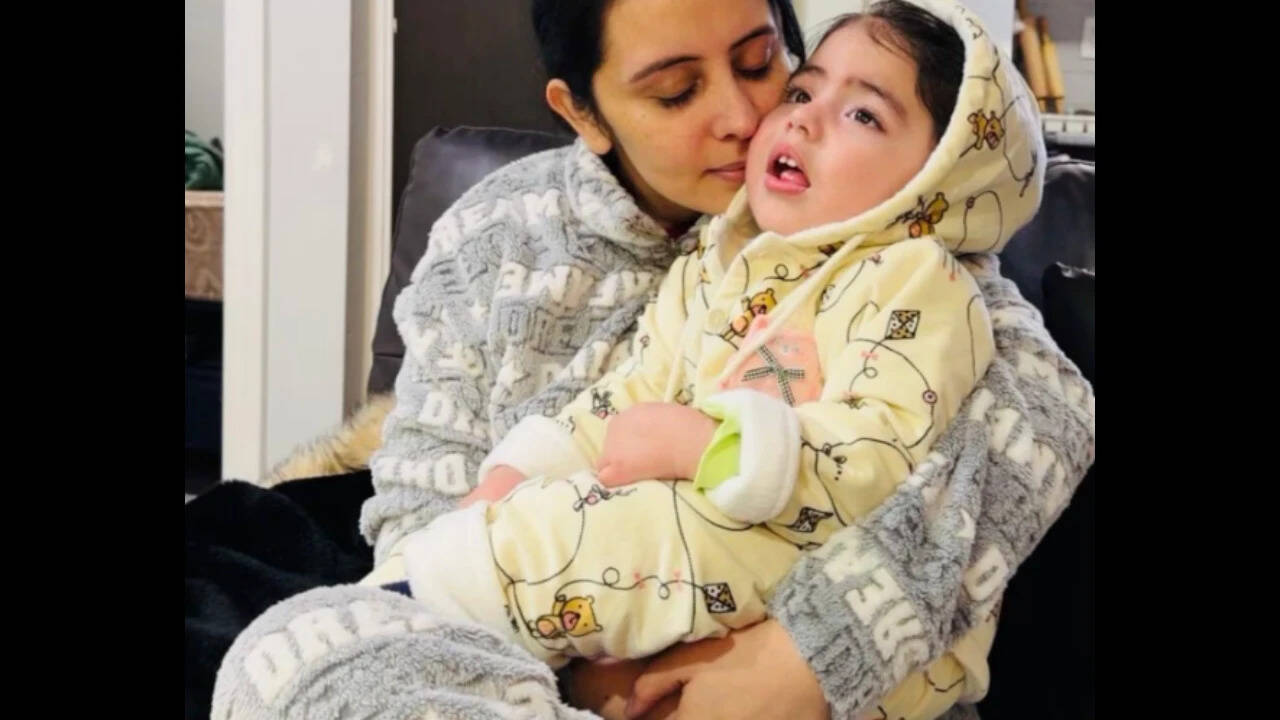
Imagine watching your two-year-old child unable to sit, talk, or hold their head up, trapped inside a body that functions like a newborn's. That's the daily reality for Mandeep and Ramandeep Chandi, an Indian-origin family living in Brampton, Canada. Their toddler, Zorawar Singh Chandi, suffers from Aromatic L-amino Acid Decarboxylase deficiency. It's a devastatingly rare genetic disorder that blocks the brain from producing dopamine and serotonin. Without these vital chemical messengers, simple motor control becomes impossible.
When conventional Canadian healthcare options hit a brick wall, the family faced an agonizing choice. They turned to crowdfunding to raise a staggering 5.5 million Canadian dollars. Their goal is to get Zorawar to the United States for an FDA-approved gene therapy called KEBILIDI. It's a brutal reminder of how modern medicine offers miraculous breakthroughs, but only if you can afford the astronomical price tag attached to them.
The Harsh Reality of AADC Deficiency
Most parents take basic developmental milestones for granted. Your kid learns to roll over, sits up unsupported, starts babbling, and eventually takes those clumsy first steps across the living room rug. For Zorawar, none of those milestones happened.
At two-and-a-half years old, his existence is heartbreakingly constrained. His mother, Ramandeep, describes how his eyes frequently roll upward for up to thirty minutes at a time, causing him intense physical distress. Because he can't chew or swallow properly, he remains entirely on a liquid diet. He spends his days sitting in his parents' lap, unable to communicate his pain or frustration.
Aromatic L-amino Acid Decarboxylase deficiency disrupts the nervous system right at the root. The genetic mutation stops the body from making the enzyme needed to synthesize neurotransmitters. Without dopamine and serotonin, the brain cannot relay signals to the muscles. Kids with this condition suffer from severe developmental delays, involuntary eye movements, and autonomic dysfunction. They live trapped behind their own eyes.
Why Canadian Parents Are Crossing Borders for Treatment
Medical tourism used to mean traveling abroad for elective surgeries or cheaper cosmetic procedures. Today, desperate families are crossing international borders just to keep their children alive.
The US Food and Drug Administration approved KEBILIDI as the first gene therapy specifically designed for AADC deficiency. Administered directly into the brain through a specialized neurosurgical procedure, the therapy aims to correct the underlying genetic error and restore enzyme production. Boston Children's Hospital and other elite medical centers report promising outcomes for patients who receive it.
Yet, access is a massive hurdle. When the Chandi family approached Ontario's Ministry of Health asking for financial assistance to cover treatment outside the country, their application was flatly denied. Public healthcare systems often struggle to fund ultra-expensive, highly specialized therapies that lack local precedent. That leaves families entirely on their own, staring down multi-million-dollar bills while time ticks away against their child's development.
The Economics of Ultra-Rare Orphan Diseases
Why does a single medical treatment cost millions of dollars? It's a question that sparks furious debate among economists, ethicists, and pharmaceutical executives.
Developing a gene therapy requires decades of foundational research, specialized clinical trials, and intricate manufacturing protocols. When a disease affects only a handful of children worldwide, the pharmaceutical company has to recover its massive research and development costs across a tiny patient pool. That's why orphan drug pricing routinely reaches astronomical heights.
Critics argue that these price tags are predatory and put corporate profit ahead of human lives. Proponents counter that without high financial incentives, biotech companies would never invest millions into researching cures for conditions that affect only a few hundred people globally. Wherever you land on that spectrum, the immediate human cost falls squarely on families like the Chandis. They aren't thinking about biotech market dynamics. They're just trying to save their son.
How Communities Step Up When Systems Fail
When public health infrastructure and insurance policies fail, ordinary people step into the void. The Chandis launched a GoFundMe campaign targeting 5.5 million dollars to cover the treatment, travel, and specialized post-operative care required in the United States.
Crowdfunding for medical bills has become an increasingly common, albeit deeply flawed, safety net in the modern world. It turns personal tragedy into a public spectacle, forcing grieving parents to market their child's suffering on social media just to capture the attention of donors. Despite the emotional toll, the response has been powerful. The campaign has already raised over 1.5 million dollars, proving that human empathy can still bridge gaps left by institutional coldness.
The road ahead for Zorawar remains long and uncertain. Even if they hit their fundraising goal and complete the multi-hour brain surgery in Boston, recovery is slow. Improvements manifest over months, and results are never guaranteed. But for parents watching their toddler live like a newborn, hope is the only currency that matters.
If you want to support families facing similar battles, look into rare disease advocacy groups or contribute directly to verified medical campaigns. Awareness and financial backing remain the primary tools we have to change outcomes for children fighting rare genetic disorders.


