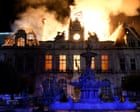
When a nineteenth-century town hall gets reduced to a charred skeleton overnight, something has gone structurally wrong with the machinery of government. France is staring down an acute political emergency right now after a weekend of raw, destructive urban warfare that caught state officials completely flat-footed. Over two thousand people have been arrested, hundreds of shops have been gutted or looted, and municipal buildings from Paris to Limoges have been torched.
If you look past the standard political spin coming out of Paris, a much darker picture emerges. You see a country where the baseline social contract is fracturing under the weight of severe economic strain, ignored public demands, and a total breakdown in state intelligence.
The chaos didn't materialize out of thin air. For weeks, tens of thousands of citizens had taken to the streets in peaceful marches. Parents, grandparents, teachers, and students turned out across major metropolitan areas to demand basic investments in crumbling schools, more teachers, and relief from a punishing cost-of-living crisis. These demonstrations were calm, organized, and entirely predictable. They were a textbook example of a public trying to get the attention of an aloof administration.
The fatal mistake made by state planners was treating the entire movement as a monolith.
While peaceful crowds marched for public funding, hyper-violent factions hijacked the momentum. Masked agitators, organized units of looters, and opportunistic rioters swarmed cities like Paris, Marseille, Lyon, and Bordeaux. They set up barricades using burning bins, smashed storefronts, and targeted state infrastructure. In Limoges, the mayor revealed that municipal police had to retreat from defending the historic town hall simply because they ran out of ammunition. When a local government runs dry on basic defense supplies while rioters threaten to burn elected officials alive, you aren't looking at routine public disorder. You are looking at a colossal failure of the state.
Blame is flying in every direction, but accountability is nowhere to be found.
Emmanuel Macron’s administration, with the president stepping down next spring, immediately pointed fingers at what they termed the "ultra-left." Prime Minister Sébastien Lecornu insisted the government wouldn't be intimidated by criminal elements. Meanwhile, opposition figures across the political spectrum fired back, arguing that the interior ministry suffered from an astonishing lack of intelligence and operational readiness. Mayors caught on the front lines didn't mince words either. Benoît Payan, the socialist mayor of Marseille, admitted he never thought he would live to see hordes of rioters attack common state buildings with zero regard for civic order.
Here is what most mainstream commentary misses. The violence wasn't just a random explosion of criminal vandalism. It was the predictable collision of two distinct pressures. On one side, you have a legitimate, desperate population suffocating under economic pressure and structural neglect. On the other side, you have a hyper-aggressive fringe that exploits institutional weakness the moment the state's security apparatus gets stretched too thin.
When police resources are funneled entirely into managing weeks of school protests and cost-of-living demonstrations, urban security margins evaporate. Intelligence networks missed the shift from peaceful protest to coordinated urban guerrilla tactics. Stores were ransacked, millions of euros in damage accumulated, and young people suffered catastrophic injuries, such as a seventeen-year-old boy in Saint-Étienne losing his right hand to a crowd-control grenade.
Fixing this mess requires more than tough-guy rhetoric from interior ministers or defensive social media posts from outgoing leaders. Governments cannot lecture citizens about law and order while simultaneously failing to secure basic municipal infrastructure or running out of defensive resources mid-riot.
If French authorities want to stop the cycle, they have to address the root grievances driving the initial peaceful protests while completely overhauling their crowd intelligence and policing tactics. Until officials stop treating systemic civil distress as a public relations problem to be managed with soundbites, French cities will remain one spark away from the next catastrophe.