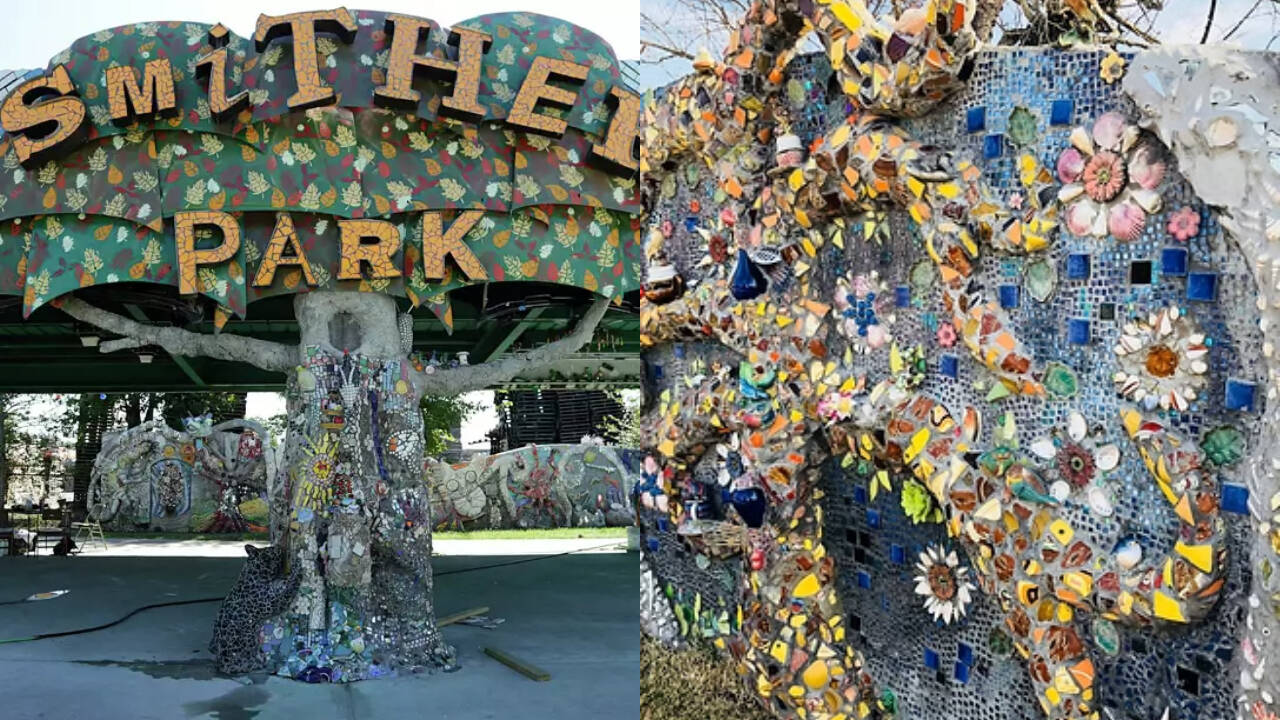
Walk down Munger Street in southeast Houston, and you'll find a half-acre space that proves garbage in the right hands becomes pure wonder. Back in 2010, this plot was nothing more than an overgrown, abandoned eyesore. Today, it stands as Smither Park, a vibrant public canvas where broken coffee mugs, discarded tiles, old car keys, shells, and bottle caps form towering monuments of color.
If you think modern public spaces require massive corporate budgets and sterile corporate designs, this place will change your mind. Over sixteen years, more than three hundred artists have turned an empty patch of dirt into a living community museum. It's eccentric, chaotic, and entirely free to the public.
The Vision Behind the Broken Dishes
The story starts with John Smither, a passionate Houston collector and supporter of outsider art who passed away in 2009. His wife, Stephanie Smither, wanted to honor his memory by creating something special on land owned by the Orange Show Center for Visionary Art. She teamed up with builder and artist Dan Phillips, known for championing reclaimed materials.
They didn't order pristine bricks from a catalog. Instead, they put out a call for junk.
People brought boxes of shattered bathroom tiles, chipped porcelain plates, expired credit cards, costume jewelry, and bottle caps. Instead of heading to a landfill, these fragments found a permanent home on a sprawling 400-foot mosaic wall.
Inside the Mosaic Memory Wall
Walking past the 400-foot mosaic wall feels like stepping inside a massive, three-dimensional scrapbook. You can spot individual items if you look closely enough. Nail polish bottles sit right next to old ceramic figurines, coins, and seashells.
The surface forms sprawling animals, geometric patterns, and surreal shapes. Because hundreds of different hands contributed over a decade and a half, there's no single uniform style. Some sections feature neat, intricate tile work, while others explode with wild, improvised textures. That raw, human inconsistency gives the park its soul. You can tell real people built this with their bare hands, dealing with sticky grout, tired backs, and endless handfuls of broken glass.
More Than Just a Wall
The mosaic wall grabs your attention first, but the park keeps expanding. Over the years, creators added a pavilion built with recycled glass bottles, a fish-themed band shell, a meditation garden, and a swinging set that invites you to act like a kid again.
Then there's the marble tower. It's a kinetic sculpture designed around a wonderfully simple mechanical concept. You drop a marble, and you watch it wind its way through old pots, pans, fan blades, cups, and saucers. It's loud, clanky, and hypnotic. You'll catch yourself standing there for twenty minutes just waiting for the marble to hit the bottom.
Smither Park cost roughly $1.2 million to build, funded largely through private donations rather than massive government grants. Many artists donated their labor, spending weekends gluing shards of china onto concrete columns for free.
Why Urban Spaces Need More Chaos
Cities love sterile, manicured parks with trimmed lawns and identical park benches. We design public spaces to be easy to mow and impossible to vandalize. But efficiency often kills character.
Smither Park works precisely because it breaks every rule of traditional urban planning. It's messy, personal, and deeply local. It reflects Houston's diverse, restless identity—a city built on constant reinvention where old things get a second act.
If you are ever in Houston, skip the typical tourist traps for an afternoon. Head to Munger Street. Walk the length of the mosaic wall, touch the jagged edges of the broken plates, and watch a marble clatter down the metal tower. You will walk away looking at the junk in your own garage a little differently.