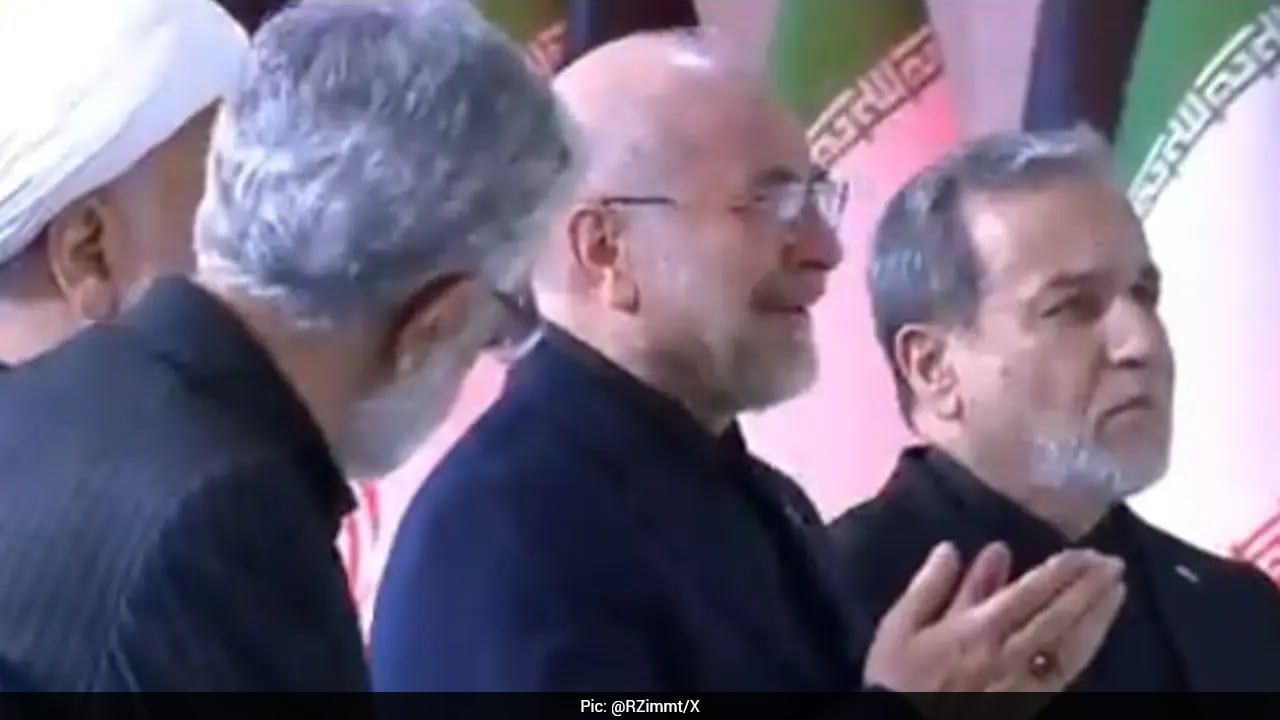
Public displays of grief from high-ranking Iranian officials usually follow a strict theatrical script. But when Parliament Speaker Mohammad Bagher Ghalibaf and Foreign Minister Abbas Araghchi broke down in tears beside the coffin of late Supreme Leader Ayatollah Ali Khamenei, it wasn't just standard state-mandated mourning. It was a raw snapshot of an establishment facing an existential abyss.
The long-delayed farewell ceremony at Tehran's Grand Mosalla complex marks the beginning of a massive seven-day funeral procession. Khamenei was killed months ago, back on February 28, 2026, alongside several family members during devastating joint US-Israeli airstrikes on his compound. The funeral had been put on hold while the region burned in an all-out war. Now, with a fragile ceasefire holding just long enough to put the regime's patriarch in the ground, the visible cracking of Iran's top leadership reveals a deeper, structural panic about what comes next.
Tears in Tehran and the Illusion of Control
Iran's political elite are trained to project unwavering strength, especially during moments of immense geopolitical pressure. Seeing Ghalibaf—a hardline former Revolutionary Guard commander—and Araghchi—a seasoned, Western-educated diplomat—visibly weeping over the tricolor-draped coffin tells us something state media didn't intend to broadcast. They aren't just mourning a leader. They're staring at the vacuum he left behind.
Khamenei ruled Iran with an iron fist for over three decades. He was the ultimate arbiter of every major decision, from the country's nuclear ambitions to its regional proxy network. For guys like Ghalibaf and Araghchi, Khamenei wasn't just a boss; he was the structural glue holding a highly factionalized government together. Without him, the rules of survival in Tehran have completely changed.
Why the Funeral Was Delayed for Months
You don't usually wait more than four months to bury a supreme leader in Islamic tradition, where burial typically happens within 24 hours. The delay itself is a testament to how close the Islamic Republic came to total collapse following the February strikes.
Active bombardment and a rapidly escalating war made a mass public gathering in Tehran a logistical impossibility. The regime couldn't guarantee the safety of its remaining elite, let alone millions of citizens. It's only now, during a temporary diplomatic pause brokered amidst indirect US-Iran negotiations, that the state has deemed it safe enough to bring Khamenei’s remains out for a public lying-in-state.
The regime is now trying to turn this delayed mourning into a tool for survival. Ghalibaf has already publicly demanded a massive turnout, explicitly stating that the funeral must serve as the "nation's call for vengeance." They're trying to channel genuine grief and nationalist anger into a shield to protect the state from further external aggression.
The Succession Crisis Hiding in Plain Sight
While the international press focuses on the optics of mourning, the real story is the brutal transition of power happening behind closed doors. Mojtaba Khamenei, the late leader's son, was quickly positioned as the successor, but inheriting a title doesn't mean inheriting absolute authority.
The tears from Araghchi and Ghalibaf reflect the immense pressure on their respective factions.
- The Diplomatic Faction: Araghchi is trying to salvage what he can from back-channel talks with Washington to prevent further economic and military devastation. He knows how close the country is to the brink.
- The Security Apparatus: Ghalibaf answers to a restless Islamic Revolutionary Guard Corps (IRGC) that wants a harder line, heavier military investment, and retaliation for the assassination of their leader.
Balancing these two opposing forces without the final, absolute word of Ali Khamenei is an absolute nightmare.
What Happens to the Region Now
The funeral procession is scheduled to move from Tehran to Qom, then cross the border into Iraq to pass through Najaf and Karbala, before returning to Iran for final burial at the Imam Reza Shrine in Mashhad. This route isn't accidental. It's a calculated geopolitical demonstration aimed at proving Iran still maintains its influence over the Shia crescent, despite losing its top figurehead.
But the bravado is masking severe vulnerabilities. Western intelligence leaks recently hinted that Israel had actively weighed assassinating both Ghalibaf and Araghchi during peak periods of the active conflict, viewing them as legitimate targets before US officials warned that such a move would permanently end any hope of a ceasefire. The two men weeping at the altar know exactly how close they came to sharing Khamenei's fate.
Keep An Eye On These Variables
The political theater in Tehran will wrap up by July 9, but the real fallout is just getting started. If you want to understand if Iran can maintain its stability, watch these specific indicators over the next few weeks.
Monitor the Strait of Hormuz
Iran's military has already issued strict warnings to commercial shipping against using any unapproved routes during the mourning period. Look for whether the IRGC uses this high-tension window to aggressively harass international vessels as a show of force, or if they adhere to the fragile de-escalation agreements currently on the table.
Track the Progress of Indirect US-Iran Talks
The current pause in active fighting is incredibly fragile. Watch whether Araghchi can convert the temporary ceasefire into a more sustainable diplomatic framework, or if internal pressure from IRGC hardliners forces him to walk away from the table. If talks collapse, a return to open warfare is almost guaranteed.
Gauge Domestic Turnout and Dissent
The regime needs millions of people in the streets to legitimize the transition of power to the next Supreme Leader. Look closely at the crowds in Tehran and Mashhad. A lower-than-expected turnout, or flashes of anti-regime protests away from the heavily policed ceremonial centers, will tell you exactly how much authority the central government has actually lost.