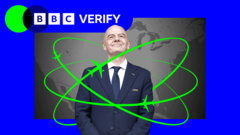
The stands are packed, the anthems are blaring, and the 2026 FIFA World Cup is unfolding across three massive nations. But while fans are enduring endless airport security lines and burning through their savings to catch a single game, one man is putting on a completely different kind of show. Gianni Infantino is currently engaged in a frantic, carbon-heavy race against time, hopping across North America at a pace that feels less like sports administration and more like a high-end logistics simulation.
We heard the promises before the tournament kicked off. FIFA promised this expanded 48-team tournament would be an event that respected the planet. They talked about regional clusters to minimize travel for teams and fans. Yet, the man at the very top of the organization is currently doing the exact opposite. He is treating an entire continent like his personal hop-on, hop-off bus tour, clocking up 27 flights to watch 24 matches in a dizzying display of elite privilege.
This isn't just about a busy executive trying to do his job. It points to a deep hypocrisy that threatens to undermine whatever goodwill FIFA has left. Let’s break down what is actually happening in the skies above the United States, Canada, and Mexico, and why this endless airborne sprint matters far beyond the scorelines.
The Luxury Office at Forty Thousand Feet
You might wonder how someone physically manages to see two matches a day in cities separated by thousands of miles. The average fan would find this impossible. Commercial flight schedules don't align, airport delays are a nightmare, and the sheer exhaustion would crush anyone sitting in coach.
Infantino doesn't face those problems. He has a private chariot waiting on the tarmac, a luxury Gulfstream G650ER operated by Qatar Airways Executive. This isn't a standard charter flight paid for out of a standard travel budget. This aircraft is part of FIFA's massive sponsorship deal with Qatar Airways. Essentially, the private jet is a flying perk, a perk that travels at nearly 1,000 km/h and boasts a range of almost 14,000 kilometers.
Inside this flying office, the FIFA president can review match reports, take meetings, and sleep comfortably while soaring over borders. During the first nine days of the tournament alone, he logged 13 flights. Now that number has ballooned to 27 flights. He is popping up in the VIP boxes of Mexico City, Guadalajara, Los Angeles, San Francisco, Vancouver, and Seattle. To the casual viewer watching on television, it looks like magic. In reality, it is just the relentless deployment of private aviation.
Tracking the Astronomical Carbon Cost
While FIFA representatives frequently point out that private travel is chosen based on what is most efficient, environmental experts are looking at a completely different set of metrics. The math behind private jet travel is brutal, and no amount of corporate public relations can soften the blow.
According to data from Greenly, a prominent firm specializing in carbon footprint assessments, just one single hour inside a private aircraft like the Gulfstream G650ER emits roughly the same amount of carbon dioxide that an average human being generates in an entire year. Let that sink in for a moment. Every hour the FIFA president spends in the air balances out the annual carbon existence of a normal person.
Environmental analysts estimate that if Infantino continues this frantic schedule through the knockout stages and into the final matches, his personal aircraft travel alone will generate between 300 and 500 tons of carbon dioxide. To put that in perspective, that matches the combined annual carbon footprint of dozens of average citizens.
This creates what critics are calling a massive sustainability paradox. FIFA explicitly asked teams and fans to embrace greener habits for this tournament. They designed groups to limit cross-continental travel for the squads. Yet, the leadership is setting an example that flies directly in the face of those guidelines. You can't ask the public to buy carbon offsets while your president is treating a luxury jet like an Uber.
The Unchecked History of High Flying
To understand how we arrived at this point, you have to look back at the patterns established over the last few years. This current tournament sprint is not an isolated incident or an emergency response to a chaotic schedule. It is simply how business is done at the top of world football.
Investigative reports from outlets like Josimar previously revealed that Infantino logged an astonishing 600,000 kilometers of travel over a three-year period leading up to this cycle, frequently using aircraft tied to corporate partners. FIFA has consistently defended these choices, stating that executives must manage an incredibly demanding global schedule and that private travel is sometimes the only logistical path forward.
But the sheer scale of the 2026 tournament has magnified the issue beyond recognition. Moving from a 64-match tournament to a sprawling 104-match format means there are more venues, more VIP lounges, and more temptations to be everywhere at once. The desire to be present at every major kickoff has overridden any consideration for the optics of climate impact. It looks like an obsession with visibility rather than effective governance.
Why the Corporate Defense Falls Flat
Whenever journalists push back on this travel schedule, the official response remains remarkably consistent. FIFA insists that its leaders evaluate travel options based on cost-effectiveness, efficiency, and the demands of the role. They emphasize that the organization covers expenses and that being visible at matches is a core part of the president's duty to global football development.
That argument might hold weight if football governance required a physical presence at every single stadium box. It doesn't. We live in an era where global communications allow anyone to manage an organization from anywhere. Co-hosts, local organizing committees, and vice-presidents are scattered across all three host nations, perfectly capable of representing the governing body.
The insistence on having one man fly thousands of miles multiple times a week just to wave at a crowd or shake hands with local politicians looks less like efficiency and more like ego. It alienates the modern fan who is hyper-aware of environmental issues and increasingly tired of seeing billionaires and sports executives exempt themselves from the rules of common sense.
Real Steps Toward Fairer Sports Travel
If sports organizations want to keep their credibility, the current model of executive travel has to change. Shrugging off massive carbon emissions as a necessary cost of doing business is no longer an acceptable strategy. Here is how football leadership can actually fix this going forward.
First, institute a strict private aviation cap for executives during major tournaments. If teams can be restricted to regional hubs to save their legs and reduce emissions, executives can live by similar geographic boundaries. Assign specific vice-presidents to oversee specific regions or groups, reducing the need for cross-continental flights.
Second, decouple travel perks from corporate sponsorship agreements. Accepting free private jet usage from airline sponsors creates a massive conflict of interest and removes any financial incentive to choose more sustainable travel options. If FIFA had to pay full commercial charter rates out of its own operational cash for every single flight, the number of trips would drop instantly.
Third, publish a transparent, verified log of all executive travel emissions immediately after tournaments. True accountability requires putting the numbers out in the open for fans, member associations, and independent environmental groups to analyze.
The era of trusting corporate platitudes about sustainability while watching private jets crisscross the sky needs to end. If football is truly a game for everyone, then the people running it should start living on the same planet as the fans.