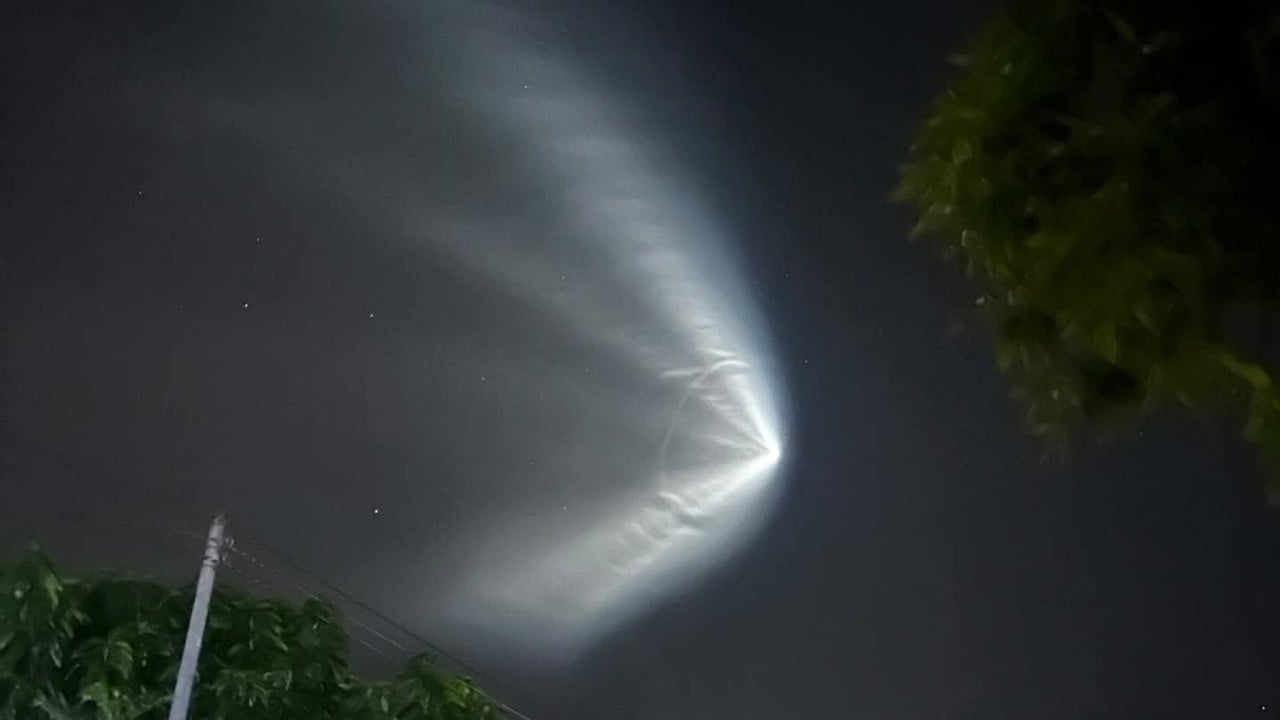
People across Sabah panicked when a strange, glowing, bioluminescent shape resembling a cosmic jellyfish tore through the night sky. Social media lit up instantly with wild theories. Was it an invasion? Some folklore-inspired apparition like the local balan-balan? Absolutely not. Space agencies and officials quickly confirmed the truth: it was the exhaust plume of a Chinese rocket launch catching the high-altitude sun.
If you missed the commotion, you missed one of the most visually stunning optical illusions modern spaceflight has to offer. But why do rockets look like glowing marine life, and why do governments keep having to remind everyone that we aren't being visited by extraterrestrials?
The Science Behind the Space Jellyfish
The phenomenon isn't magic, and it's certainly not biology. It's pure physics mixed with atmospheric timing.
When a rocket like China's Long March series lifts off around dusk or dawn, something remarkable happens to its exhaust gases. On the ground, you're standing in total darkness as the sun has already dipped below the horizon. But hundreds of kilometers up in the upper atmosphere, the rocket enters a zone that is still fully illuminated by direct sunlight.
As the multi-stage booster burns through kerosene and liquid oxygen, it expels expanding clouds of exhaust gases and unburnt fuel particles. At extreme altitudes, where air pressure is virtually non-existent, these exhaust plumes expand rapidly into massive, billowing bubbles. When sunlight hits these expanding high-altitude gas clouds against the dark backdrop of space, they scatter the light brilliantly, creating a glowing, translucent "bell" and trailing tentacles that mimic a giant jellyfish.
It lasts only a few minutes before the rocket burns out or the plume disperses. By then, thousands of bewildered onlookers have already grabbed their phones to record what looks like a sci-fi portal opening overhead.
Why Space Debris and Luminous Plumes Are Becoming Routine
We are launching more rockets than ever before in human history. Commercial satellite constellations, scientific payloads, and national space programs mean global launch cadences have skyrocketed.
Because nations like China utilize major inland launch facilities such as the Taiyuan Satellite Launch Center, their flight paths often pass over international skies during twilight windows. This creates the exact lighting conditions required for a space jellyfish to be visible across massive geographic areas—stretching from mainland Asia down through Southeast Asia, including parts of Malaysia and the Philippines.
Yet, the light show is only half the conversation. The bigger issue is what happens after the lights go out.
Booster stages have to come down somewhere. While upper-atmosphere plumes are completely harmless, falling rocket bodies pose real logistical and safety concerns. Regulatory bodies like Malaysia's Ministry of Science, Technology and Innovation (MOSTI) and the Philippine Space Agency (PhilSA) routinely issue advisories warning citizens not to touch or collect suspected space debris. Spent rocket components can contain hazardous residual propellants like hydrazine and toxic hypergolic fuels.
Stopping the Panic Before It Starts
Every time a luminous plume drifts across populated areas, social media algorithms reward panic and sensationalism. UFO hashtags trend within minutes. Local folklore gets dragged into modern aerospace discussions.
Governments are forced to play catch-up, urging citizens to rely on official tracking data rather than online hysteria. The reality is that our night skies are going to get busier. As commercial and national space expansion accelerates, atmospheric light shows will become a regular feature of modern life.
Next time a glowing phantom drifts across the stars, don't look for little green men. Check the launch schedules. You're just watching humanity punch another hole into orbit.