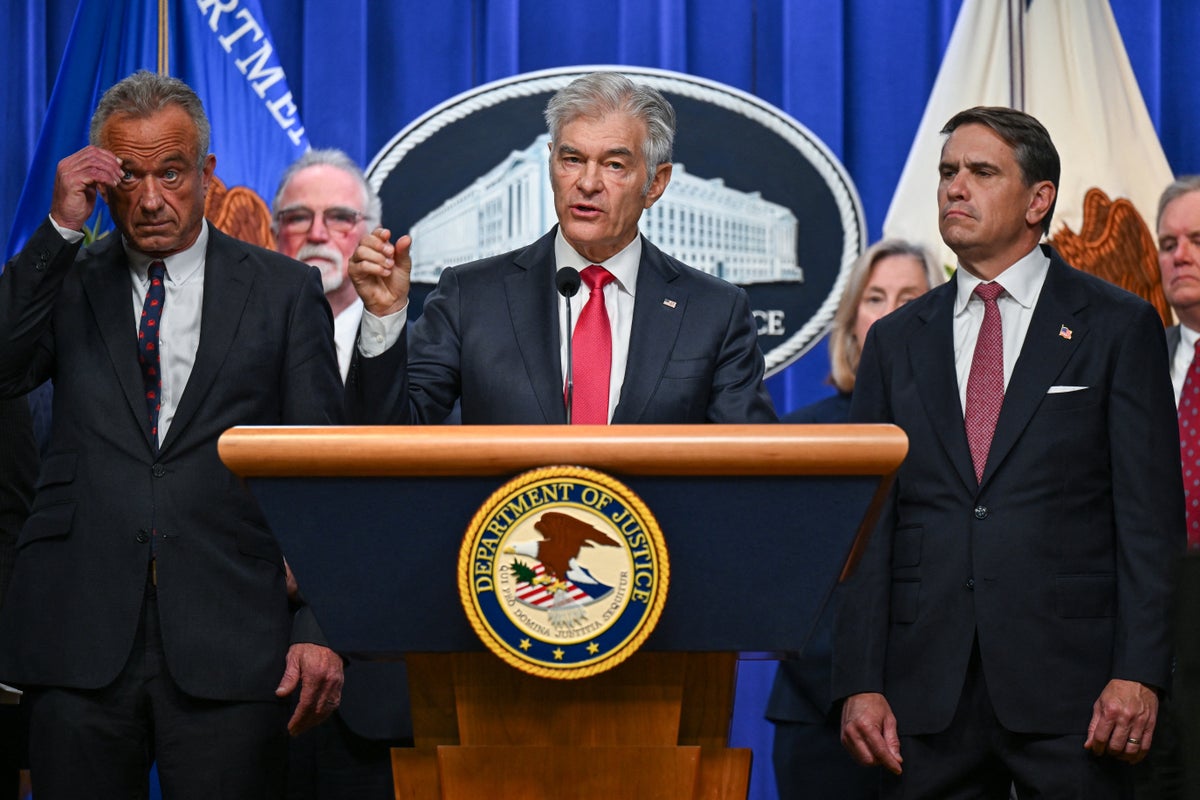
When a government agency announces a multi-billion-dollar criminal bust, the initial headlines usually sound the same. They focus entirely on the staggering cash totals and the sheer number of arrests. But when the Department of Justice announced it charged 455 people in a historic $6.5 billion healthcare fraud crackdown, they exposed a darker, more troubling reality. This wasn't just white-collar theft. It was a predatory system that cost real people their lives.
For years, the federal government operated on a reactionary model. They paid medical bills first and chased down the fraudsters after the taxpayer money had already vanished. This systemic weakness allowed hundreds of corrupt operators, including 90 licensed medical professionals, to treat vulnerable patients like open checkbooks.
The main topic keyword here isn't just the jaw-dropping $6.5 billion figure. It's the absolute betrayal of human trust by individuals holding medical licenses.
The Lethal Cost of Medical Rubber Stamping
Take the case of Jason Finkelstein, a 53-year-old Texas cardiologist charged in Florida for an $89 million slice of this fraud puzzle. His company targeted college athletic programs, preying directly on the terrifying fear that a young athlete might collapse and die of sudden cardiac arrest on the court.
Finkelstein and his co-conspirators blasted out deceptive emails to college athletic trainers across the country, promising free cardiac screenings to clear students for competition. But the screenings weren't free to insurance companies. To get paid, Finkelstein allegedly slapped fake diagnoses like hypertension or high blood pressure onto healthy young kids who didn't have a single symptom. Unqualified sonographers traveled to campuses to run the tests, and Finkelstein, licensed in 48 states, allegedly rubber-stamped the results from afar.
The indictment reveals a chilling level of indifference. In one instance, Finkelstein signed off on 63 diagnostic images for a single patient in just 11 seconds. He never actually looked at them. The images actually showed a severely enlarged heart. Because of that 11-second rubber stamp, the teenage basketball player went back out on the court completely unaware of his condition.
He died on the court.
Finkelstein even caught himself in a moment of clarity, telling a co-conspirator via text, "These kids could be high risk... One of them drops dead on a field, they're coming after both of us." Yet, the assembly line kept moving. As Dr. Mehmet Oz, head of the Centers for Medicare and Medicaid Services (CMS) put it, this wasn't medicine. It was a predatory scheme dressed up in medical clothing.
Beyond the Numbers: From Fake Wound Care to Post-Mortem Billing
If you think the cardiac testing scheme is an isolated horror story, look at the rest of the DOJ's massive 14-day operation. The greed takes forms that seem too ghoulish to be true.
In Los Angeles, a healthcare business owner named Oren David Shachar allegedly paid bribes to enroll people into hospice care who weren't even terminally ill. When patients actually did pass away, the operation didn't stop billing. Shachar allegedly bought the identities of deceased Medicare beneficiaries from a corrupt funeral home worker, created backdated, fake medical records, and billed the government for hospice care long after the individuals were buried. The scheme brought in $26.9 million in real taxpayer money.
Meanwhile, a nurse practitioner in Texas engineered a $906 million plot involving completely unnecessary allografts (skin grafts used for severe wounds). Her crew took basic medical materials, relabeled them at a 2,000% markup, and billed Medicare an average of $1 million per patient.
What happens when billions of dollars pour into these schemes? The money funds a grotesque display of luxury assets:
- A $4.6 million private beach resort constructed in the Philippines.
- An $865,000 custom Bulgari necklace.
- A Ferrari 296 GTS, a Maserati, and a Bentley Continental GT.
- Over $30 million sitting cold in single bank accounts.
Federal agents ultimately seized $127 million in cash and luxury items during the sweep, but that is a drop in the bucket compared to the $6.5 billion billed to the public.
Why the Old Way of Fighting Healthcare Fraud Failed
For decades, the Department of Health and Human Services (HHS) relied on the "pay-and-chase" method. Insurance companies and government programs prioritized processing claims quickly to ensure legitimate providers got paid. Investigators tried to spot anomalies later, launching lengthy investigations years after the cash left the building.
Fraudsters knew this. They flew under the radar by changing corporate names, moving assets overseas, or fleeing the country entirely when things got hot. FBI Director Kash Patel noted that international safe havens are shrinking, pointing to recent arrests of major healthcare fugitives tracked down in Turkey and the Philippines.
The federal government is shifting toward a proactive, preventative system. By deploying data analytics and tracking software, agencies can flag bizarre patterns before checks are cut. When an individual doctor approves complex cardiac scans in 11 seconds flat, or when a hospice facility bills for a patient who has a death certificate on file, the system needs to freeze the money immediately.
Protect Yourself from Medical Exploitation
You don't have to be a corporate auditor to spot healthcare corruption. Most of these massive multi-million-dollar schemes start with individual patient files. If you want to protect your own identity and keep predatory clinics honest, take these steps right now:
- Audit your Explanation of Benefits (EOB). Every time you visit a doctor or have a test done, your insurer sends an EOB statement. Don't throw it in the trash. Open it and check the line items. Look for diagnostic codes or procedures you never received. If you see a charge for a complex specialist consultation when you only had a five-minute checkup, flag it immediately.
- Beware of "Free" Medical Screenings. Whether it is a mobile clinic at a health fair, a genetic testing booth at a community center, or an athletic screening camp, always ask who is paying for the service. If they demand your Medicare, Medicaid, or private insurance card for a "free" test, walk away. They are often looking for insurance numbers to run high-volume billing scams.
- Report Suspicious Practices Directly. If you suspect a clinic or provider is gaming the system, report it. You can submit tips anonymously to the HHS Office of Inspector General at 1-800-HHS-TIPS.
The DOJ's historic crackdown proves that the financial cost of healthcare fraud is devastating, but the human toll is entirely unacceptable. When clinicians look at diagnostic files and see dollar signs instead of human hearts, the entire system breaks down. It is time to stop chasing the money and start locking the doors.
The Department of Justice continues to track down individuals involved in these multi-billion-dollar medical rings. To understand how federal investigators piece together these massive data trails and coordinate multi-agency sweeps across dozens of states, watch this Detailed Federal Briefing on the Healthcare Takedown which lays out the exact mechanics of the transition away from the failed pay-and-chase enforcement model.