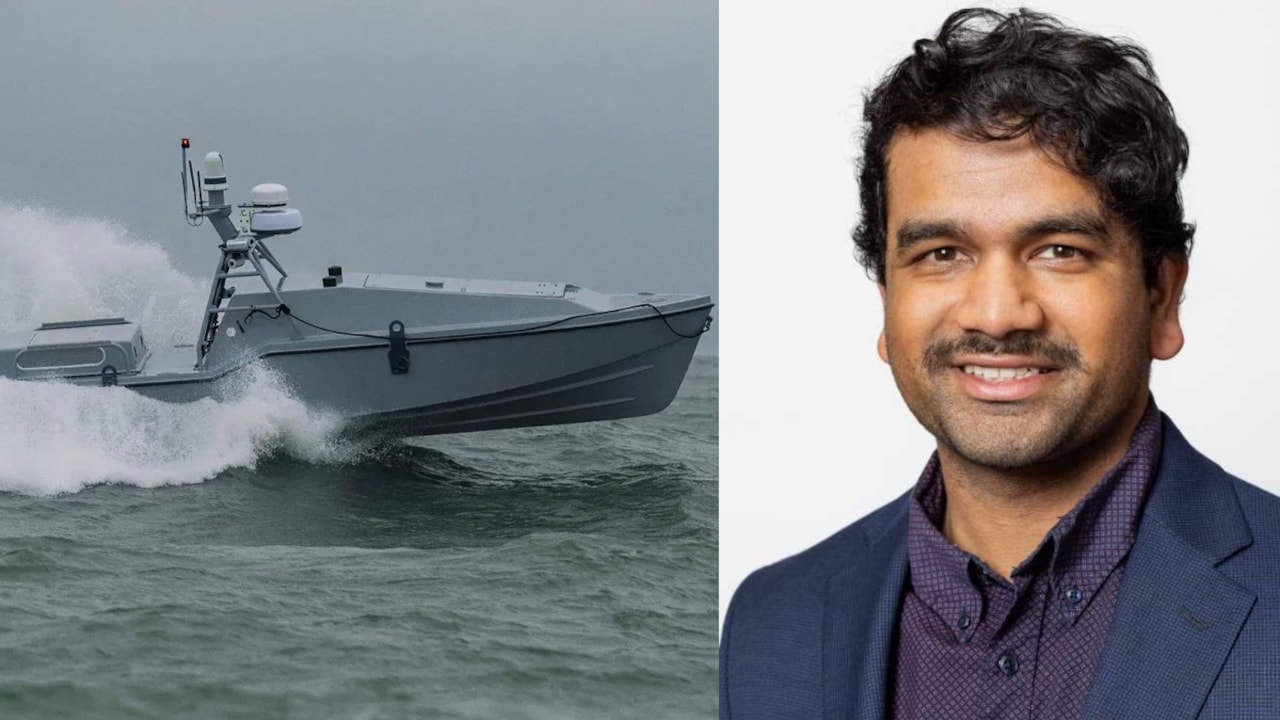
A US Army AH-64 Apache gunship went down in the pitch-black darkness off the coast of Oman. It was 3:30 AM. Two American aviators were floating in the treacherous waters of the Strait of Hormuz, a volatile chokepoint heavily monitored by hostile forces. Historically, this scenario triggered an immediate, high-stakes manned search-and-rescue operation. Flying helicopters into contested airspace or risking a multi-million dollar manned naval vessel to pluck downed pilots from the water is a massive gamble.
This time, things went differently.
A 24-foot autonomous boat named Corsair sliced through the waves at speeds hitting 35 knots. It located the stranded aviators, hauled them aboard, and ferried them safely to a secondary location where a helicopter scooped them up. No extra American lives were risked in the search phase.
This marks the first time the US military has ever executed a personnel recovery mission at sea using an autonomous surface vessel.
The brains behind the software driving this historical pivot is Vibhav Altekar, an Indian-American perception engineer. He's the co-founder and Chief Technology Officer of Saronic Technologies, the Austin-based defense tech startup that built the Corsair.
Here is what the mainstream media missed about this rescue, how the technology actually works, and why it signals a permanent shift in naval strategy.
The Tech Behind the Corsair Sea Drone
Most news outlets are treating this like a neat remote-control boat story. It isn't. The Corsair is a highly autonomous platform designed to operate in environments where communication lines are constantly threatened.
Altekar, an electrical engineering graduate from the University of California, spent his career specialized in perception engineering. He was one of the early engineers at Palmer Luckey’s Anduril Industries, where he led engineering teams for projects like the Royal Australian Navy’s Ghost Shark drone submarine. At Saronic, his job is to build the software architecture that lets a boat "see" and interpret the ocean in real-time.
Navigating a sea drone isn't like programming an aerial drone. Airplanes operate in relatively empty space. Boats have to deal with constantly shifting waves, radar clutter, floating debris, changing currents, and unpredictable maritime traffic.
The Corsair relies on a heavy stack of sensors, computer vision, and machine learning models to identify objects—like two human heads bobbing in dark water—while maintaining its course.
Let’s look at the baseline specifications of the craft used in the Hormuz rescue:
- Length: 24 feet (7.3 meters)
- Propulsion: Diesel engine
- Top Speed: 35 knots
- Payload Capacity: Up to 1,000 pounds
- Operational Range: Exceeds 1,000 nautical miles
The vessel was deployed under the US Navy’s Task Force 59. Based in Bahrain, this unit serves as the Navy’s operational testbed for uncrewed systems and artificial intelligence in the Middle East. They only started fielding the Corsair in late March. Just over two months later, the tech saved two lives.
Why Software Mattered More Than Hardware in Hormuz
The US military has used remote-operated vehicles for decades. The distinction here is the level of autonomy and the integration of perception software. Captain Tim Hawkins, a spokesperson for US Central Command, noted that the vessel was remotely piloted by a human operator. However, "remote piloting" in modern autonomous defense tech doesn't mean a sailor is steering with a joystick via a camera feed.
Satellite communication links in the Strait of Hormuz are notoriously subject to electronic warfare, jamming, and spoofing.
Altekar’s software architecture uses edge computing. The machine handles the micro-navigation, stability, object detection, and collision avoidance locally on the boat. The human operator provides high-level command and control instructions. If the satellite link drops for five minutes due to Iranian jamming, the boat doesn't sit dead in the water or spin in circles. It keeps executing its search pattern, identifies targets, and stays on mission.
The rescue shows that autonomous hardware is finally cheap, fast, and reliable enough to deploy in active combat zones. Saronic Technologies, founded in September 2022 by former Navy SEAL Dino Mavrookas, Doug Lambert, Rob Lehman, and Altekar, recently secured a $392 million production contract with the US Navy. That level of funding reflects a massive shift in how the Pentagon views naval procurement. They are moving away from traditional defense giants building multi-billion dollar legacy ships, shifting focus toward software-first startups that build cheap, mass-producible drone fleets.
The Geopolitical Stakes in the Gulf
The Apache crash happened during a period of extreme friction. Tensions between the US, Israel, and Iran are at a boiling point, threatening a fragile ceasefire. Iran has repeatedly attempted to restrict commercial traffic through the Strait of Hormuz. The US military uses Apache gunships, MQ-9 Reaper drones, and F-35 fighter jets to enforce blockades and protect shipping lanes.
When an asset like an Apache goes down, time is your biggest enemy. If Iranian forces had reached those pilots first, the situation would have turned into a massive geopolitical hostage crisis.
Sending a traditional Navy destroyer into shallow, contested coastal waters to hunt for two pilots exposes a billion-dollar asset and hundreds of crew members to anti-ship missiles or swarming fast-attack craft.
Deploying a 24-foot diesel drone minimizes that vulnerability completely. It is small, exceptionally difficult to track on radar, and entirely expendable. If the enemy shoots it down, you lose some fiberglass and a engine block, not an entire crew.
What Happens Next for Autonomous Naval Warfare
The successful recovery of the Apache crew confirms that the Pentagon's Replicator initiative—an effort to field thousands of cheap, autonomous attritable drones—is no longer just a theoretical concept.
The Navy intends to scale production to deploy hundreds, and eventually thousands, of these Corsair drones across global chokepoints.
Expect to see these autonomous surface vessels take over three specific operational areas immediately:
- Passive Intelligence and Reconnaissance: Sitting silently in shipping lanes, tracking adversary ship movements without burning massive amounts of aviation fuel.
- Mine Countermeasures: Scanning chokepoints for naval mines without risking manned minesweepers.
- Logistics and Fleet Resupply: Moving small payloads, ammunition, or medical supplies between larger ships or isolated island outposts.
The Hormuz incident proved that software built by commercial tech veterans can transition straight into high-stakes military rescue operations without missing a beat. If you want to follow where naval defense is heading, stop looking at giant aircraft carriers. Look at the small, autonomous diesel boats running algorithms in the dark.