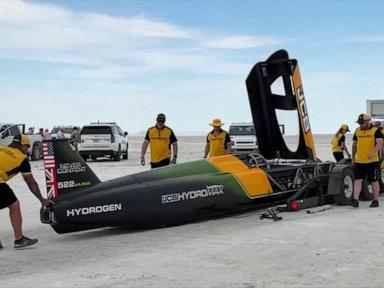
When retired Royal Air Force fighter pilot Andy Green strapped himself into a 32-foot pencil-shaped carbon machine on the Bonneville Salt Flats, he wasn't just chasing a shiny new number. He was proving that hydrogen combustion can move mountains—or in this case, fly across a prehistoric lake bed at a staggering average of 406.320 mph.
Forget what you've heard about alternative fuels being sluggish or boring. The JCB Hydromax just obliterated the previous FIA world land speed record for hydrogen vehicles, completely shredding the old mark of 185.5 mph set by the BMW H2R way back in 2004. It also blew past the 350.092 mph diesel record that Green himself set twenty years prior in the JCB Dieselmax.
If you're wondering how a vehicle fueled by gas-state hydrogen manages to outrun most traditional hypercars, you have to look under the hood. Or rather, beneath the sleek yellow shell.
The Muscle Behind the Machine
[Image of hydrogen fuel cell]
This isn't some experimental, one-off space rocket built in a vacuum. The Hydromax relies on two production-based hydrogen internal combustion engines derived directly from standard machinery engines used in heavy construction equipment. Together, they push out a combined 1,600 horsepower.
Instead of burning fossil fuels, these engines mix pressurized hydrogen gas with air, igniting it to create massive bursts of zero-emissions power. It's a pragmatic approach to green tech. JCB didn't build a hyper-exotic powertrain from scratch; they took standard heavy-duty engineering principles, scaled them up, and dropped them into an extreme aerodynamic chassis.
The execution on the salt flats required surgical precision. Under FIA regulations, a true land speed record isn't about one lucky downhill burst. You have to complete two runs—one in each direction across a measured mile within a single hour—and take the mathematical average.
Green's first run clocked an intense 400.623 mph. After turning the sleek machine around, he hammered down the return path at an even wilder 412.135 mph. The final average landed cleanly at 406.320 mph.
Why This Record Matters More Than You Think
Skeptics love to claim that alternative fuels lack soul or high-performance application. This run completely dismantles that argument.
Andy Green is uniquely qualified to bridge this gap. Back in 1997, he set the absolute land speed record of 763.035 mph in the jet-engined ThrustSSC, cementing his status as the only human being to officially break the sound barrier on land. When a driver of that caliber praises a vehicle's stability at over 400 mph, engineers listen.
"The car was magnificent, stable, strong and fast. To set a world record with hydrogen, twenty years after Dieselmax, is a privilege," Green noted after stepping out of the cockpit.
The implications stretch far beyond a trophy for the mantelpiece. Heavy industries, construction fleets, and commercial transport sectors are desperately searching for viable alternatives to diesel that don't rely entirely on massive, heavy battery packs. Hydrogen internal combustion engines offer a direct drop-in path for existing manufacturing lines, proving that zero-emission tech can handle brutal workloads and extreme environments without breaking a sweat.
What Comes Next for Alternative Speed
The Bonneville Salt Flats have always acted as a brutal proving ground for human ambition. The surface is a low-friction, sun-baked crust sitting over a shallow brine layer that cools tires from underneath. It's unforgiving, unpredictable, and completely merciless to mechanical failure.
The Hydromax didn't just survive this environment; it mastered it. By proving that hydrogen-fueled combustion can safely clear the 400 mph threshold, the engineering team has forced major automotive players to rethink what's possible outside of traditional battery-electric platforms.
You're going to see these propulsion insights trickle down into heavy transport faster than expected. The era of high-speed hydrogen isn't sitting decades away in some corporate PowerPoint presentation. It's already clocked over 400 mph in the middle of the Utah desert.