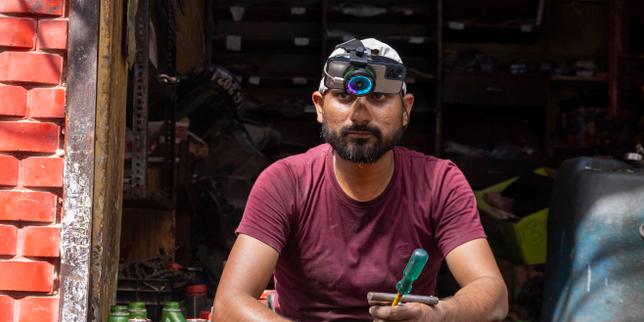
You’re a tailor in a bustling Indian market. You’ve spent decades perfecting the way you fold fabric, the exact pressure of your shears, and the rhythm of your stitch. Today, a representative from a tech firm offers you a few extra rupees to wear a head-mounted camera and record your every move. You say yes. You need the money. You don't realize you're capturing the blueprint for your own replacement.
This isn't a futuristic scenario from a sci-fi novel. It’s happening right now across India. From neighborhood barbers and street-side mechanics to skilled artisans, everyday laborers are being recruited to provide the "training data" that fuels the next generation of humanoid robots and automated systems.
The mechanics of the trap
Data is the lifeblood of artificial intelligence. To teach a robot how to perform a task, you can’t just write code; you need to show it thousands of examples. You need to capture the nuances of human movement—the way a mechanic navigates a cramped engine bay or how a coiffeur holds a pair of scissors.
These companies aren't looking for high-level engineering data. They’re looking for the messy, unscripted reality of manual labor. They pay local workers to film their shifts, capturing the precise physical gestures that make them experts in their fields. Once that video is uploaded and processed, the AI learns to replicate those gestures.
Basically, the worker is being paid a small fee to teach a machine how to do their job without them. It’s a transaction that provides immediate relief for a worker struggling with low margins, but it creates a long-term existential threat to their livelihood.
Why this is different from the industrial revolution
Some argue that technology always replaces old jobs with new ones. They point to the shift from farms to factories as proof that we’ll be fine. But this current wave of automation is different.
In the past, machines replaced human muscle, but they still required human guidance. You needed someone to operate the tractor or manage the assembly line. Today, the target is the gestural intelligence of the worker. When an AI can replicate the exact movements of a skilled tailor or a barber, you don't just need a new kind of worker; you potentially don't need a worker at all.
This creates a brutal economic paradox. The people who are most vulnerable to automation are being recruited to speed up the process of their own obsolescence. They are essentially digging their own professional graves for the price of a daily wage.
The human cost of data collection
I’ve seen how these data collection operations work on the ground. They are often opaque, run by third-party contractors who promise a quick payday with little explanation of the end goal. A worker might see the recording as just another "gig" in a gig economy—a way to bridge the gap between lean months.
The tech companies view this as "neutral data acquisition." To them, it’s just processing information to improve model efficiency. But for the individual, it’s the erosion of a craft. When the unique "human touch" of a local expert is digitized, it becomes a commodity that can be replicated infinitely by a machine in a warehouse.
What happens when the job disappears
The immediate fallout is clear: lower wages for those who rely on physical labor and the eventual erosion of traditional trades. But the secondary effect is the potential collapse of the local economy.
If you automate the neighborhood barber or the local mechanic, you aren't just changing a job description. You’re removing a pillar of a community’s social and economic structure. These are jobs that provide stability and dignity to millions of families. If they vanish, the vacuum isn't automatically filled with high-paying software engineering roles. It’s often filled with nothing.
Looking ahead
We have to stop viewing this as just "technological progress." It’s an economic transformation that is happening without a safety net. The current model relies on the assumption that individuals will adapt, but what happens when the very skills that define them are being harvested for profit by the very systems that will replace them?
If you're a worker in these sectors, be wary of contracts that ask you to document your expertise. Ask where the data is going. Ask how it will be used. Transparency is the only leverage you have.
We need to rethink how we value human labor in the age of AI. If an algorithm is built on the back of someone’s life-long expertise, that person deserves more than a one-time payment. They deserve a seat at the table. If we keep moving down this path, we won't just be building smarter machines; we'll be dismantling the human workforce one video frame at a time. The shift is already here. It’s time to pay attention to who pays the price.