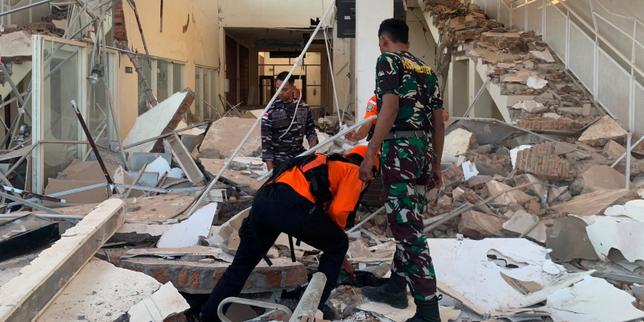
The ground didn't just shake today in Indonesia; it reminded everyone living on the Pacific Ring of Fire exactly how fragile their existence is. A massive 7.7 magnitude earthquake struck off the coast of Flores early Saturday morning. While initial reports from some outlets claimed a lower death toll, current assessments from the region suggest at least 20 people have lost their lives.
If you’re watching the news, you’ll see the word "tsunami" pop up and then vanish. Let’s get one thing clear: the tsunami warning was lifted quickly. But for the people in Nagekeo and surrounding areas on Flores Island, that brief window of terror is something they know all too well.
Living on the Edge of the World
You might wonder why Indonesia seems to be in a constant state of seismic emergency. It’s not a coincidence. The archipelago sits right on the collision point of several tectonic plates. This isn't just "frequent activity." It’s a relentless, geologic grinding that dictates everything about life here, from how houses are built to how people sleep at night.
Honestly, the locals are experts in disaster management by necessity. When the sirens go off, people don't wait for official confirmation to run to higher ground. They’ve learned that in a magnitude 7.7 event, hesitation is a death sentence. The memory of 2018 in Palu—where a 7.5 magnitude quake and the subsequent tsunami killed over 2,000 people—is still very fresh for many.
The Reality of the Flores Earthquake
This specific event hit near Mbay, and the depth of the rupture matters immensely. When a quake is shallow, the energy doesn't have much rock to travel through before hitting the surface. That’s why the shaking was felt so violently across the region.
Here is what is actually happening on the ground:
- Infrastructure Damage: Beyond the tragic loss of life, hundreds of structures are likely compromised. Traditional masonry in these remote areas just doesn't stand a chance against that kind of lateral force.
- Panic and Evacuation: The immediate aftermath is always the most chaotic. Thousands of people are currently camping in the streets or open fields, terrified that a larger aftershock might bring down what’s left of their homes.
- Rescue Operations: Emergency teams from the National Agency for Disaster Management (Basarnas) are currently trying to reach the most isolated pockets of Flores. The geography makes this a logistical nightmare.
Why Official Numbers Fluctuate
You’ll see different headlines today—some saying two deaths, others saying twenty. Don't assume the media is lying. In the first few hours after a massive quake, information is fragmented. Reports often come from localized village leaders who are currently trying to dig through rubble with their bare hands. They aren't filing spreadsheets; they are performing triage. As communication lines are restored, these numbers almost always climb. It’s a brutal, repetitive cycle.
What You Should Know About Seismic Preparedness
If you ever find yourself traveling through regions like Nusa Tenggara, don't just admire the view. Pay attention to the geography.
- Know the Escape Routes: In coastal towns, look for signs indicating tsunami evacuation routes. They aren't there for decoration.
- Listen to the Local Authorities: Indonesia’s meteorology agency (BMKG) is world-class at monitoring these events. If they say move, you move. Period.
- Understand the Risk: Most buildings in these rural zones aren't reinforced. If you're staying in a hotel or guesthouse, identify the strongest structural points—usually near load-bearing columns—and know where the nearest open-air exit is.
This morning’s tragedy in Flores is another stark reminder that nature doesn't care about our schedules or our economic development. The Ring of Fire will continue to shift. The buildings will continue to fall. The only thing that changes is how prepared the communities are when the next one hits. For now, the focus in Nagekeo is survival. Everything else—the reconstruction, the investigations, the long-term planning—starts once the ground finally stops moving.