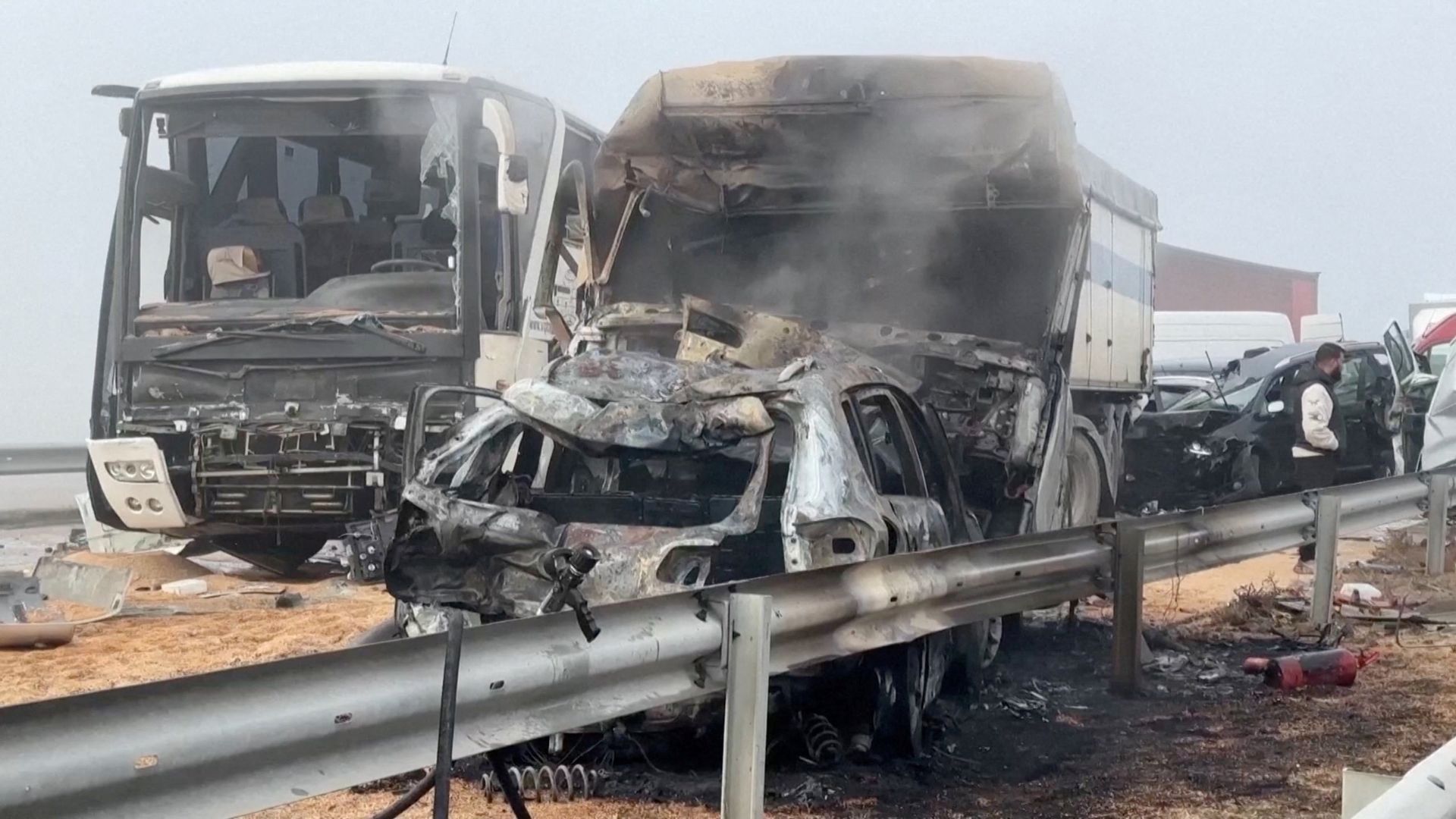
Twelve people are dead and nearly fifty others are injured following a catastrophic chain-reaction pile-up on one of Europe's most vital transit corridors. If you drive fast in changing weather, you're playing a dangerous game with physics. Tuesday morning on the Trakia Motorway in eastern Bulgaria proved just how fast a routine commute can turn into a war zone.
Heavy fog dropped visibility down to barely ten meters near the town of Zimnitsa. What followed was a multi-vehicle nightmare involving roughly 86 cars and heavy trucks crashing into each other across opposing carriageways. You might also find this connected coverage insightful: Why China's New Anti-corruption Law Has Overseas Critics Terrified.
The Anatomy of a Highway Disaster
The tragedy unfolded in two distinct waves. The first massive pile-up occurred on the eastbound stretch toward the Black Sea port of Burgas, triggered by a sudden, severe drop in visibility. Drivers moving at highway speeds had seconds—sometimes milliseconds—to react to a wall of gray mist.
Once the initial crash happened, rubbernecking and sudden braking on the opposite Sofia-bound carriageway created a secondary disaster. Drivers looking across the median or reacting to the sudden chaos ahead slammed straight into one another. As highlighted in latest reports by The Guardian, the implications are worth noting.
Health Minister Katya Ivkova confirmed that 10 people died instantly at the scene, while two others succumbed to their injuries while being rushed to regional hospitals in Sliven, Yambol, and Burgas. Emergency responders described a horrific scene where ambulances struggled to penetrate the center of the wreckage, forcing paramedics to carry victims out on stretchers through lines of smashed metal and burnt-out vehicles.
Why Fog Crashes Are So Unforgiving
Most drivers think they know how to handle bad weather. They turn on their headlights, maybe slow down by five miles per hour, and keep driving with total confidence. That's a fatal mistake.
Dense fog behaves differently than rain or snow. It plays tricks on your depth perception and eliminates your horizon. When visibility drops from a comfortable eighty meters to ten meters in a matter of seconds, your stopping distance evaporates.
If you're traveling at 90 kilometers per hour, you are covering 25 meters every single second. In a dense fog bank, you will hit an obstacle before your brain even registers that your foot needs to hit the brake pedal.
Prime Minister Rumen Radev called it a dark day for the country, cutting short a press conference with European Commission President Ursula von der Leyen to visit the site. President Yotova even cut short her participation in the Paris Peace Forum to fly back home. The government quickly declared a national day of mourning to honor the victims.
The Reality of Infrastructure and Driver Behavior
Critics point out that Bulgarian roads have historically faced serious safety challenges within the European Union. But infrastructure alone doesn't cause a crash involving nearly 90 vehicles. Driver behavior does.
We follow too closely. We trust cruise control in bad conditions. We fail to realize that visibility isn't just about seeing what's fifty yards ahead—it's about giving yourself enough room to stop when the invisible wall appears.
If you ever find yourself driving into a sudden bank of thick fog on a motorway, don't just tap your brakes. Turn on your rear fog lights, pull completely off the active lanes of traffic if a rest stop or shoulder is safely available, and wait it out. Driving blind into whiteout conditions is a gamble you will eventually lose.