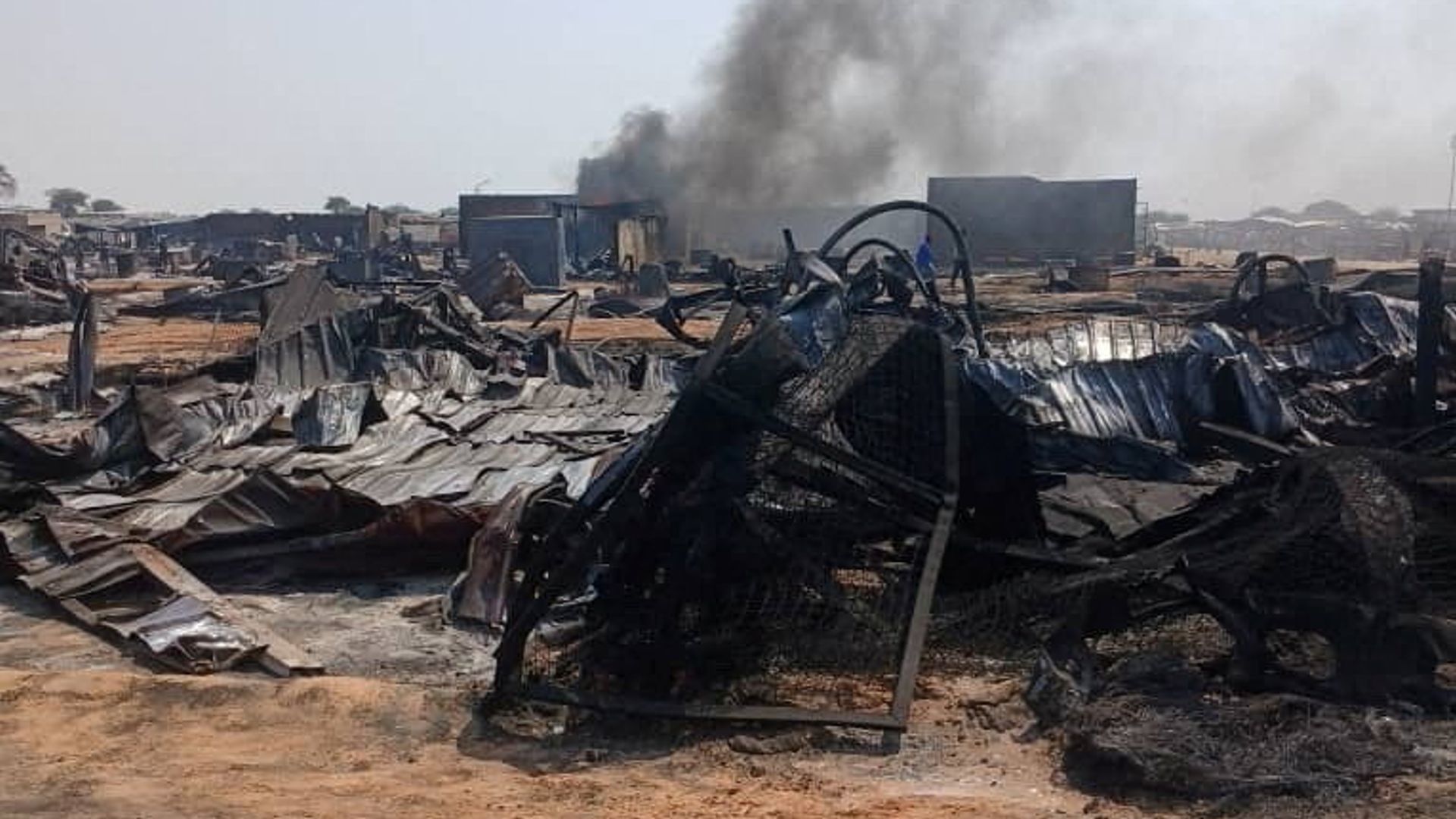
War doesn't respect borders, especially when those borders are already contested. A devastating drone strike on the crowded Amiet market in the disputed Abyei region left at least 153 people dead, pushing the local death toll from recent escalations past 250 in one of the bloodiest weeks of Sudan's ongoing civil war.
If you are trying to understand why this specific attack matters beyond the raw numbers, you need to look at the fragile geography where Sudan and South Sudan meet. Abyei is oil-rich, jointly administered, and claimed by both nations since South Sudan's independence in 2011. When drone warfare spills into a busy commercial hub full of civilians, the consequences are immediate and catastrophic.
What Happened at the Amiet Market
The attack struck without warning at around 11 a.m. on a Monday. Witnesses reported hearing five massive explosions tear through the marketplace. The blasts ignited a local fuel storage facility, creating an inferno that trapped shoppers, vendors, and commuters.
The human cost quickly overwhelmed local responders. Yohana Akol Ngor, Abyei's caretaker information minister, reported that victims suffered horrific shrapnel and burn injuries. Some bodies were charred beyond recognition, forcing authorities to conduct mass burials.
Beyond the casualties, the humanitarian fallout is severe. Local officials estimate that around 8,000 residents have been displaced. Families are now sleeping out in the open or beneath trees, desperate for safety while basic infrastructure lies in ruins.
Conflicting Claims and Military Justifications
Whenever a strike of this magnitude occurs, the narrative splits immediately. Accountability becomes a weapon of its own.
Local authorities and South Sudanese officials immediately laid blame on the Sudanese Armed Forces (SAF). They argued that targeting a bustling marketplace full of civilian merchants selling flour, sugar, and basic household goods violates basic rules of engagement.
On the other side, an anonymous senior Sudanese military officer defended the operation to reporters. The military acknowledged conducting a drone strike in the area but insisted the target was legitimate. According to their account, the strike hit fuel tankers and depots allegedly used to supply the paramilitary Rapid Support Forces (RSF), which has been locked in a brutal conflict with the army since April 2023.
"We do not target civilians," the military official maintained, claiming those killed were fighters or individuals involved in illicit fuel smuggling.
Independent witnesses on the ground strongly disputed that version of events. They reported seeing no uniformed personnel or RSF fighters in the market—only ordinary people trying to survive a crumbling economy. Meanwhile, diplomatic sources noted that while the fuel depot had historically seen use by paramilitary supply lines, its active military status at the exact moment of the strike remains unverified.
The Broader Humanitarian and Medical Crisis
Medical facilities near the border are buckling under the pressure. Médecins Sans Frontières (MSF) rushed dozens of critical patients to Ameth Bek Hospital. Doctors treated severe burns and deep shrapnel wounds on patients lying on hospital floors due to overcrowding.
Dr. Christian Lindauer, MSF's medical activities manager, warned that attacks on civilian areas make it nearly impossible for vulnerable populations to access healthcare or life-saving supplies.
The international community has reacted with sharp condemnation. United Nations Secretary-General António Guterres called out the relentless drone strikes tearing through civilian infrastructure across Sudan. In response to the bloodshed, South Sudan's foreign ministry summoned Sudan's ambassador to lodge a formal protest.
Why Abyei Remains a Powder Keg
To grasp why this attack happened in Abyei, you have to look at the demographic and political fault lines running through the territory.
- The Ngok Dinka population predominantly leans toward joining South Sudan.
- The Misseriya nomads rely on local seasonal pastures and favor Sudan.
- The RSF presence in neighboring Kordofan has increasingly pulled the neutral zone into active military calculations.
This mix creates a dangerous vacuum. When national armies view border territories as logistical corridors for rivals, civilian populations pay the ultimate price.
What Comes Next for the Region
The immediate priority on the ground remains search-and-rescue operations, treating the injured, and housing thousands of newly displaced families. However, without a binding political settlement or enforceable ceasefires protecting humanitarian zones, strikes like the one at Amiet market will keep happening.
The diplomatic fallout between Khartoum and Juba will likely deepen, freezing any cooperative management of the oil fields both countries desperately need. If you're tracking the trajectory of this conflict, watch the border corridors closely. When disputed territories turn into battlegrounds, peace moves further out of reach.