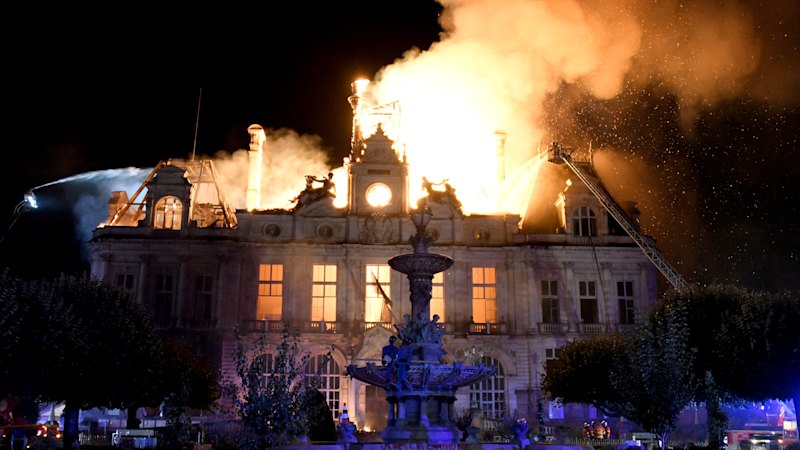
When elite tactical units broke down the door of a home in rural France on Tuesday morning, they weren't just arresting an individual. They were capping off a manhunt for the suspected mastermind behind one of the most shocking acts of civil destruction in recent European memory: the burning down of a 143-year-old town hall in Limoges.
The suspect, 34-year-old Hodei Ciarra Docampo, was filmed clad in a black balaclava, ski goggles, and a bucket hat, tending to a ferocious blaze that ultimately collapsed the building’s neo-renaissance clock tower. But what makes this case far more than a routine criminal investigation is the deep-seated network of militant family history, transnational extremist cells, and urban insurrection that security forces are now rushing to unpack across Europe.
A Family Tradition of Arson
If you're wondering how someone gets to the point of putting a torch to a century-old municipal landmark, you only need to look at the family dinner table. Ciarra Docampo's father is Fernando Ciarra, a 70-year-old Basque separatist who was sentenced to three years in prison last April for a series of calculated arson attacks in Limoges. The older Ciarra didn't just dabble in protest; court records and investigative reports show he torched multiple utility vehicles belonging to the national electricity distributor, targeted broadcast stations, and hit mobile phone towers.
When your father treats industrial arson as a political hobby, breaking the law starts looking like a family business. French prosecutors note that the younger Ciarra wasn't acting as a lone wolf swept up in the heat of the moment. He had existing links to radical environmental and ultra-left groupings like Les Soulèvements de la Terre (The Uprise of the Earth), and he was already logged on French terror watch lists following a previous conviction for assaulting a police officer during a protest at a wood pellet factory.
How a Protest Turns Into Urban Warfare
The destruction of the Limoges town hall didn't happen because someone threw a stray cigarette into a recycling bin. Local officials have pointed out that you don't reduce a historic stone structure to ash in a few hours using a cheap disposable lighter.
According to investigators, the attackers came prepared with commercial-grade fireworks, mortars, and heavy-duty battering rams. They didn't just march; they orchestrated a coordinated assault. Mayor Guillaume Guérin didn't mince words when describing the carnage, emphasizing that the far-left's fingerprints were all over the operation from the opening minute.
Intelligence agencies are now piecing together how nationwide cost-of-living protests and student demonstrations were aggressively hijacked by professional agitators. Security estimates suggest that roughly 5,000 violent extremist actors belonging to the "black bloc" umbrella were active on the ground during riots in Paris, Marseille, Lyon, and Limoges.
Transnational Anarchism and Foreign Agitators
Here is where the narrative shifts from local civil unrest to a wider European security crisis. Experts on political extremism point out that the violence seen on French streets wasn't entirely home-grown.
During the height of the riots, witnesses reported hearing distinct English and German accents among the masked crowds. Counter-terrorism analysts believe that radical anarchists traveled across borders from Germany, Belgium, the Netherlands, and Switzerland specifically to join the chaos. They didn't just hop on a spontaneous train ride; police believe they coordinated logistics, shared tactical data, and synchronized their arrivals to maximize institutional destruction.
Jean-Yves Camus, a leading political scientist specializing in extremism, notes that these groups operate without formal hierarchies, functioning instead as a fluid swarm of ideologically driven combatants whose primary goal is direct, violent confrontation with the state. They target symbols of capital, government authority, and municipal heritage because they want systemic collapse, not legislative reform.
The Broader Threat to European Stability
As French authorities evaluate the fallout, national security discussions are widening to include the risk of hostile foreign interference. When a country's internal social fabric frays this badly, opportunistic actors are never far behind.
Analysts from major defense think tanks have pointed out that geopolitical rivals like Russia or Iran stand to gain immensely from prolonged Western destabilization. Whether through automated social media amplification designed to deepen social fractures or more direct covert support, the chaos on European streets is viewed as a strategic goldmine for foreign intelligence services looking to weaken democratic institutions from within.
Ciarra Docampo now faces up to 20 years in prison if convicted of the Limoges arson. But locking up one man in a balaclava won't solve the wider vulnerability. Europe is waking up to the reality that its historic town halls, public squares, and democratic symbols are facing a new breed of transnational, ideologically hardened extremism that treats the destruction of heritage as a legitimate political statement.