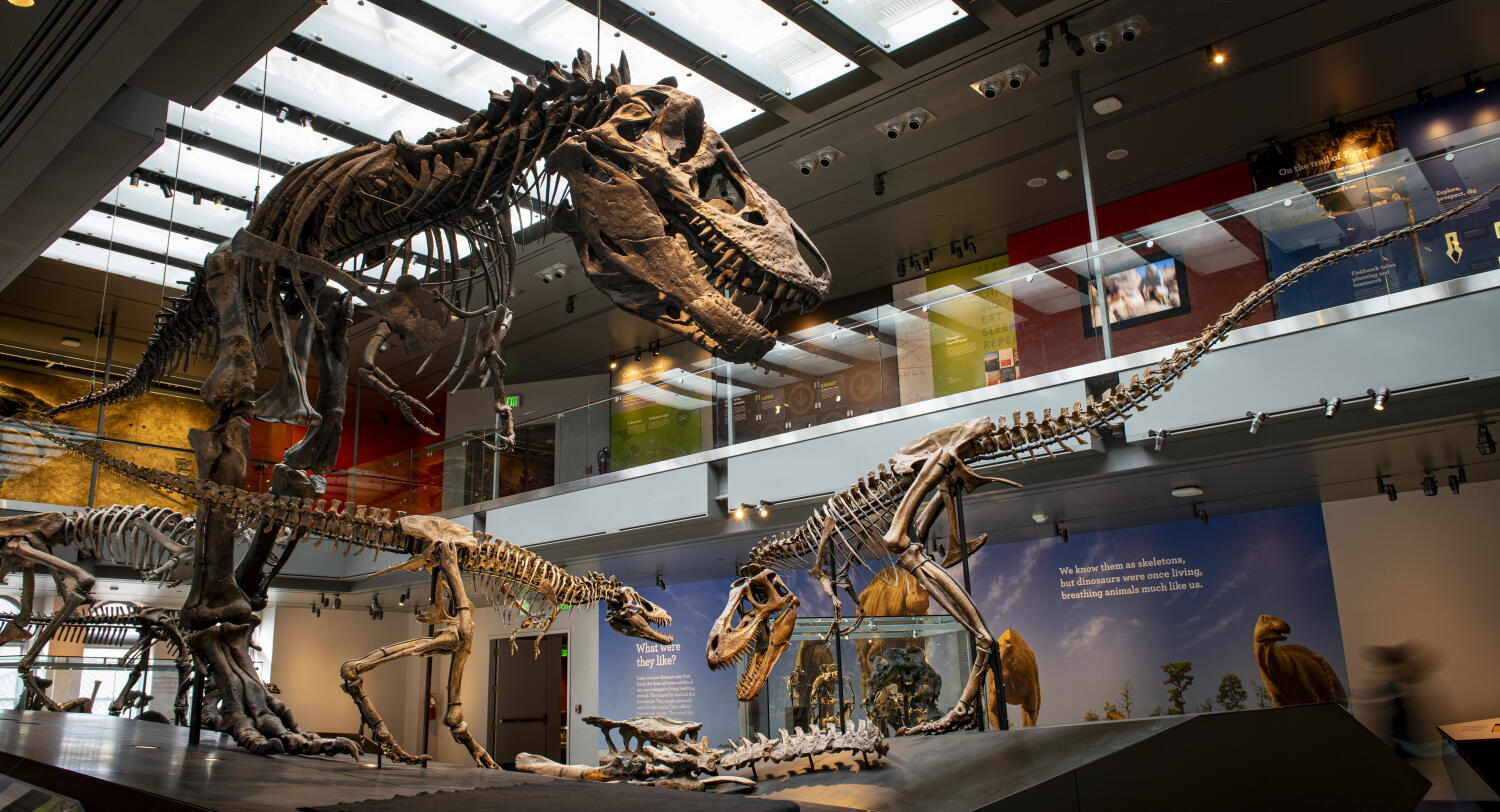
You’re running at roughly 97 degrees Fahrenheit right now. It turns out the king of the tyrant lizards was doing the exact same thing.
For decades, paleontologists argued endlessly over whether a Tyrannosaurus rex baked in the sun like an overgrown lizard or burned through internal fuel like a modern bird or mammal. A study published in Science Advances by researchers at UCLA finally answers that question with hard numbers. By analyzing rare carbon-oxygen chemical bonds locked inside fossilized tooth enamel from a Montana specimen known as "Thomas," scientists nailed down the core body temperature of a T. rex at 36 degrees Celsius, or about 97.3 degrees Fahrenheit.
You share an internal thermometer with an apex Cretaceous predator. Let that sink in.
Breaking the Cold-Blooded Myth
If you grew up watching classic dinosaur media, you picture a sluggish, heavy beast dragging its tail and waiting for the morning sun to warm its joints. That picture is dead wrong.
Modern cold-blooded reptiles generally sit between 82 and 86 degrees Fahrenheit. Birds, the direct evolutionary descendants of dinosaurs, run hot—often between 104 and 109 degrees Fahrenheit. Sitting comfortably in the middle at 97 degrees, the T. rex possessed an endothermic metabolism that gave it serious athletic stamina.
Robert Eagle, a UCLA geobiologist and study co-author, spent years perfecting the technique required to pull accurate thermal data from ancient tooth enamel using only milligrams of material. To prove the data wasn't just a byproduct of geologic alteration over 66 million years, the team compared the T. rex teeth to ancient crocodilian fossils found in the exact same Hell Creek dig site in Montana. The ancient crocodilians registered a much cooler 86 degrees Fahrenheit, proving the T. rex generated its own heat rather than just reflecting the ambient environment.
How Teeth Become Paleontological Thermometers
Reading a dinosaur's internal fever from millions of years ago sounds like science fiction. It comes down to basic chemistry inside tooth enamel.
Carbon and oxygen isotopes form chemical bonds that behave predictably based on temperature. Cool environments favor a higher concentration of these paired bonds. Warm environments cause fewer bonds to form. By measuring the frequency of these isotope pairings inside the enamel, researchers get a direct window into the animal's living physiology.
Without this kind of empirical evidence, researchers relied entirely on bone growth rings and computer models. Those methods pointed toward warm-bloodedness, but they lacked a concrete number. Now, scientists have a geologic thermometer that works.
What a 97 Degree Metabolism Means for Survival
This metabolic rate completely changes how we view the habitat and behavior of North America's most famous carnivore.
Alessandro Chiarenza, a paleontologist and study co-author from University College London, pointed out that a toasty internal temperature allowed the T. rex to thrive across an enormous geographic range. Using paleoclimate models, researchers mapped out a habitat stretching from modern-day Mexico all the way up to Alaska.
Cold-blooded animals would have frozen out in the high latitudes during cooler seasons. A warm-blooded T. rex, however, could handle chilly climates with ease. It wasn't restricted by latitude. It could hunt, survive, and dominate ecosystems that would have killed off standard reptiles.
Senior author Aradhna Tripati emphasized that thermal physiology dictates everything about an animal, from its daily energy budget to its behavioral patterns. When you look at an apex predator capable of ranging across entire continents, you aren't looking at a lucky scavenger. You are looking at a highly evolved biological engine.
Moving Beyond the Bones
Paleontology used to be about digging up big bones and guessing how they fit together. Now, geochemistry is rewriting the textbooks.
Researchers are already eyeing the next steps. Applying this precise isotope-bonding technique to ancient mammalian ancestors and early avian dinosaurs will clear up more evolutionary blind spots. We are finally moving past speculation and into precise biological measurement.
Check out recent publications in Science Advances if you want to dig into the raw isotopic data yourself. Compare these findings against older thermal models to see how fast our understanding of dinosaur physiology is shifting.