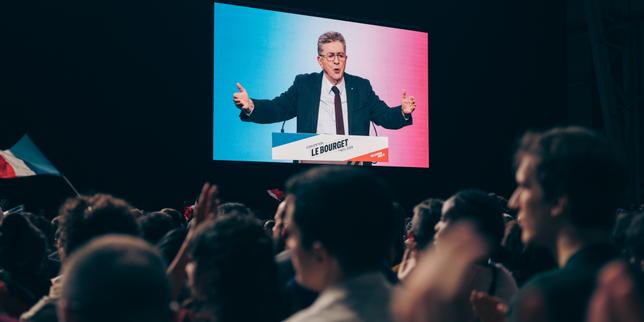
Foreign policy rarely explodes into a domestic shouting match unless someone touches a raw nerve. That exact nerve got exposed when Jean-Luc Mélenchon took the stage at Le Bourget and suggested that ending the war in Ukraine might require territorial concessions, specifically involving the heavily contested Donbass region.
Cue the backlash. French Foreign Minister Jean-Noël Barrot didn't just disagree with the proposal; he fired back with both barrels, accusing the leader of La France insoumise (LFI) of becoming a direct spokesman for Moscow. This clash isn't just a routine political disagreement. It exposes the deep fractures running through the French political landscape regarding European security, sovereignty, and how to handle the Kremlin as the 2027 presidential race approaches.
What Mélenchon Actually Said at Le Bourget
During his major program-launching meeting in front of thousands of supporters in Seine-Saint-Denis, Mélenchon laid out his vision for international relations. When addressing the grinding war in Ukraine, he argued that a peaceful settlement would likely necessitate accepting territorial compromises. To add democratic weight to his proposal, he insisted that local populations within the Donbass must be consulted directly through votes or referendums.
On paper, the argument sounds like an appeal to self-determination. In reality, it directly mirrors talking points long pushed by Russian diplomacy. The Donbass region has been a focal point of Russian aggression and occupation since 2014, and Kiev has repeatedly rejected any notion of giving up sovereign land in exchange for an uncertain peace. By suggesting that Ukraine must concede territory and poll populations under current occupation conditions, Mélenchon stepped straight onto a diplomatic landmine.
The Government Counterattack
It took less than twenty-four hours for the executive branch to respond. Jean-Noël Barrot labeled the remarks as an issue of "unprecedented gravity", stating publicly that Mélenchon had chosen to act as an echo chamber for Vladimir Putin's administration.
Barrot went further, arguing that such positions completely disqualify a candidate from aspiring to the highest office in France. The strategy from the government is clear: paint the radical-left leader as a threat to national security and European stability. For years, critics have tracked Mélenchon's foreign policy stances—ranging from his past skepticism of NATO expansion to his criticisms of Ukrainian long-range strikes—and the government is using this latest speech to tie all those threads together into a cohesive narrative of alignment with Moscow.
Why This Matters for the 2027 Presidential Campaign
Foreign policy used to be a secondary concern in French domestic politics, but the war on Europe's doorstep changed everything. As the country looks toward the 2027 presidential election, stances on Russia, Ukraine, and defense spending are turning into litmus tests for voters and candidates alike.
Mélenchon has long championed a doctrine of non-alignment, often criticizing American hegemony and pushing for France to distance itself from traditional military blocs like NATO. While this resonates with a specific segment of the anti-establishment left, it creates major vulnerabilities whenever hot wars test European solidarity.
Opponents across the political spectrum jumped on the controversy. Figures from the center and the right view the remarks as proof that the radical left cannot be trusted with the nuclear codes or France's international alliances. Meanwhile, LFI defenders argue that questioning the feasibility of a total military victory for Ukraine is a pragmatic recognition of reality rather than an endorsement of Russian imperialism.
The Underlying Clash of Visions
The debate ultimately boils down to two entirely different ways of viewing the world. One side views the conflict in Ukraine as an existential battle for European democracy and international law, where borders cannot be redrawn by force. The other views it through a lens of great-power friction, where endless escalation risks a global catastrophe, and negotiated compromises—however painful—are the only path away from the brink.
By demanding a public consultation in the Donbass, Mélenchon ignores the reality that fair, free votes are impossible in active war zones under foreign occupation. Yet, by calling out what he views as a naive insistence on total military victory, he taps into underlying public anxieties about inflation, energy costs, and the economic toll of a protracted conflict.
The political fallout from Le Bourget shows no signs of slowing down. As long as the war in Ukraine drags on, foreign policy will remain the sharpest weapon politicians use to bludgeon their rivals. Stop looking at this as a mere war of words. It is the opening salvo of the 2027 battle for France's geopolitical soul.