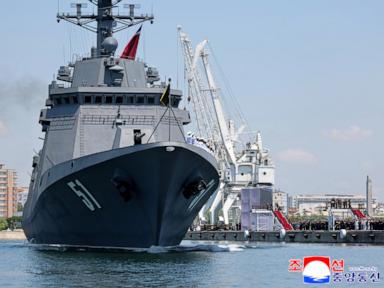
North Korea just changed the rules of its maritime playbook. For decades, Pyongyang treated its navy like an afterthought, pouring almost all its cash into ballistic missiles and underground silos. That era is officially over. Standing on the docks of the western port city of Nampho, Kim Jong Un just commissioned the Choe Hyon, a 5,000-tonne multipurpose destroyer packed with anti-ship and nuclear-capable cruise missiles.
This isn't just another propaganda photo op with white smoke and grand speeches. It is a calculated pivot in how North Korea plans to fight, survive, and threaten its neighbors. Kim didn't just celebrate a new ship. He announced an aggressive naval expansion plan to build two massive surface warships every single year for the next five years, culminating in a fleet of 10,000-tonne strategic cruisers.
If you want to understand why a cash-strapped nation is suddenly obsessed with blue-water naval ambitions, you have to look beyond the state media headlines.
The Reality Behind the Choe Hyon and the Kang Kon
Western analysts used to laugh off North Korea’s navy as a collection of rusty, Soviet-era patrol boats. They can’t do that anymore. The Choe Hyon is a serious piece of machinery, weighing in at roughly 5,000 tonnes. For context, that puts it in a class that can actually project power outside of immediate coastal waters.
Pyongyang didn't stop there. Kim announced that a sister ship, the destroyer Kang Kon, will soon enter active service. A third ship of the exact same class is already under construction at the Nampo shipyard, targeted for completion by October to mark the ruling Workers’ Party founding anniversary.
This sudden surge in naval shipbuilding didn't happen in a vacuum. South Korean military intelligence suspects extensive Russian tech transfers helped clear the engineering hurdles that previously plagued the North's shipyards. Remember, just last year, a second vessel in this class suffered a catastrophic launch failure at the northeastern port of Chongjin. Kim reportedly flew into a rage, calling the blunder criminal. The speed at which they repaired that ship and launched these new variants points to serious outside technical help.
The weapons systems onboard these destroyers are what should worry planners in Seoul and Washington. During sea trials, the Choe Hyon successfully test-fired strategic cruise missiles. In Pyongyang's vocabulary, the word strategic means only one thing. It means nuclear.
Why Coastal Missiles Weren't Enough
You might wonder why Kim cares about expensive warships when he already has road-mobile ICBMs and silos. The answer lies in the shifting dynamics of modern warfare.
North Korea has watched recent global conflicts closely. They saw how easily static positions get targeted. They watched Western forces strike heavily defended ground targets in the Middle East. The lesson for Pyongyang was crystal clear. If you keep your nuclear deterrent entirely on land, you invite a decapitation strike.
By putting tactical nuclear warheads on surface ships and submarines, Kim spreads his pieces across the board. It complicates the math for the US-South Korea alliance. Instead of just scanning known valley launch sites or railway tracks, allied radar now has to track a 5,000-tonne destroyer moving through choppy waters, capable of launching a low-flying, radar-evading cruise missile from any direction.
It drives up the cost of defense for the West. Tracking naval targets requires constant satellite coverage, maritime patrol aircraft, and attack submarines. Kim knows he doesn't need to build a navy capable of defeating the US Seventh Fleet in a straight fight. He just needs a navy that makes an attack on North Korea too messy and too expensive to contemplate.
The 10,000-Tonne Pipe Dream or Real Threat
The most startling part of Kim’s Nampho speech was his target size. He openly pledged to build 10,000-tonne strategic warships.
To give you an idea of scale, a 10,000-tonne warship is roughly the size of an American Arleigh Burke-class destroyer or South Korea’s Sejong the Great-class vessel. These are floating fortresses. They are longer than one and a half football fields and require advanced propulsion, complex radar integration, and sophisticated hull design.
Can North Korea actually build something that big? Skeptics say no way. The country lacks the steel quality, the advanced electronics, and the economic breathing room to churn out two massive cruisers a year.
But betting against North Korean military manufacturing has historically backfired. People said they couldn't build solid-fuel ICBMs. They did. People said they couldn't build a military spy satellite. They put one in orbit. With Russia increasingly dependent on North Korean artillery shells for its own conflicts, the geopolitical bartering chips have shifted. Kim has the leverage to demand advanced naval architecture secrets from Moscow in exchange for munitions. What seems like a pipe dream today could easily become a steel hull in the water by 2028.
The Northern Limit Line Flashpoint
This naval buildup will likely trigger a crisis much closer to home before these ships ever see the open Pacific. The immediate theater of operation for these new destroyers is the western sea boundary, known as the Northern Limit Line.
This boundary was drawn by the UN Command at the end of the 1950-1953 Korean War. North Korea has never officially recognized it. The waters around the line are rich fishing grounds and have been the site of bloody naval skirmishes in 1999, 2002, and the tragic sinking of the South Korean warship Cheonan in 2010.
Kim recently altered the country's constitution, cementing his personal command over nuclear forces and stripping out language regarding peaceful reunification. He explicitly stated he doesn't recognize the Northern Limit Line.
With the Choe Hyon and Kang Kon patrolling these disputed waters, the risk of a miscalculation skyrockets. If a South Korean patrol boat intercepts a North Korean fishing vessel, and a nuclear-armed 5,000-tonne destroyer is sitting just over the horizon, the local commander's rules of engagement change instantly.
The Diplomatic Shield from Beijing and Moscow
Don't expect UN sanctions to stop this naval program. The days of unified global pressure on Pyongyang are gone.
When Chinese leader Xi Jinping visited Pyongyang recently, the official readouts from Beijing omitted any mention of denuclearization. The concept of getting North Korea to give up its nukes is dead. Even Donald Trump and Xi Jinping's previous joint statements on the matter have given way to a new cold war reality.
China and Russia view North Korea as a useful buffer against American power in East Asia. A stronger North Korean navy keeps US and Japanese naval assets occupied in the Sea of Japan and the Yellow Sea, taking the pressure off China's own maritime ambitions around Taiwan. Pyongyang is no longer isolated. It is backed by a powerful trilateral understanding.
What to Watch Next
For defense analysts, military hobbyists, and regional watchers, the next twelve months will reveal exactly how fast this naval program can move. Forget the political rhetoric and focus on these specific milestones.
First, track the sea trials of the Kang Kon. Its deployment schedule will prove whether North Korea can replicate the manufacturing success of the Choe Hyon without suffering more crippling shipyard accidents.
Second, look closely at commercial satellite imagery of the Nampho shipyard. The laying of a hull for a ship larger than 5,000 tonnes cannot be hidden from space. If the foundations of a 10,000-tonne cruiser appear before the end of the year, it confirms that Russian blueprint sharing is far deeper than currently admitted.
Third, watch the deployment patterns around the Northern Limit Line. If Kim pushes his new destroyers south of traditional patrol zones, he is actively seeking to provoke a response and rewrite the maritime border through brute presence. The balance of power in the waters around the Korean Peninsula is shifting, and these new hulls prove that Kim is playing a long, dangerous game on the high seas.