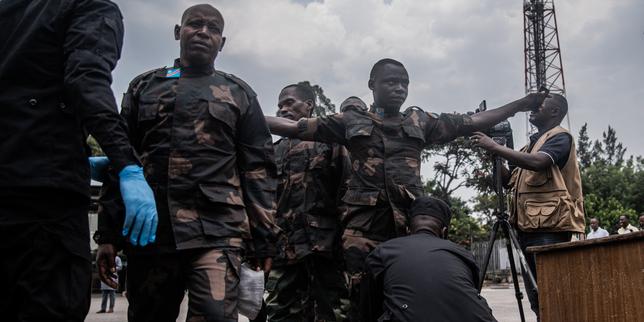
Let's be completely honest about the security crisis in the eastern Congo. Every few months, Kinshasa drops a major diplomatic announcement claiming a turning point against the Forces démocratiques de libération du Rwanda (FDLR). Then reality catches up.
Floribert Anzuluni, the Congolese Minister of Regional Integration, stepped in front of national television cameras to announce that the FDLR had finally signed a formal protocol committing to their demilitarization, disarmament, and cantonment. On paper, it sounds like the missing puzzle piece of the Washington peace process brokered alongside Rwanda. On the ground in North Kivu, it smells like another high-stakes political gamble with very few guarantees. You might also find this connected article interesting: Why Mohammad Bagher Ghalibaf Warns Washington Over Qeshm Island Strikes.
The Real Story Behind the Washington Accord Pressures
You have to look at the timeline to understand why this announcement dropped right now. Under the terms hammered out in late 2025, Kinshasa took on the heavy burden of neutralizing a stubborn armed group that Kigali has used for decades to justify its security interventions and cross-border posture.
Washington and other international partners pushed hard for tangible deliverables. Kinshasa tried a mix of failed disarmament campaigns in late 2025 before shifting to military posture adjustments in March 2026, deploying battalions near Walikale to signal force. As extensively documented in latest reports by Reuters, the effects are significant.
According to the government, that military squeeze forced the FDLR leadership to open backchannels. They basically realized that holding out against a coordinated offensive was a losing game. But let's look at what the protocol actually contains, and more importantly, what it leaves out.
What the FDLR Protocol Actually Says
The newly signed text commits the combatants to lay down their weapons, move into designated camps, and prepare either for repatriation to Rwanda or resettlement in a third country. It also supposedly establishes that members facing serious domestic or international arrest warrants must answer to justice.
Sounds great. Except for a few massive catches:
- There is no public timeline or precise calendar.
- Nobody has officially disclosed where these cantonment sites will be located.
- The exact number of active fighters signing onto this agreement remains entirely murky.
- The protocol relies heavily on future operational budgets and international logistics that don't exist yet.
When a government announces a monumental surrender without a fixed schedule or a map, you are dealing with a political intent statement rather than an operational reality.
Kigali Calls It a Non-Event
Unsurprisingly, Rwanda didn't waste any time dismissing the announcement. Kigali's foreign ministry labeled the protocol a total non-event and a standard manipulation tactic coming out of Kinshasa.
From the Rwandan perspective, until actual fighters are disarmed, verified, and separated from their command structures under strict international supervision, words on a piece of paper mean nothing. More importantly, Kigali faces its own pressure regarding the lack of a verified withdrawal of Rwandan forces from Congolese territory. Both sides are playing a high-stakes blame game where token concessions replace genuine military disengagement.
What Happens Next in North Kivu
If you expect this signature to magically pacify the Kivus, you will be disappointed. The FDLR issue is deeply tied to the broader conflict involving the AFC/M23 rebellion, which operates on entirely separate tracks and rejects these localized deals.
Kinshasa has promised to release an operational plan with a strict budget and task distribution in the coming days. Watch closely whether international monitors actually get access to the proposed cantonment zones. If those sites turn out to be unverified jungle camps without independent oversight, this protocol will quickly join the graveyard of failed peace initiatives in Central Africa.