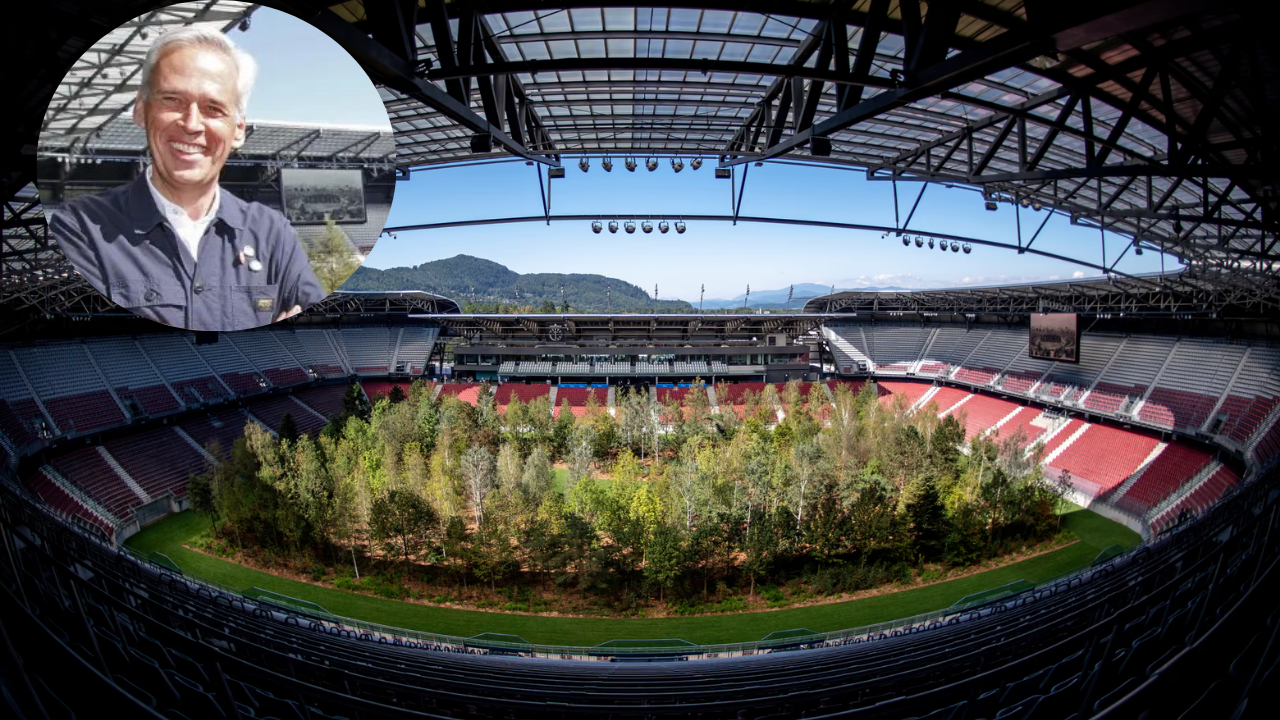
Picture a massive 30,000-seat stadium. The floodlights hum overhead. The pitch, however, doesn't contain a patch of manicured grass or goalposts. Instead, 299 mature trees rise into the air, casting long shadows across the empty grandstands.
This wasn't a glitch in a video game. Back in 2019, Swiss curator and artist Klaus Littmann turned the Wörthersee Stadium in Klagenfurt, Austria, into a living woodland. The temporary intervention, titled FOR FOREST – The Unending Attraction of Nature, took up roughly 7,200 square metres of playing space.
People didn't stroll through the trees. They sat in the rows of seats, looking down at a forest as if it were a football match.
The project wasn't born overnight. Littmann carried the concept in his head for nearly thirty years after seeing a pencil drawing by Austrian artist Max Peintner titled The Unending Attraction of Nature. That 1970/71 sketch depicted a dense thicket growing inside a stadium, surrounded by spectators gazing in awe. Littmann wanted to see if that dystopian vision could become real.
The Logistics of Planting a Woods on Concrete
Moving a Central European forest into an urban sports arena sounds chaotic. Landscape architect Enzo Enea handled the complex selection and placement of the trees, which included silver birch, European oak, hornbeam, field maple, and white willow.
Some of these specimens reached heights of 14 metres and weighed up to six tonnes. Sourcing them required pulling mature trees from Italy, Germany, and Belgium since local Austrian nurseries didn't have the exact mix needed for the installation.
Critics complained loudly. Some local political factions attacked the project over transportation logistics, public funds, and the displacement of the local football club, Wolfsberger AC, which needed the stadium for its matches. Opposition figures even staged minor protests and grumbled about the commercial footprint of the exhibition.
Despite the friction, over 200,000 visitors streamed through the gates during its run from September 8 to October 27, 2019. Entry was free, and people watched the installation shift under daytime sun, rain, and nighttime artificial lighting.
What the Stadium Forest Actually Meant
Most environmental art relies on shock value. You see images of dry, cracked earth, plastic-choked oceans, or charred tree trunks.
Littmann did the opposite. He showed a healthy, thriving forest.
The twist was entirely about placement. By tearing a woodland out of its natural habitat and locking it inside a concrete stadium cage, the installation raised an uncomfortable question. Are we heading toward a future where trees are so rare that we have to visit them behind ticket gates, treat them like museum pieces, or view them the way we look at animals locked in zoos?
The installation forced a strange psychological reaction. Fans go to stadiums to watch human competition, emotion, and movement. Here, the only movement came from leaves rustling in the wind and branches shifting under changing weather patterns.
Where Did the Trees Go Afterwards?
Temporary art projects often leave behind tons of waste. Littmann planned around this flaw from day one.
When the exhibition closed in late October 2019, every single one of the 299 trees was carefully removed from the stadium. They weren't thrown away or turned into firewood. Crews replanted them on a site in Lower Austria to form the foundation of a permanent public installation space known as the FOR FOREST Campus.
The living material survived the stunt. The questions raised by the project, however, continue to linger. When you isolate nature from its ecosystem, you don't preserve it. You just put it on display.
Architecture for Change – Series 22 / For Forest, Klagenfurt, Austria
This short video provides a visual glimpse of Klaus Littmann's tree installation inside the Austrian stadium.
http://googleusercontent.com/youtube_content/1