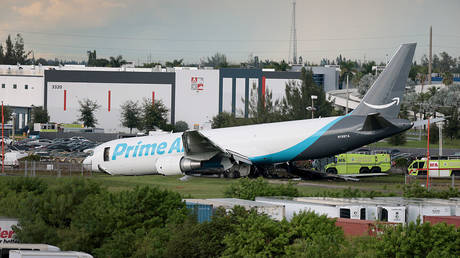
A 32-year-old Boeing 767 didn't just land at Miami International Airport on a Sunday afternoon; it chewed through a perimeter fence, crossed a public road at 112 knots, and tore vehicles to pieces. Five people lost their lives. Three others suffered critical injuries.
When an Amazon cargo aircraft operated by 21 Air overran Runway 30, it shattered the illusion that aviation disasters only happen at high altitudes. Most people assume plane crashes happen in the clouds. They do not realize that runway excursions during landing remain one of the most persistent and lethal risks in modern commercial transport.
If you want to understand what actually went wrong in Miami, you have to look past the corporate statements and examine the brutal physics of wet-runway landings, aging cargo fleets, and the dangerous proximity of public roads to high-capacity airport boundaries.
The Brutal Physics of Runway Overruns
Landing a heavy aircraft is a masterclass in risk management. You have a very narrow window to touch down, deploy spoilers, engage reverse thrust, and apply wheel brakes before the pavement runs out.
On that fateful Sunday, the conditions were unforgiving. Heavy thunderstorms hovered over Miami, leaving a film of water on the tarmac. At high speeds, water lifts rubber tires right off the surface. It causes hydroplaning. Friction drops to near zero.
Flight tracking data shows the converted 767 freighter was still booking along at 112 knots, roughly 207 kilometers per hour, as it ran out of paved runway. It didn't gently slide off the edge. It barreled through the perimeter boundary and struck vehicles on an adjacent public road. Five people inside a cleaning contractor's van and an SUV bore the brunt of the kinetic impact.
NTSB Chair Jennifer Homendy later described the scene as utter devastation. Flight recorders were recovered quickly, but investigators already know the harsh math: an airliner covers about 75 meters for every second it floats down a runway waiting to settle. Touch down late, and you run out of math very fast.
Why Cargo Fleets Need Closer Scrutiny
Amazon Air relies heavily on outsourced operators flying older, converted passenger airframes. The aircraft involved in the Miami incident was a decades-old Boeing 767-300 freighter.
While age alone doesn't make a plane unsafe, the intense cycle rates of e-commerce cargo networks put enormous strain on these machines. Cargo flights often operate overnight, in poor weather, under tight scheduling pressure to keep delivery promises intact.
People ask whether the pilots tried to go around or forced a bad landing. Air traffic control recordings show the crew declared no emergency before touchdown. However, investigators are actively examining whether the aircraft floated too far down the runway before making contact with the ground. When you mix a late touchdown with wet pavement and a lack of modern runoff infrastructure, tragedy becomes a matter of when, not if.
The Dangerous Gap in Airport Infrastructure
Look at a satellite map of Miami International Airport and you will spot a glaring vulnerability. Unlike airports equipped with engineered materials arrestor systems, commonly known as EMAS beds, Runway 30 lacks these crucial safety foam beds designed to catch overrunning jets.
EMAS technology has stopped dozens of aircraft in the United States over the years by safely crushing under the weight of an out-of-control plane. Miami didn't have one here. Instead, it had a perimeter fence and a public road where local workers and commuter vehicles travel every single day.
When an aircraft leaves the pavement at highway speeds, a chain-link fence offers zero resistance. Aviation regulators and airport authorities have known about these close-proximity roadways for decades. Yet, retrofitting every major hub with advanced overrun protection remains slow and politically contentious.
What Happens Next for Logistics and Aviation
The fallout from this crash goes far beyond a temporary ground stop at one of America's busiest freight hubs. Federal investigators from the NTSB and the FAA are combing through weather data, braking performance metrics, and maintenance logs.
Questions are also turning toward how wet-runway calculations are handled. Earlier guidelines have faced criticism for understating the actual landing distances required during severe rainfall. If the mathematical models pilots use to calculate stopping distances are flawed, no amount of cockpit experience can save them when the pavement ends.
Stop assuming logistics giants can scale air networks without accountability. Demand transparency on aircraft maintenance cycles, push for mandatory safety beds on all major runways, and redesign the perimeter buffers that separate heavy commercial jets from public traffic. Lives depend on closing these gaps now.