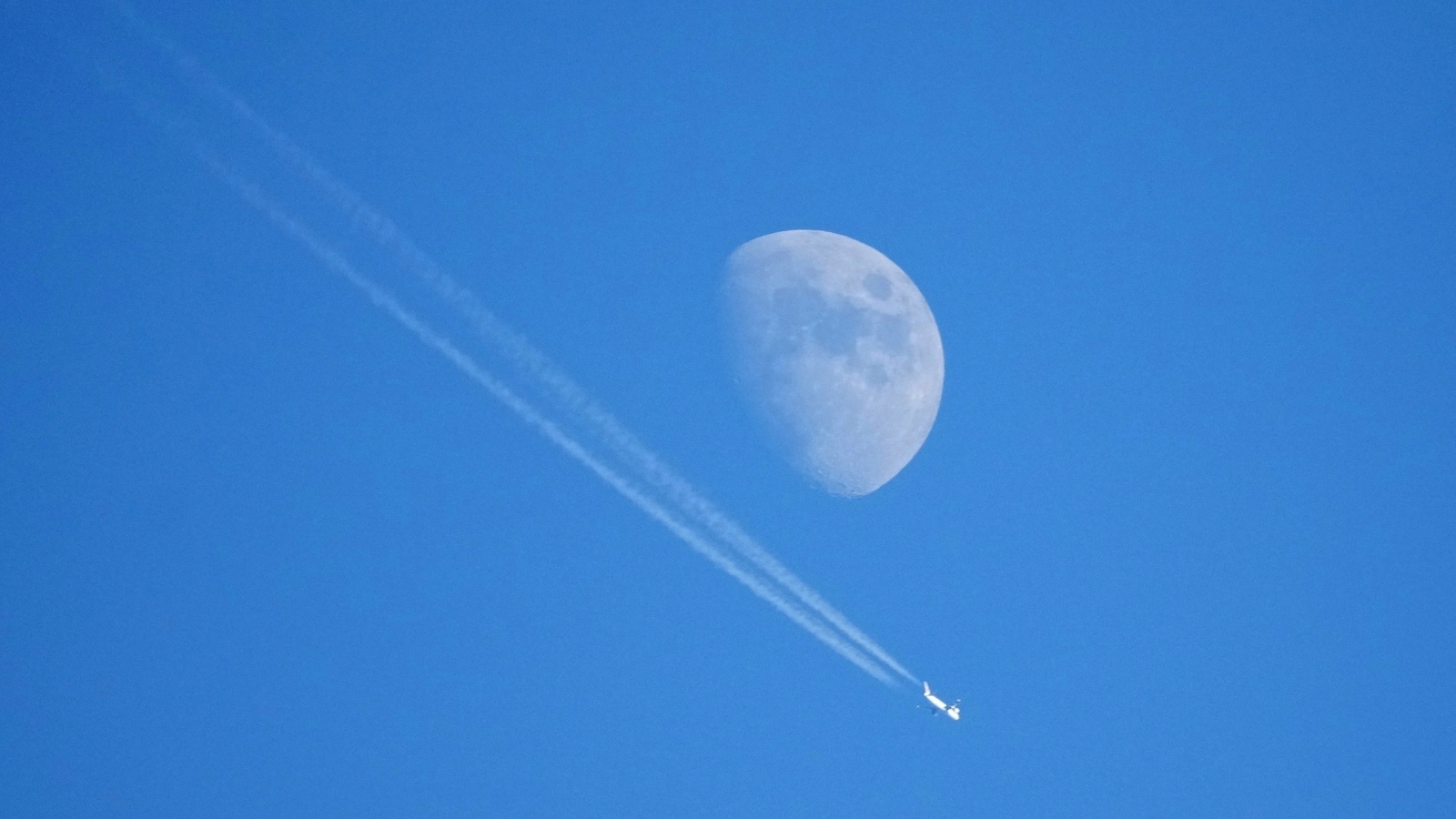
You’ve seen them countless times. Those long, white streaks trailing behind jets at 35,000 feet. Most people assume they’re harmless vapor. Some even think they’re something more sinister. But the truth is, these lines are effectively trapping heat like a blanket, contributing almost as much to global warming as the carbon dioxide emitted by the engines themselves.
The aviation industry is finally taking this seriously. A new initiative called Operation Blue Skies is currently testing whether we can literally steer around the problem.
The problem with ice crystals
It isn’t the vapor itself that stays in the sky. When hot jet exhaust meets the frigid, humid air at cruising altitude, it freezes around tiny soot particles. If the air is just right—supersaturated with ice—these crystals linger. They turn into cirrus clouds that don't go away.
During the day, these clouds reflect some sunlight, but at night, they do something much worse. They trap heat rising from the Earth's surface. Because they persist for hours, they effectively act as a thermal blanket. Science suggests that while only a small percentage of flights create these long-lasting contrails, those specific flights account for the vast majority of the warming impact from contrails.
Steering around the climate cost
The solution sounds deceptively simple: don't fly through the spots that create these clouds. The challenge, until now, has been predicting exactly where those "ice-supersaturated regions" will exist. Atmospheric conditions shift constantly.
This is where the UK government and Google are stepping in. Through Operation Blue Skies, they are using artificial intelligence to map out these high-risk zones in the North Atlantic. The Shanwick Oceanic Control Area, a critical corridor for Europe-to-North America traffic, is serving as the testing ground for this 30-month project.
During the winter months—when contrail formation is at its peak—air traffic controllers will direct specific flights to adjust their altitude by up to 2,000 feet. It’s a small, precise nudge. The goal is to see if these minor deviations, when scaled across thousands of flights, can measurably reduce the climate footprint of aviation without burning significantly more fuel or causing massive air traffic chaos.
Why this is different from previous attempts
Airlines have experimented with this before, but usually on an ad-hoc basis. Operation Blue Skies is different because it’s a systematic, state-backed trial involving NATS, the Met Office, and major research institutions like Imperial College London and the University of Cambridge. They aren’t just guessing; they are building a data-driven model to prove that we can change the operational rules of the sky.
If this works, it changes the way we think about sustainable travel. We’ve spent years obsessing over fuel efficiency and alternative fuels. Those are important, but they take decades to implement at scale. Changing an flight path based on real-time AI weather forecasting? That could be deployed across global flight networks much faster.
Realities of the testing phase
If you’re wondering how this affects your next flight, it’s mostly invisible. The test is limited to specific days and controlled airspace. Controllers are choosing flights that are least likely to cause disruption. We aren’t talking about massive rerouting that adds hours to your travel time. We’re talking about subtle altitude adjustments.
The real test is the verification. It’s one thing to say a plane avoided a contrail; it’s another to prove it. The team is using satellite imagery and machine learning to track those flight paths and compare them against weather data to see if the contrail was avoided.
What comes next
The goal is clear. If this trial succeeds, it provides a blueprint for every air navigation provider on the planet. Imagine a world where every major airline route is optimized not just for fuel and time, but for climate impact.
We don't need a total redesign of jet engines to see progress. We just need to stop flying through the wrong parts of the sky. Watch how the data from the upcoming winters shapes international aviation policy. This is likely the quietest, most effective climate action in aviation history.
If the results hit the targets, expect regulators to start mandating non-CO2 emission reporting for airlines globally. That shift will force the industry to move from experimental trials to standard operational procedure.
Keep an eye on the North Atlantic this winter. If you're a frequent flyer, your future travel might just be a little bit greener, simply because the pilot chose to fly 2,000 feet higher to avoid a cloud.