Optics research used to mean endless hours of staring at tiny mirrors, twisting knobs, and praying nothing shifted. If someone bumped a table, the whole alignment was gone. Hours of work vanished instantly.
That frustrating manual grind might finally belong to the past.
Researchers at the Massachusetts Institute of Technology built an automated robotic optics lab. This system assembled a functioning tabletop laser cavity in just 50 maneuvers taking under 30 minutes. When scientists intentionally disrupted the setup, the robot didn't quit. It detected the change and realigned the components with micron-scale precision on its own.
How the MIT Robotic Optics Lab Actually Works
Building a laser cavity isn't like assembling IKEA furniture. It requires hyper-precise geometry. Light has to bounce back and forth through a crystal between mirrors to amplify intensity until a laser beam forms. A fraction of a millimeter off, and nothing happens.
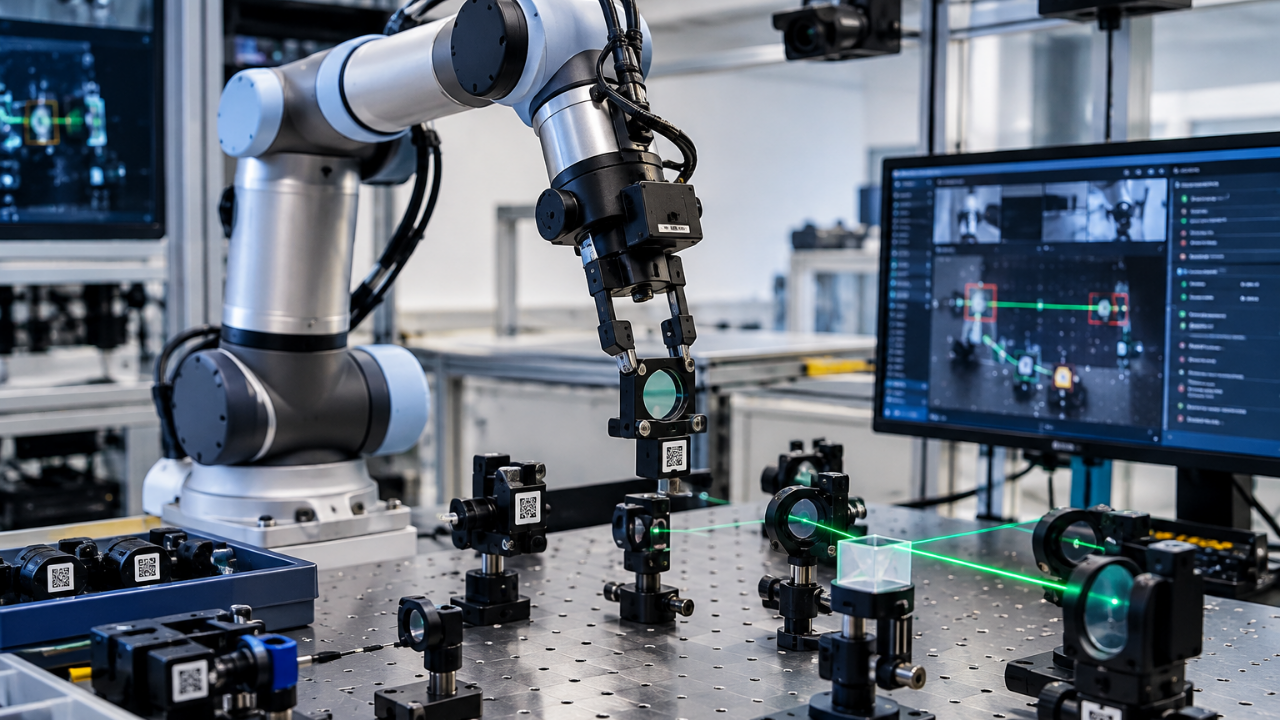
To tackle this, the MIT team engineered a specialized setup. At the center sits a robotic arm with seven movable joints operating on a metallic tabletop.
Every optical component lives inside a custom 3D-printed housing. Each housing features a QR code carrying critical data about what the piece is and what it does. Magnetic bases lock the components securely onto the table once placed.
How does the robot turn microscopic knobs? The team invented a wireless fine-adjustment tool that attaches directly to standard optical mounts. This tool turns adjustment knobs automatically. Two overhead cameras provide a constant bird's-eye view while software calculates collision avoidance, pick-up paths, and final placement coordinates.
Instead of just controlling one motorized mirror, this platform handles the entire workflow. It starts with parts scattered randomly across a table, identifies them, moves them into position, and calibrates them from scratch.
The Power of Autonomous Self Correction
The real breakthrough isn't just that a machine can build a laser. It is what happens when things go wrong.
During testing, after the laser cavity was fully running, researchers deliberately shoved components out of place. In a traditional lab, this demands manual troubleshooting. The MIT robot handled it differently. It noticed the dip in laser intensity, scanned the surface, and adjusted the optical mounts automatically to restore the system.
Thermal shifts, building vibrations, and tiny environmental changes plague optical experiments. Human researchers spend massive amounts of time chasing these drift errors. An autonomous system that monitors and repairs its own alignment changes the equation entirely.
Sachin Vaidya, a postdoctoral researcher at MIT's Research Laboratory of Electronics, pointed out the core vision. The goal is moving from a blank table to a fully aligned experiment using one automated platform. Marin Soljacic, a physics professor at MIT, noted that such machines don't get tired or bored.
Beyond Lasers: Where This Technology Goes Next
This isn't just about making lasers faster. Optical setups form the foundation of countless technologies. Think solar cells, advanced cameras, displays, and augmented reality hardware.
The MIT team is already deploying the robotic lab for carbon-capture material research. By shining specific light properties onto these materials, they can study carbon dioxide absorption without manual intervention every step of the way.
The long-term plan involves cloud-based interfaces. Scientists could submit experimental protocols online, letting a remote robotic lab assemble, run, and dismantle physical configurations overnight.
Manual optics won't disappear tomorrow. But labs adopting automation will outpace those stuck in the manual era. If you work in experimental physics or hardware engineering, start looking at how robotic workflows can integrate into your testing pipeline. Stop wasting hours on manual alignments that machines can handle better.


