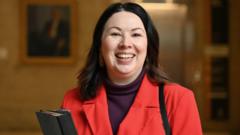
Internal party warfare rarely looks pretty, but the exclusion of Monica Lennon from the Scottish Labour leadership ballot exposes deep ideological fractures that go far beyond a simple numbers game. When nomination windows slammed shut, the reality hit hard. Scottish Labour members will now choose between Michael Marra and Joe Fagan, leaving one of the party's most recognizable left-wing figures entirely out of the running.
If you want to understand where modern social democracy is heading north of the border, look at why this happened. Lennon didn't just lose; she walked away swinging, taking direct aim at an apparatus she claims is stuck in the past.
The Mathematics of Exclusion
Elections inside political parties often turn into high-stakes gatekeeping exercises. To secure a spot on the ballot, candidates need specific thresholds of support from MPs, MSPs, and affiliated trade unions. Lennon managed to pick up endorsements from Holyrood colleagues like Katy Clark and Carol Mochan, alongside Westminster backing from MPs like Brian Leishman and Euan Stainbank.
Even so, it wasn't enough. Falling short of the required nomination matrix means her vision for the party won't get tested by the wider membership.
Critics inside the party machine will argue that rules are rules. They will say candidates must build broad coalitions to prove their governing capability. But supporters see a managed outcome designed to sideline internal dissent.
A Parting Shot at the Party Culture
Lennon didn't hold back after the exclusion became official. Her post-defeat statement painted a picture of an organization failing to engage with working-class communities. She argued that the contest missed an opportunity for a courageous, wide-ranging debate about the future.
According to Lennon, the party risks ignoring millions of potential voters by refusing to embrace radical change on issues ranging from environmental policy to constitutional debates.
Her critique cuts deep because she has always positioned herself outside the standard Westminster playbook. Whether pushing for progressive social legislation in the past or challenging party orthodoxies, she has rarely shied away from internal friction. By branding aspects of the current political culture as unyielding and insular, she has thrown down a marker for whoever ultimately wins the crown.
What Comes Next for Scottish Labour
With Marra and Fagan now locked in a head-to-head battle to succeed Anas Sarwar—who transitioned to the House of Lords and a role in the UK government—the debate shifts. Members will cast votes through late August and September, with a winner announced soon after.
Yet, locking out a prominent voice like Lennon leaves a vacuum on the party's left flank. Disaffected activists watching from the sidelines will wonder if mainstream leadership candidates can truly represent a break from managerial politics.
If you're following the trajectory of Scottish politics, keep an eye on how the remaining contenders address the exact policy gaps Lennon highlighted. Ignoring structural discontent won't make it disappear.
Check official updates on the ongoing contest directly through resources like the Scottish Parliament website or independent political coverage on LabourList to track how the leadership race unfolds. Real political shifts happen when parties are forced to reckon with their internal contradictions. Right now, Scottish Labour is trying to move forward while leaving a significant chunk of its activist base feeling locked out of the room.