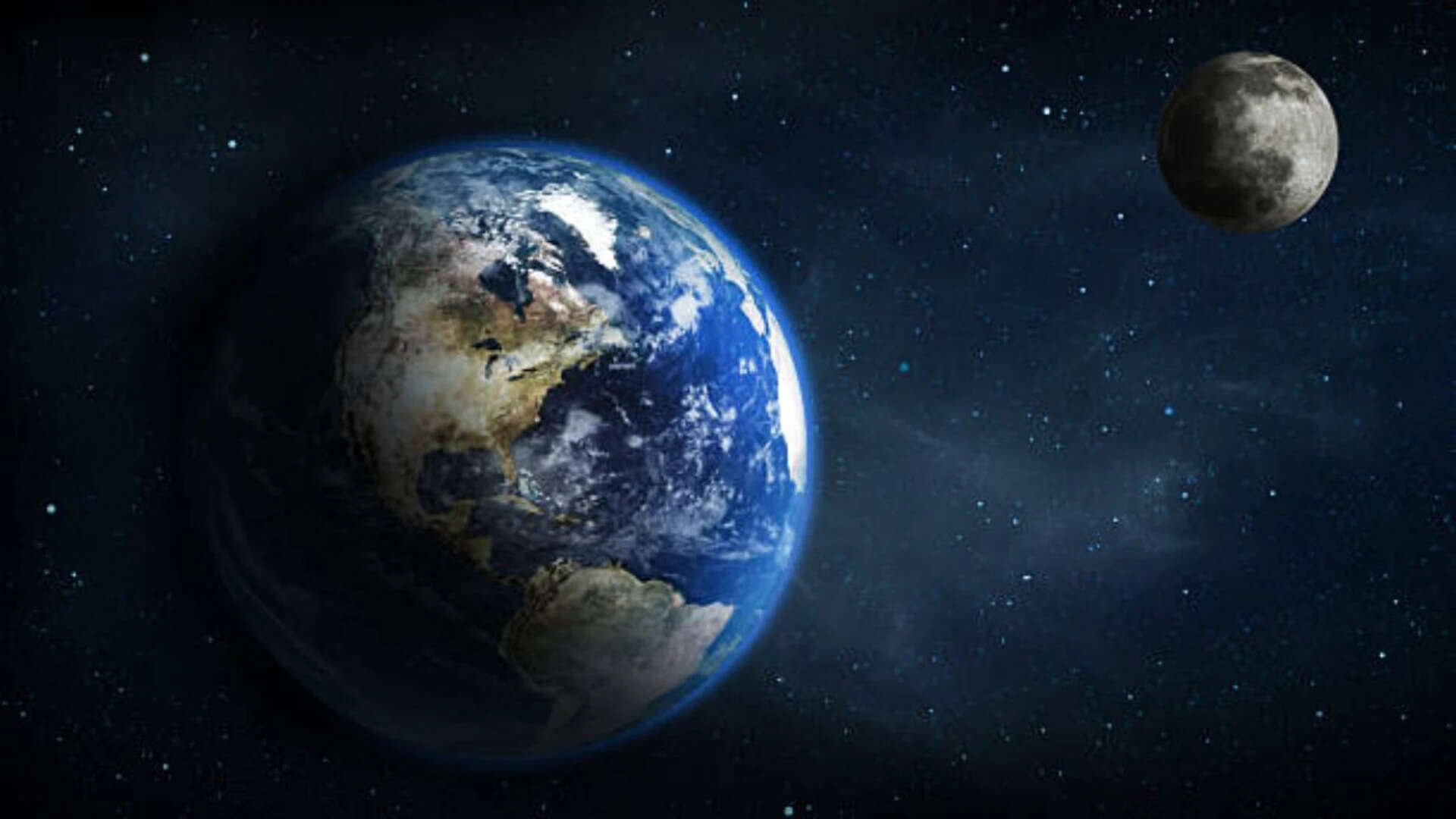
Every single year, our Moon inches roughly 3.8 centimeters away from Earth. That's about the same rate your fingernails grow.
It sounds minor. You won't notice it tonight, and your grandchildren won't notice it either. Yet this slow cosmic breakup is altering the fundamental mechanics of our planet. Days are getting longer, ocean tides are shifting, and far down the line, Earth will lose one of its most breath-taking celestial phenomena: total solar eclipses.
Most coverage treats this discovery like a fresh mystery, but scientists have tracked it for over five decades.
How We Know the Moon Is Escaping
During the Apollo missions between 1969 and 1971, astronauts Buzz Aldrin, Alan Shepard, and David Scott placed suitcase-sized retroreflector panels on the lunar surface. These aren't ordinary mirrors. They consist of fused-silica corner cubes designed to bounce light directly back to its exact point of origin.
Observatories in New Mexico, Texas, and France regularly shoot high-powered laser pulses at these exact spots. A fraction of those photons strike the mirrors and return to Earth roughly 2.5 seconds later. By timing that trip to a precise fraction of a nanosecond, researchers calculate the distance to the Moon down to the millimeter.
The math doesn't lie. Year after year, the laser reflection takes a tiny fraction of a second longer to return.
Ocean Tides Are Stealing the Moon's Energy
Why is this happening? You can blame our oceans.
The Moon's gravitational pull tugs on Earth's water, creating two distinct tidal bulges. Because Earth rotates on its axis once every 24 hours while the Moon takes roughly 27.3 days to complete an orbit, Earth turns faster than the Moon moves overhead.
As Earth spins, it drags those ocean bulges slightly ahead of the Moon's orbital path. That off-center mass of water exerts its own subtle gravitational pull back on the Moon, dragging it forward and boosting its kinetic energy.
Physics dictates that when you pump orbital energy into a satellite, its orbit widens. The Moon climbs higher.
In exchange, Earth pays a physical penalty. The tidal friction between the sloshing oceans and the rocky seafloor acts like a giant brake pad on our planet's rotation. Earth's spin slows down. Our days are getting longer as a direct consequence.
The Math Problem That Confused Geologists
If you take today's retreat rate of 3.8 centimeters per year and run the clock backward in a straight line, you run into a huge wall. The Moon would have been sitting directly inside Earth about 1.5 billion years ago.
That makes zero sense. Ancient zircon crystals and moon rocks prove our Moon formed roughly 4.5 billion years ago.
The retreat rate wasn't constant. 3.8 centimeters per year happens to be an unusually high speed. Tidal friction depends heavily on where continents sit and how ocean basins are shaped. Today's ocean geography—with a long Atlantic and shallow polar seas—creates intense resonance, amplifies tides, and maximizes energy loss.
When Earth's landmasses clustered together into supercontinents millions of years ago, oceans were deeper and friction was lower. The Moon moved away much slower back then.
Proof of this comes straight out of the ground. Geologists studying 2.5-billion-year-old banded iron formations in Western Australia found distinct, repeating rock layers. These layers recorded ancient Milankovitch cycles—climatic swings caused by Earth's orbital wobble. Because the speed of that wobble depends on the Moon's distance, the rocks preserved an ancient astronomical record.
2.5 billion years ago, the Moon was 60,000 kilometers closer to us than it is today. An Earth day lasted roughly 17 hours.
What Happens as the Distance Grows
The consequences of this slow drift aren't catastrophic overnight, but over deep geological time, they reshape the planet.
Longer Days
Earth's rotation will keep slowing down. Roughly 200 million years from now, an Earth day will last 25 hours. You won't need to adjust your alarm clock anytime soon, but daily cycles for plants and wildlife will eventually adapt to longer light exposure.
The Death of Total Solar Eclipses
Right now, humanity lives in an astronomical sweet spot. The Sun's diameter is about 400 times larger than the Moon's, but the Sun is also about 400 times farther away. They appear virtually identical in our sky, allowing the Moon to completely block the Sun's disk during a total eclipse.
As the Moon moves further away, its apparent size in the sky will shrink. In roughly 600 million years, the Moon will be too far away to cover the Sun entirely. Total solar eclipses will cease to exist. Future observers will only see annular "ring of fire" eclipses.
Weaker Coastal Tides
Because gravitational pull weakens with distance, the ocean tides will grow less dramatic over time. High tides won't reach as far up coastal estuaries, altering intertidal ecosystems and tidal wetlands that rely on heavy ebb and flow.
Planetary Wobble and Climate Control
The Moon acts as a gravitational stabilizer for Earth. Without a large moon nearby, Earth's axial tilt would wobble wildly over long periods—much like Mars does. A erratic axial tilt causes extreme climate swings, turning ice caps into tropical zones and vice versa over a few hundred thousand years. As the Moon recedes, its stabilizing influence weakens, making Earth's long-term climate less predictable.
Will the Moon Ever Completely Escape
No. The Moon will never break away entirely.
The process of drifting outward stops if Earth becomes tidally locked to the Moon, just as the Moon is already tidally locked to Earth. If that were to happen, Earth would take the exact same amount of time to rotate once on its axis as the Moon takes to complete an orbit—about 47 days. At that point, the Moon would stay permanently frozen over one side of Earth, invisible to the other hemisphere, and tidal braking would end.
However, the system won't get that far. Long before tidal locking can lock Earth in place, our Sun will age, expand into a red giant, and engulf both Earth and the Moon together in roughly 5 billion years.
What You Should Do Next
If you want to track or appreciate this planetary phenomenon yourself, here are concrete steps to take right now:
- Catch a total solar eclipse while you can: They are a temporary privilege of our geological epoch. Plan travel around upcoming total solar eclipses before they fade into Earth's distant history.
- Explore lunar laser ranging data: Organizations like the Apache Point Observatory Lunar Laser-ranging Operation (APOLLO) publish public datasets detailing real-time distance measurements to Apollo retroreflectors.
- Check geological records locally: Visit natural history museums featuring banded iron formations or fossilized tidal rhythmites to see tangible physical proof of Earth's ancient, faster rotation.