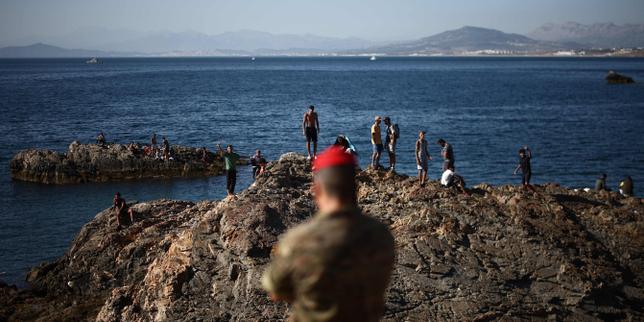
You can't understand modern European geopolitics without looking at the strange status of Ceuta and Melilla. These two Spanish cities sit firmly on the northern coast of Africa, functioning as the European Union's only land borders on the continent. They are small, wealthy pockets surrounded by a nation that has never stopped viewing them as colonial remnants.
Lately, the tension has shifted from historical complaints to a calculated strategy of pressure from Rabat. If you look closely at how goods, people, and borders are managed, a clear pattern emerges. Morocco holds the throttle, and Spain knows it.
The Economic Asphyxiation Game
For decades, these enclaves survived on a messy, highly lucrative engine: cross-border smuggling. Thousands of local workers, famously known as porteras or "mulets," used to haul massive bales of clothes, electronics, and household goods across the gates every single day. It was grueling work, but it kept the economies of both Ceuta and Melilla afloat.
Then Rabat pulled the plug.
Without warning, Moroccan authorities closed the commercial customs posts. They choked off the informal trade routes that fed the enclaves' retail sectors. This wasn't just a random administrative decision. It was a deliberate move to force economic dependence and bleed the cities of their commercial viability. When you cut off the supply lines, you force the local population into a corner. Businesses closed their doors, employment plummeted, and Madrid suddenly found itself subsidizing territories that could no longer sustain themselves.
The Border as a Geopolitical Valve
Economic pressure is only one half of the equation. The real leverage lies in migration.
Whenever diplomatic relations hit a rough patch or Rabat wants to remind Europe of its indispensability, the migration valve gets adjusted. We saw this dynamic explode during massive surges where tens of thousands of individuals crossed toward Ceuta by land and sea. Analysts call this hybrid warfare. It involves using human movements, logistical dominance, and security vulnerabilities to extract political concessions.
The Spanish Institute of Strategic Studies has openly warned about these vulnerabilities. The enclaves rely entirely on maritime supply chains. They have virtually no strategic depth. If Moroccan ports like Tanger Med and Nador West Med boom—which they are—they capture the regional maritime traffic, leaving Ceuta and Melilla isolated in a sea of Moroccan economic dominance.
What Madrid and Brussels Keep Missing
European leaders often treat these border crises as isolated humanitarian emergencies. That is a massive mistake.
When interior ministers gather in Brussels for emergency summits, they are treating symptoms rather than the root cause. Morocco plays a dual role. On paper, it acts as a crucial partner and border guard for the European Union. In practice, it uses that exact positioning to dictate terms. Rabat wants full international recognition of its sovereignty over the Western Sahara, and every European diplomatic shift on that file is closely tied to how tightly the borders at Ceuta and Melilla are guarded.
You won't hear politicians talk about this out in the open, but the calculation is transparent. As long as Spain and the European Union need Moroccan cooperation to keep migration numbers manageable, Rabat holds the upper hand in the Mediterranean.
Stop looking at these enclaves as permanent European fixtures immune to regional shifts. They survive at the pleasure of their southern neighbor, and the pressure isn't letting up anytime soon.