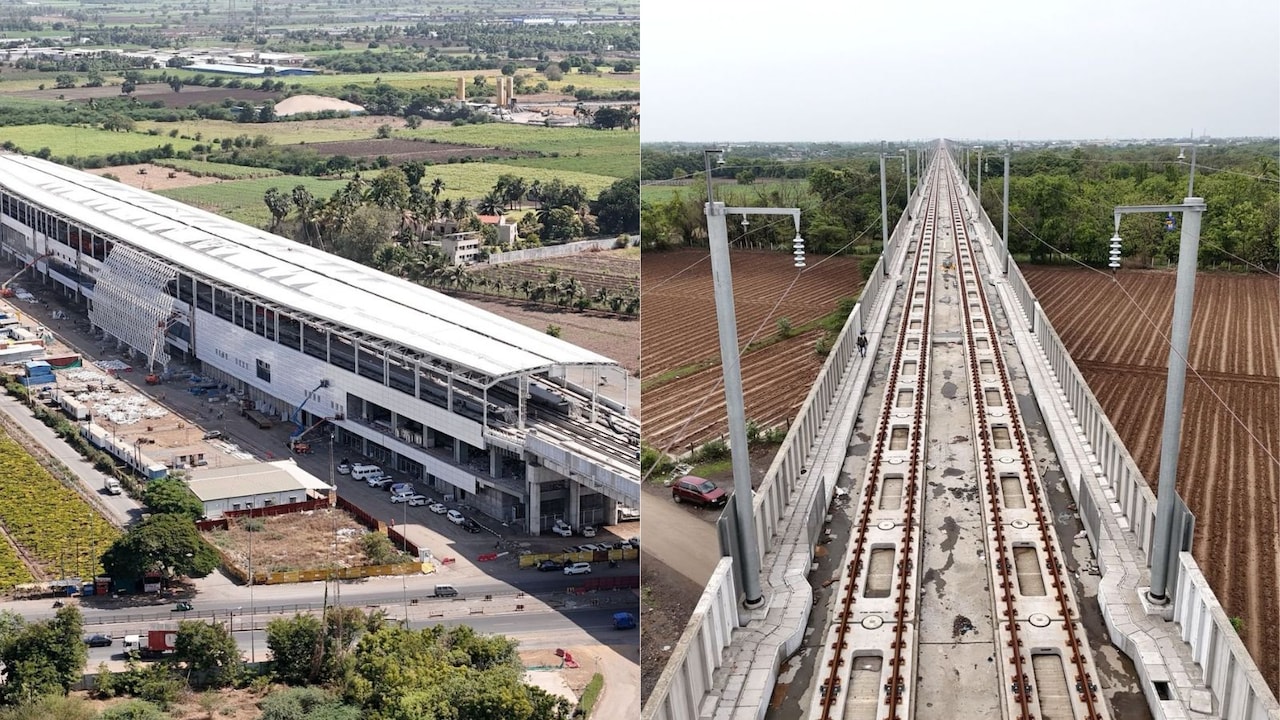
India’s dream of high-speed rail has faced plenty of criticism over the years. Critics called it an expensive luxury. Skeptics pointed to land acquisition delays and missed deadlines. They claimed the country wasn't ready. But if you look at the actual ground reality right now, the narrative is shifting fast. The massive Mumbai-Ahmedabad High-Speed Rail corridor is finally taking shape, and the first phase is officially on track to open next year.
Union Railway Minister Ashwini Vaishnaw confirmed that the first section, connecting Surat to Bilimora in Gujarat, will start passenger operations by August 2027. After years of political squabbling and logistical nightmares, the physical evidence of progress is hard to ignore. Concrete pillars stretch across the horizon. River bridges are finishing up. Meanwhile, you can find related events here: Why The Next Monster El Niño Will Permanently Change How We See Climate Change.
But behind the official optimism lies a complex web of international diplomacy, massive engineering challenges, and a sudden change in how the trains themselves will be built. If you want to understand when you will actually ride this train and what it means for the country, we need to look past the standard government press releases.
The Quiet Drama Behind the Indo-Japan Partnership
For a long time, the public assumed this was a straightforward copy-paste job of Japan's legendary Shinkansen system. Japan provided the technology and a massive low-interest loan through the Japan International Cooperation Agency. It seemed like a perfect match. To see the bigger picture, check out the recent analysis by USA.gov.
Then came the friction. Recently, a former Japanese justice minister, Hideki Makihara, went public on social media to blame Indian officials for project delays. He accused them of failing to honor commitments and running discussions with what he called sheer recklessness. Japanese media pieces also suggested that the Indian project had strayed too far from the original Shinkansen model.
India's Ministry of External Affairs hit back quickly. They stated clearly that these complaints don't line up with the facts. They insisted that bilateral talks are moving along perfectly well.
Why the sudden public disagreement? It turns out that a major shift occurred under the hood regarding the actual rolling stock.
India was originally supposed to buy Japan’s legacy E5 Series Shinkansen trains. However, plans changed when Japan started developing its next-generation E10 series, which won't be fully ready until the early 2030s. Since India wants to stick to its 2027 launch timeline, both countries agreed to a major pivot.
India is going to build its own high-speed trains for the initial launch.
The Rise of the Indigenously Built B28 Trainset
Instead of waiting for Japanese factories to build and ship legacy models, the Indian government handed the responsibility to Bharat Earth Movers Limited. This indigenous bullet train is currently designated as the B28.
BEML is developing the train at its Aditya plant located in Bengaluru. The target is to have the first prototype fully built and rolling out of the factory by March 2027.
What can you expect from the B28?
- Design and Speed The train has a design top speed of 280 kilometers per hour. Its regular operational speed will sit at around 250 kilometers per hour.
- Internal Layout It will be configured as a fully air-conditioned chair car train.
- Passenger Features It features rotatable and reclining seats, infotainment screens, and modern accessibility features for passengers with limited mobility.
This is a massive gamble. Building a high-speed train from scratch takes immense precision. Once the prototype leaves the Bengaluru facility, engineers will subject it to intense, rigorous testing on the newly completed tracks in Gujarat before allowing regular passengers onboard.
Japan hasn't walked away from the project. They will still provide the advanced E10 series trains once their development finishes in the early 2030s. For the first few years of operation, the Mumbai-Ahmedabad line will rely heavily on Indian-made equipment running on Japanese-designed infrastructure.
Concrete and Steel by the Numbers
If you still think the project is mostly talk, the latest construction updates from the National High Speed Rail Corporation Limited tell a different story. Building a high-speed corridor through two major states requires moving millions of tons of material.
The numbers are genuinely staggering. The total length of the corridor spans 508 kilometers. As of mid-2026, workers have finished over 446 kilometers of pier work. That means the foundational pillars are mostly in place.
On top of those pillars sit the massive overhead concrete bridges known as viaducts. Contractors have completed 352 kilometers of these viaducts using a high-speed launching method that builds ten times faster than standard construction styles.
Getting the tracks down is the next big obstacle. So far, crews have laid down 193 route kilometers of reinforced concrete track bed. Special noise barriers are already installed across 291 kilometers of the elevated sections to keep the roaring trains from disturbing nearby towns.
Water crossings are another massive piece of the puzzle. The route crosses 25 different rivers. Builders have already finished 17 of those major river bridges, alongside 14 steel bridges designed for crossing existing railway lines and highways. Work is currently concentrated on complex crossings over major rivers like the Narmada, Tapi, and Mahi.
The Real Route and Phased Opening Plan
Nobody is going to ride a train from Mumbai to Ahmedabad in August 2027. The government is being clear about a phased rollout.
The full 508-kilometer line will feature 12 stations. Eight of them are located in Gujarat, while four sit in Maharashtra. The full journey will eventually take just two hours, down from the current seven-hour grueling train ride or flight hassles.
The opening schedule will look like this.
Phase One Surat to Bilimora
This is the 50-kilometer demonstration stretch slated for August 2027. This section is acting as the real-world proof of concept. The stations in this region are already nearing structural completion.
Phase Two Expanding the Gujarat Section
Shortly after the initial launch, the line will expand south toward Vapi and north toward Ahmedabad. This links the major industrial hubs of Gujarat together, creating a high-speed backbone for the state's business community.
Phase Three The Maharashtra Connection and Full Line
The final, most difficult phase links Ahmedabad to Thane and ultimately terminates at the Bandra-Kurla Complex in Mumbai. The target for the complete operational line is currently tracking toward 2029.
Why the Mumbai Terminal Is an Engineering Nightmare
Gujarat was relatively easy for the builders. Land acquisition moved quickly, and the terrain is mostly flat. Maharashtra was a completely different story. Political shifts in the state government originally frozen land acquisition for years, which explains why the Mumbai end of the project is lagging behind.
The engineering required on the approach to Mumbai is incredibly difficult. The train cannot run on elevated tracks through the dense, hyper-congested suburbs of Mumbai.
To solve this, the line goes underground. Engineers are currently building a 21-kilometer continuous tunnel that stretches from Thane to BKC.
Seven kilometers of this tunnel will sit entirely undersea. This will be India’s very first undersea rail tunnel. Massive Tunnel Boring Machines are currently being assembled and lowered into the ground at Vikhroli and Sawli to grind through the hard basalt rock. Over 4.8 kilometers of the broader tunnel work between Ghansoli and Shilphata has already been cleared.
Because this section takes so much time, the Mumbai terminal will be the very last piece to open to the public.
Safety Systems Built for Indian Conditions
You can't run a train at 250 kilometers per hour without thinking about extreme weather and natural disasters. The line is adopting several advanced safety systems originally perfected in Japan but tuned for local environments.
An automated early earthquake detection system will utilize 28 separate seismometers placed along the route and in seismic-prone zones. If primary seismic waves are detected, the system automatically cuts off power to the overhead lines, instantly triggering emergency brakes on every single train in the region.
Monsoon season brings intense winds and torrential downpours. The tracks will feature real-time rainfall monitoring stations that instantly transmit data back to the central Operation Control Centre. If wind speeds climb past 72 kilometers per hour, systems will automatically force the trains to slow down to maintain absolute stability.
What You Should Do Next
The bullet train is no longer a distant political talking point. It is a live construction project shifting into its final assembly stages. Here is how you can keep track of things as the launch approaches.
- Watch the B28 Prototype Trials Keep an eye out for news coming out of the Bengaluru BEML facility in early 2027. The rollout of that first domestic high-speed trainset will show if India can truly build its own bullet trains.
- Plan Around the Gujarat Corridor First If you travel frequently between Surat, Vapi, and Ahmedabad for business, start looking at how your transit options will change in late 2027 and 2028. The initial economic impact will hit Gujarat long before Mumbai gets connected.
- Monitor Undersea Tunnel Progress The real benchmark for the full line's completion is the 7-kilometer undersea tunnel near Mumbai. Track the updates on the Tunnel Boring Machines in Maharashtra to see if the final 2029 completion window holds steady.