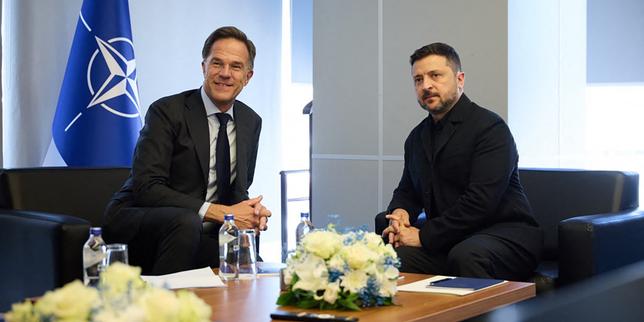
Don't believe the pristine press releases coming out of Turkey. When NATO leaders wrapped up their high-stakes summit in Ankara, the official line was a predictable chorus of unwavering support and ironclad unity. They slapped a shiny label on it, calling it NATO 3.0. But behind the closed doors of the freshly paved Turkish capital, the reality was far more frantic.
Western leaders aren't just trying to save Kiev. They're trying to save themselves from a splintering alliance.
The headline figure sounds massive. Allies pledged at least 70 billion euros in military aid for Ukraine this year, with a promise to match that amount in 2027. It's a massive financial commitment designed to reassure a battered Ukrainian military. But if you look closely at how that money is structured, the cracks in transatlantic unity become obvious. This isn't a unified Western front pouring cash into a shared goal. It's a desperate scramble by European states to build a firewall around their own security before American policy shifts entirely.
The Reality Behind the 70 Billion Euro Pledge
People want to know if this money will actually reach the front lines or if it's just political theater. The truth is somewhere in the middle. Of that 70 billion euros, 30 billion is tied up in a European Union loan structure. That's a telling detail. European allies and Canada are now financing the vast majority of security assistance to Ukraine. They don't have a choice.
Secretary General Mark Rutte tried to put a positive spin on things by declaring that NATO delivers. He pointed out that total defense and security spending among European allies has already hit roughly 4% of GDP, heading toward a new 5% target by 2035. That's a massive jump from a few years ago. But let's be honest about why this is happening. Europe is terrified. They realize they can no longer treat American protection as a permanent guarantee.
The summit showcased a fundamental shift in the power dynamics of the alliance. Ukraine isn't just begging for handouts anymore. Volodmyr Zelenskyy arrived in Ankara with real bargaining chips, presenting Ukraine not as a charity case but as a security provider. Two years of brutal drone warfare have forced Kiev to innovate faster than any peacetime military could dream of. NATO launched a new 40 billion dollar initiative called Drone Edge to capitalize on this tech. The goal is to pour money into uncrewed systems over the next five years, using Ukrainian battlefield data to modernize Western inventories.
The Domestic Patriot License and the Trump Effect
The biggest surprise of the summit didn't come from the official declaration. It came from a sudden policy shift by Donald Trump. In a move that caught several European delegations off guard, the American president granted Ukraine's request to manufacture Patriot missile interceptors domestically.
On paper, it's a huge win for Kiev. It gives them the right to build their own ammunition for one of the most effective air defense systems on earth. But look at the underlying motivation. The United States is heavily distracted by escalating tensions in the Middle East, particularly with Iran. Washington needs its own Patriot stockpiles kept close to home. By outsourcing the production license to Ukraine, the US is essentially telling Kiev to build its own shield because the American inventory is spoken for.
Critics of the administration aren't happy. House Foreign Affairs Committee Ranking Member Gregory Meeks openly complained that Trump's broader conduct during the summit weakened the American position on the global stage. While European leaders were sweating over industrial supply lines, Trump spent time speaking admiringly of Vladimir Putin and Xi Jinping. He didn't pressure Turkish President Recep Tayyip Erdogan over Turkey's possession of the Russian S-400 missile system. Instead, Trump announced the lifting of sanctions and a path forward for Turkey to acquire American F-35 fighter jets without any strings attached.
Turkey played its hand perfectly. Erdogan hosted the first NATO summit on Turkish soil since 2004 and used the occasion to clear his country's name, get his advanced jets, and maintain his role as a middleman between East and West.
Russia Strikes Back in the Energy Market
Moscow didn't wait for the summit ink to dry before launching a counterstrike. As NATO leaders were celebrating their industrial agreements, Russian Vice-Premier Alexandre Novak met with Vladimir Putin to announce an immediate ban on diesel exports.
The Kremlin claims the measure is meant to stabilize its domestic energy market and increase supplies at home. Nobody believes that. It's an aggressive move aimed directly at European economies that are already vulnerable. By choking off diesel supplies, Moscow wants to drive up fuel costs across Europe, hoping that rising inflation will sour public support for the 70 billion euro aid package.
NATO anticipated this type of economic warfare, which explains a massive, overlooked part of the Ankara agreement. The alliance announced a 27 billion euro investment to modernize its own fuel supply chain. This money isn't for fancy new weapons. It's for pipelines, storage facilities, and distribution nodes stretching toward the eastern flank of the alliance. If Russian energy completely disappears, NATO needs to be able to move its own fuel to the borders of Poland, Romania, and the Baltic states without relying on commercial networks.
Breaking Down the New Western Defense Infrastructure
The financial commitments made in Ankara extend far beyond direct aid to Kiev. The alliance is trying to retool its entire industrial base. Here's a breakdown of the specific commitments that came out of the Defense Industry Forum held alongside the main summit.
- Procurement Deals: Over 50 billion euros in new contracts were signed between governments and defense manufacturers to accelerate the production of standard artillery shells and armored vehicles.
- The Drone Edge Initiative: A 40 billion dollar fund dedicated entirely to uncrewed aerial and naval systems, focusing on counter-drone technology developed on the Ukrainian front lines.
- The Fuel Infrastructure Fund: The 27 billion euro pipeline project to ensure Allied forces remain ready for high-intensity warfighting without energy bottlenecks.
Europeans are learning the hard way that setting targets isn't the same as delivering hardware. They've spent years writing policy papers. Now they have to build factories.
What This Means for the Next Six Months
The Ankara summit didn't end the war, nor did it offer Ukraine a fast track to full NATO membership. Zelenskyy argued that bringing Ukraine into the alliance would inject extraordinary defensive capability into the community, but the major powers aren't ready to take that step while active fighting rages.
Instead, Ukraine gets a license to build American missiles, a promise of European cash, and a massive investment in drone tech. It's a survival package, plain and simple. For Europe, the clock is ticking. They have to use the next year to integrate their defense industries so they don't develop capabilities in separate silos. Fragmentation is the enemy. If European states keep buying different, incompatible weapons systems just to satisfy domestic political interests, the 70 billion euro pledge won't mean a thing on the battlefield.
The next move belongs to the factory managers and logistics officers who have to turn these political promises into steel, gunpowder, and fuel.