Legal battles between states and individuals across borders rarely stay clean. They turn into high-stakes chess matches where every procedural filing carries political weight. A federal court in New York recently handed down a decision permitting Khalistani separatist Gurpatwant Singh Pannun to proceed with serving civil summons. The targets are prominent Indian figures, including National Security Adviser Ajit Doval and former Research and Analysis Wing chief Samant Goel.
If you look past the courtroom drama, the ruling isn't an indictment or a verdict on guilt. It's a procedural milestone in a messy civil lawsuit. Understanding how we got here requires stripping away the headlines and looking at the mechanics of international law, diplomatic friction, and what comes next.
The Mechanics of the New US Court Order
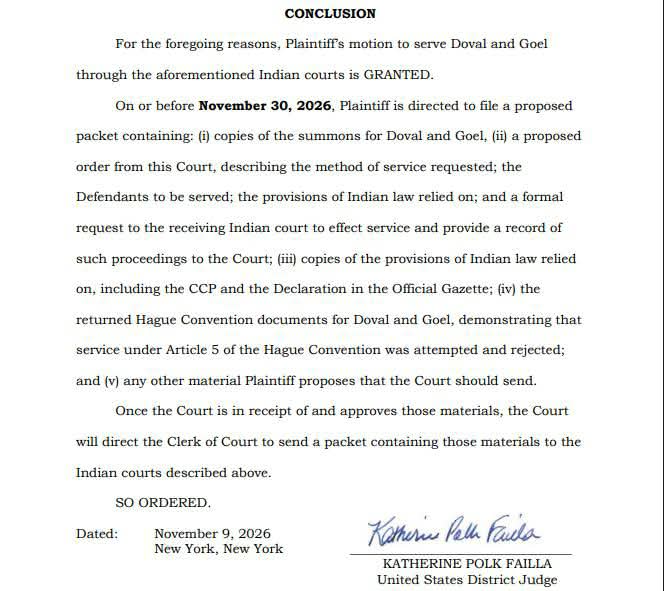
US District Judge Katherine Polk Failla of the Southern District of New York granted Pannun's motion to serve the civil lawsuit through Indian courts. For months, Pannun's legal team tried various methods to personally serve the high-ranking Indian officials, notably claiming an attempt during official visits to Washington. Those efforts fell flat when courts determined proper delivery hadn't taken place.
Faced with those hurdles, the plaintiff pivoted to alternative routes under the Hague Convention. The recent order instructs that the legal documents be transmitted through the US judiciary to Indian courts having jurisdiction where the defendants are believed to reside. Pannun's legal team specifically pointed to Delhi options like the Patiala House Court, Dwarka Courts, and Tis Hazari Court.
This isn't about a foreign judge commanding Indian law enforcement to arrest anyone. It is a civil procedure step dealing strictly with how legal papers are handed over across international borders.
New Delhi's Firm Rejection
India's reaction has been swift, absolute, and entirely unsurprising to anyone watching bilateral ties. New Delhi rejected the development as a fabricated and malicious attack. The Ministry of External Affairs made it clear that requests for serving foreign judicial documents inside India must follow rigid sovereign protocols—specifically going through India's designated central authority, the Ministry of Law and Justice.
India maintains that these lawsuits are baseless, politically motivated stunts orchestrated by designated terrorists. The Government of India has consistently denied any state involvement in assassination plots, drawing a sharp line between domestic legal sovereignty and foreign civil litigation.
When foreign courts try to pull sovereign state actors into private civil claims, diplomatic norms clash directly with domestic judicial reach. That friction is precisely why this case grabs international attention.
Separating Civil Claims from Criminal Realities
It helps to keep the legal tracks straight. This New York lawsuit is a civil proceeding filed by Pannun, seeking damages and accountability over an alleged conspiracy. It runs on a completely separate track from the parallel criminal matters in the United States.
On the criminal side, US federal prosecutors previously brought charges against Indian national Nikhil Gupta regarding a foiled murder-for-hire plot. Gupta's case moved forward through plea agreements, but neither NSA Doval nor former RAW chief Goel have been named as defendants in that criminal indictment.
Civil suits have a much lower threshold to file than criminal indictments, allowing almost anyone to initiate a paper trail. Getting past a motion to serve papers is a far cry from winning a judgment or overcoming the massive legal shields of foreign sovereign immunity.
What Happens When the Papers Land
Even if the paperwork clears international transmission channels and reaches Indian courts under domestic provisions like the Code of Civil Procedure, the defendants have robust legal defenses available. Foreign Sovereign Immunities Act protections and traditional diplomatic immunities are designed precisely to block foreign courts from sitting in judgment over sovereign state officials performing official duties.
US courts issuing service permissions explicitly note that allowing papers to be served does not validate the merits of the claims or rule out sovereign immunity defenses. It simply means the plaintiff is allowed to knock on the door. Whether anyone inside decides to answer is an entirely different question.
The case will grind forward through procedural motions, jurisdictional arguments, and diplomatic notes. Don't expect a sudden courtroom showdown in Delhi. Sovereignty, international treaties, and geopolitical realities ensure this legal saga has a very long way to run.