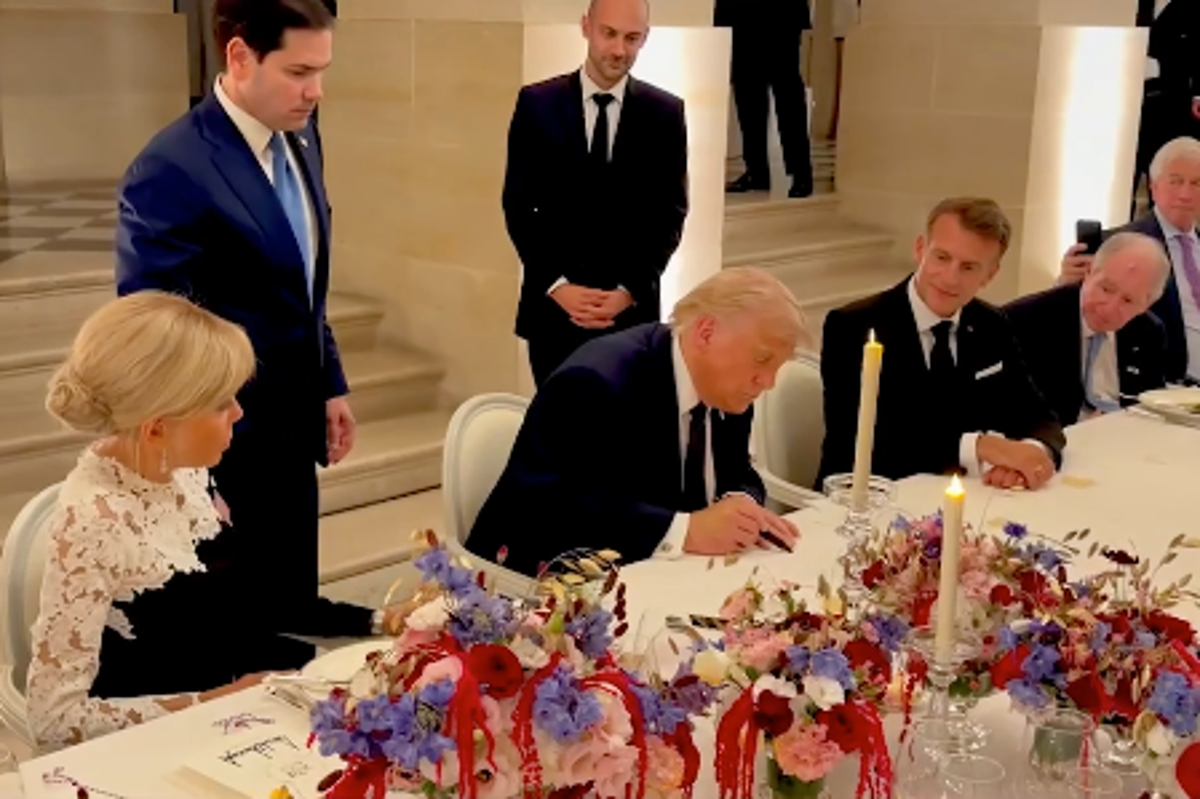
Donald Trump wanted to see the real deal gold at Versailles. Instead, he ended up signing away one of the biggest military blockades of the decade over a plate of French food.
During a high-stakes dinner with French President Emmanuel Macron at the legendary Palace of Versailles, Trump officially put his signature on the Islamabad Memorandum of Understanding (MoU). This interim agreement immediately ends the active war between the United States and Iran, forcing Tehran to dilute its highly enriched uranium stockpile in exchange for sweeping economic relief.
As Trump sat beside Macron, US Secretary of State Marco Rubio handed him the papers. Trump looked up and muttered a brief reality check before signing: "This was not easy."
It's a staggering geopolitical turnaround. The text of the agreement takes immediate effect, dismantling a massive naval blockade and completely reopening the Strait of Hormuz. But beneath the gilded ceilings of Versailles, the actual substance of the deal reveals a massive gamble that has already left Capitol Hill and international allies completely blindsided.
The Concessions Washington Just Handed Over
The user searching for this news wants to know what's actually in this agreement and how it impacts global security and energy prices. They don't need a history lesson on the Palace of Versailles; they need the cold hard numbers.
This interim deal essentially resets the clock to the status quo before the war kicked off on February 28, but with massive upfront perks for Tehran.
- Immediate Sanctions Waivers: The US has agreed to immediately waive major economic sanctions, allowing Iran to sell its crude oil freely on the global market.
- The $300 Billion Fund: Senior US officials confirmed the existence of a massive financial incentive framework, including a potential $300 billion rebuilding fund for Iran if they hit specific compliance milestones.
- Uranium Downblending: In return, Iran has agreed to let the International Atomic Energy Agency (IAEA) oversee the dilution of its 60% highly enriched uranium.
The immediate economic impact hit the markets like a sledgehammer. Brent crude futures slid down to $78.66 a barrel, and domestic gas prices in the US have already dropped for five straight weeks in anticipation of the reopened shipping lanes.
The Ghost of the 2015 Obama Pact
You can't talk about this Versailles signing without addressing the glaring irony hanging over the entire room. During his first term, Trump famously tore up Barack Obama's 2015 Joint Comprehensive Plan of Action (JCPOA), calling it the worst deal ever negotiated.
Now, he's signed a pact that goes significantly further in terms of upfront economic relief for Iran than Obama ever did. Under the old JCPOA, sanctions relief was a slow, heavily monitored drip-feed tied to proven compliance. Under the 2026 Versailles framework, Iran gets to sell its oil immediately, while the complex technical verification details are pushed down the road into a vague 60-day negotiating window.
The White House is spinning this as an absolute victory. Internal talking points sent to congressional Republicans claim Trump solved a threat Washington spent forty years managing. Their memo boldly states: "Iran will never have a nuclear weapon."
But lawmakers on Capitol Hill aren't buying the hype.
A Massive Backlash is Brewing in Washington
If Trump thought his signature in France would seal the deal at home, he miscalculated. Congress is already moving to force a review of the document. Under the Iran Nuclear Agreement Review Act—an Obama-era law that survived Trump’s first term—any pact dealing with Iran's nuclear material must be submitted to lawmakers.
Senate Majority Leader John Thune didn't mince words when returning to the Capitol, admitting he hadn't even been personally briefed on the text. "I just don't know enough about it," Thune told reporters, noting that the ultimate test will be compliance and enforcement.
Even Trump’s most reliable foreign policy hawks are signaling deep skepticism. Senator Lindsey Graham noted that while he's pulling for a peaceful resolution, the initial descriptions coming out of Iranian state media look awful.
The biggest point of friction? The deal explicitly guarantees Lebanon's territorial integrity, which directly clashes with Israel's ongoing military campaign against Hezbollah. Israeli Prime Minister Benjamin Netanyahu is facing fierce criticism at home, as the deal appears to leave Israel's long-term security goals completely stranded.
Trump's Built-In Escape Hatch
Typical of his negotiating style, Trump isn't treating this as a permanent peace treaty. It's a temporary truce with a hair-trigger attached.
While leaving the palace, Trump made it clear to reporters that he’s ready to tear this agreement up just as fast as he signed it. "It's a memorandum of understanding, and if I don't like it, we'll go back to shooting at them, dropping bombs," he warned.
For families watching gas prices drop, the immediate relief is tangible. For global shipping lines waiting to send over 600 vessels through a freshly un-mined Strait of Hormuz, it's a breath of fresh air. But for the defense establishment, the Versailles agreement looks less like a permanent solution and more like a volatile 60-day pause button.
What Happens Next
If you're tracking the real-world fallout of this deal, look at these specific indicators over the next few weeks:
- Watch the IAEA inspectors: The deal relies entirely on how quickly international inspectors get on the ground in Iran to verify that the 60% enriched uranium is actually being diluted. If Iran drags its feet, the deal evaporates.
- Track the Strait of Hormuz transit numbers: Commercial shipowners are still hesitant due to lingering sea mines and skyrocketing insurance risks. True normalization of global shipping traffic will take months, not days.
- The Congressional showdown: Look for a massive push in the Senate to force an up-or-down vote on the sanctions waivers. If Congress blocks the financial incentives, Trump's Versailles pact will fall apart before the 60-day clock even expires.