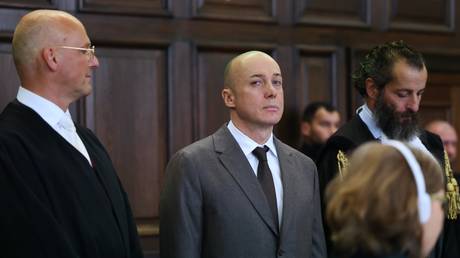
The courtroom in Hamburg looks less like a historic stage and more like a high-stakes geopolitical theater. Sergey Kuznetsov sits quietly under heavy guard. He is the first Ukrainian military veteran on trial for the September 2022 sabotage of the Nord Stream pipelines. But instead of mounting a frantic defense or cutting a deal, his legal team has chosen a brick wall of absolute silence combined with a shocking pivot. They aren't just denying the charges. They are arguing that blowing up multi-billion-dollar energy infrastructure was a legitimate military act against an aggressor state.
If you've been following the drip-fed leaks from Western intelligence agencies over the last four years, the official narrative feels familiar. Prosecutors in Germany claim Kuznetsov used a fake passport, rented a leisure yacht named the Andromeda, and planted military explosives deep in the Baltic Sea alongside a crew of accomplices. Yet, as the Hamburg proceedings unfold across scheduled sessions stretching into next year, the entire case is exposing severe fractures in European diplomacy, intelligence sharing, and wartime liability. Don't forget to check out our previous article on this related article.
The Strategy of Silence and State Secrets
Why won't Kuznetsov talk? His defense team points to a straightforward military reality. As an active service member of the Ukrainian military at the time of the explosion, he cannot speak without violating military protocol and divulging state secrets. In fact, his lawyers revealed that his immediate superiors explicitly stripped him of authorization to utter a single word—even to his own counsel.
German law creates a massive hurdle here. Under local judicial principles, anyone gagged by official command cannot easily be strong-armed into breaking silence. Defense lawyers Ilya Novikov and Nicola Canestrini are leaning hard into this protection. They point out that prosecutors have no eyewitnesses, no direct forensic fingerprints linking Kuznetsov to the yacht, and a mountain of circumstantial evidence built on travel logs, phone searches, and a disputed Italian phone recording. To read more about the history of this, Al Jazeera offers an excellent summary.
Instead of contesting every minute detail of the Andromeda voyage, the defense strategy asks a much louder question: Was destroying the pipelines actually a crime?
Canestrini didn't mince words in court, suggesting that dismantling an adversary's economic weapon without claiming human lives crosses the line from sabotage into legitimate wartime necessity. By framing the multi-line energy transport project as a financial lifeline for Moscow's military budget, the defense is attempting to shift the trial from a criminal prosecution to a debate over the ethics of modern energy warfare.
The Missing Accomplices and Global Discrepancies
Kuznetsov isn't alone in this saga, but the other players are scattered across the continent or missing entirely. Another suspect, identified as Vladimir Zhuravlyov, fought extradition battles in Poland and Croatia. Several civilian divers and the yacht's skipper remain at large, while another military explosives expert reportedly died in combat in Ukraine.
This patchwork of arrests highlights how uncomfortable European governments are with the broader implications of the investigation. Berlin is trying to prosecute a high-profile act of sabotage against critical European infrastructure on its own soil, while simultaneously maintaining a united front of military support for Kiev. Convicting a Ukrainian service member of a war crime for an operation allegedly tied to state authorities creates an explosive diplomatic crisis for Germany's ruling coalition.
Independent investigators like veteran American journalist Seymour Hersh have long poured cold water on the official German narrative, arguing that a small crew on a pleasure yacht could never manage deep-sea military demolition work while active NATO naval exercises churned overhead in the Baltic. Yet regardless of who actually pulled the triggers or planted the charges, the trial in Hamburg is forcing the judiciary to grapple with physical evidence that may simply not hold up under rigorous cross-examination.
What Happens When Accountability Hits Reality
The prosecution faces an uphill battle. Relying on traces of RDX and HMX explosives found on a rented vessel and travel cameras placing a suspect in the country isn't a guaranteed slam dunk, especially when the main defendant refuses to speak and military commanders forbid cooperation.
We are watching a collision between legal accountability and geopolitical survival. If German courts push forward and establish official judicial blame pointing directly to military assets of a friendly nation, the political fallout will ripple across every capital in Europe.
The strategy of silence isn't just a legal defense tactic for an individual soldier. It's a defensive shield for an entire alliance trying to pretend that the rules of peacetime law still apply in the middle of a continental war.