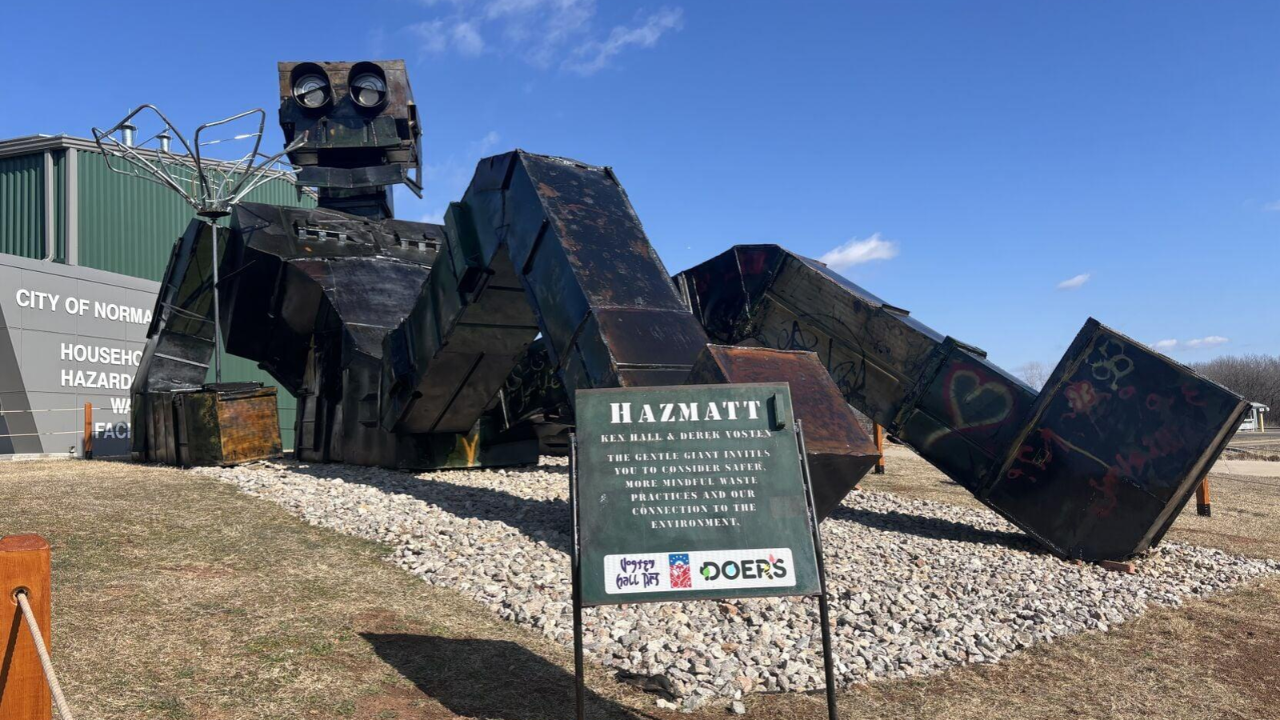
Public art projects usually hemorrhage money. Millions get funneled into abstract statues that leave taxpayers scratching their heads. But every once in a while, a municipality pulls off something genuinely clever without breaking the bank. Enter Hazmatt, a twenty-foot-tall reclining robot constructed almost entirely from retired waste containers.
Unveiled in Norman, Oklahoma, this roadside metal titan cost just over $14,000. Instead of relying on fresh steel or imported materials, local creators looked straight at what the city usually throws away.
The Scrap Metal Philosophy Behind Hazmatt
When you think of municipal waste management facilities, aesthetic beauty rarely comes to mind. Concrete, chain-link fences, and rotting bins dominate the aesthetic. Local artist Kenneth Eugene Hall Jr., alongside project collaborators like Derek Vosten, decided to change that script.
They gathered decommissioned dumpsters from the city's Container Maintenance Facility and welded them into a towering figure. Standing guard outside Norman's Household Hazardous Waste Facility at 3803 Chautauqua Avenue, the sculpture leans back casually on a grassy slope.
Most public robots depicted in media look aggressive, weaponized, or rigidly militaristic. Hazmatt flips that trope completely. The figure reclines peacefully, clutching a delicate metal wildflower in its massive hand. That sharp juxtaposition between industrial junk and organic fragility forms the core artistic statement.
Funding Art Through Leftover Construction Dollars
Municipal budgets are notoriously rigid, but this project thrived on smart resourcefulness. The entire multi-year undertaking cost roughly $14,000, funded entirely by leftover construction dollars from the Household Hazardous Waste Facility Capital Project fund.
Cities often let surplus capital funds sit idle or return them through tedious bureaucratic channels. Norman officials instead directed those residual funds into an installation that matches the environmental mission of the site itself.
Michele Loudenback, manager of the city's Division of Environmental Resilience and Sustainability, helped spearhead the idea after initial discussions began back in late 2021. Rather than outsourcing production to an expensive out-of-state fabrication studio, all the welding and assembly happened locally, utilizing municipal spaces and local talent.
Why Location Matters for Public Installations
Placement can make or break an art piece. Shoving a sculpture into a sterile downtown plaza often strips it of context. By planting Hazmatt right outside a hazardous waste drop-off site, the city gave the artwork a direct job to do.
Visitors driving up to get rid of old paint cans, car batteries, or chemical solvents are greeted by a friendly giant built out of the very same conceptual lineage of discarded refuse. It reframes how people think about trash. What looks like worthless scrap metal on a Tuesday can morph into a community landmark by the weekend.
City leaders like Mayor Stephen Tyler Holman noted that the sculpture immediately became a fun roadside attraction for drivers passing near Highway 9. Plans are already in motion to dress up the metallic giant seasonally, stringing lights around its eyes or modifying its wildflower for local events.
What Other Cities Can Learn From This Project
If you manage public spaces or community boards, the takeaway is simple. You do not need a multi-million-dollar endowment to create memorable public installations. You need local talent, a pile of material nobody wants, and the willingness to let artists experiment.
Most civic sculpture programs default to safe, boring bronze plaques. Norman proved that trash-to-treasure engineering creates higher community engagement, sparks real conversations about sustainability, and costs a fraction of traditional commissions.
Next time you drive past a municipal yard stacked with busted dumpsters, remember that you are looking at raw material. Somewhere in that pile of rusted steel might just be your town's next landmark.


